
Customer Behaviour · Analysis
Replenit's 9x claim: how a small store can test an AI retention engine
The 9x figure compares Escentual with its own earlier performance, not a control group. A small store can test one flow with a holdout, but the sources do not show that smaller retailers can buy the upgrade.
- By
- The Cart Plot Editorial
- Published
- Sources checked
- Evidence
- 6 sources
At a glance
- Replenit's Escentual figure of over nine times revenue per customer decision compares against the retailer's initial performance, not a control group1.
- Replenit's published figures for Maestro use different baselines, including the previous version, Maestro 1.0 and an unnamed since-launch period, and they do not reconcile1,2.
- Klaviyo's global holdout groups need at least 400,000 profiles, so smaller stores can only test one flow with a random sample split5.
- Inficial recommends measuring total contribution per eligible profile rather than email-attributed revenue per recipient6.
Replenit announced Maestro 2.0, an AI decision engine for customer retention, on 18 November 20261. Its headline result, that Escentual now records over nine times more revenue per customer decision, is measured against the retailer's own earlier performance, so the sources do not show what a store would have earned without the upgrade1. A store with a small customer file is best placed to answer the question by running a holdout test on its own repeat-purchase data before it commits to paying for the upgrade.
What does the Escentual 9x figure actually measure?
ChannelX reports that Escentual, a UK online beauty retailer, "has recorded over 9x revenue per customer decision compared with its initial performance"1. This is a before-and-after comparison that the vendor reports, not a controlled test.
The vendor's figures differ by source:
- ChannelX reports Replenit's claim that, compared with the previous version, Maestro 2.0 raises revenue per decision by 22% to 110% for replenishment agents and by up to 39% for cross-sell agents1.
- The same article gives no absolute revenue figures and no sample sizes1.
- Replenit's case-study block shows 9.1x revenue per decision "since launch", a 31.6X return on investment and 362,000 decisions2. The captured block does not name the retailer beside these figures.
- Replenit's model-improvement table shows engagement revenue per decision up 32% over Maestro 1.02.
These numbers do not reconcile. They use different baselines: the retailer's initial performance, the previous software version and an unnamed "since launch" period. None of them is a control group. A store should therefore read the 9x figure as one vendor's account of one customer, not as an expected uplift for its own file.
Why platform attribution does not prove lift
Attributed revenue counts purchases made within a set window after a customer sees or clicks a campaign, whether or not the message changed their decision4. Klaviyo's default window for email opens and clicks is five days5.
Incremental revenue is the extra revenue a campaign creates above what customers would have spent anyway. InsiderOne describes estimating it by projecting the control group's conversion rate and average order value onto the audience that received the campaign, then subtracting that baseline from the revenue the campaign generated4.
Replenit describes its learning loop this way: "What the customer did next flows back into memory"3. It says Maestro is measured on "the business outcome you set, such as repeat revenue, not on how many messages it sent"3. That describes how the engine is judged. It is not a measure of the store's net repeat revenue.
| Figure or metric | Source | What it measures | Can it show lift for your store? |
|---|---|---|---|
| 9x revenue per customer decision (Escentual) | S1 | Change against Escentual's initial performance | No |
| 22% to 110% revenue per decision (replenishment agents) | S1 | Change against Maestro's previous version | No1 |
| 9.1x revenue per decision, 31.6X ROI | S2 | Since-launch figures across 362,000 decisions | No |
| +32% engagement revenue per decision | S2 | Change against Maestro 1.0 | No |
| Attributed revenue in a platform dashboard | S4, S5 | Purchases within a window after a message | Only for ranking messages |
| Holdout gap in contribution per eligible profile | S4, S6 | Difference between treated and control groups | Yes, if run properly |
Can a small customer file support a clean holdout?
Probably not for a whole-programme test, but possibly for one flow. LiftSignals reports that Klaviyo's global holdout groups need at least 400,000 profiles, and that smaller stores can test one flow with a random sample split5. The global holdout covers campaigns and flows on every channel except transactional flow messages5, so it measures the programme as a whole.
A common method assigns a control share at random, often 10% to 20%, and compares the groups over a fixed window4. Maestro 2.0 is available to Replenit's enterprise retail customers1. The sources do not say whether smaller retailers can buy it.
Illustrative example: a store with 8,000 active profiles that holds back 10% to 20% would withhold 800 to 1,600 people from one flow1. Whether that is enough depends on the baseline repeat rate and the smallest lift worth detecting. We recommend calculating that minimum detectable effect before the test starts. LiftSignals warns that "A holdout too small to read is the worst option: you give up sales and still learn nothing"5. If the calculation shows the test cannot detect a plausible lift in a reasonable time, the store cannot verify the vendor's claim and should decide on other grounds.
How should a store build its own repeat-purchase baseline?
Build the baseline from the store's own orders, measured per eligible customer rather than per message. Inficial recommends measuring total contribution per eligible profile, not email-attributed revenue per recipient, as the main metric6. In its definition, contribution subtracts product cost, discounts, payment fees, fulfilment, shipping subsidy and refunds known by the decision date6.
Replenit says a plain catalogue, one identifier per customer and order history are enough to start2. That is a low bar for data, not evidence that the store's baseline is ready.
We recommend the following baseline:
- Define a cohort by first-purchase month.
- Count only profiles that are eligible for the flow.
- Track the repeat-order rate and contribution per profile over a fixed window, such as 90 days.
Pull these figures from the store's own order system. The vendor's dashboard measures decisions the vendor's tool made, so it cannot serve as the baseline. For a parallel discussion of incrementality in paid media, see Retail media ROAS vs incrementality: four design checks before spend.
How should a store run a one-flow holdout?
Test one flow, such as a post-purchase replenishment reminder, and split eligible customers at random before the decision engine acts on them. Keep the design simple enough that one person can run it.
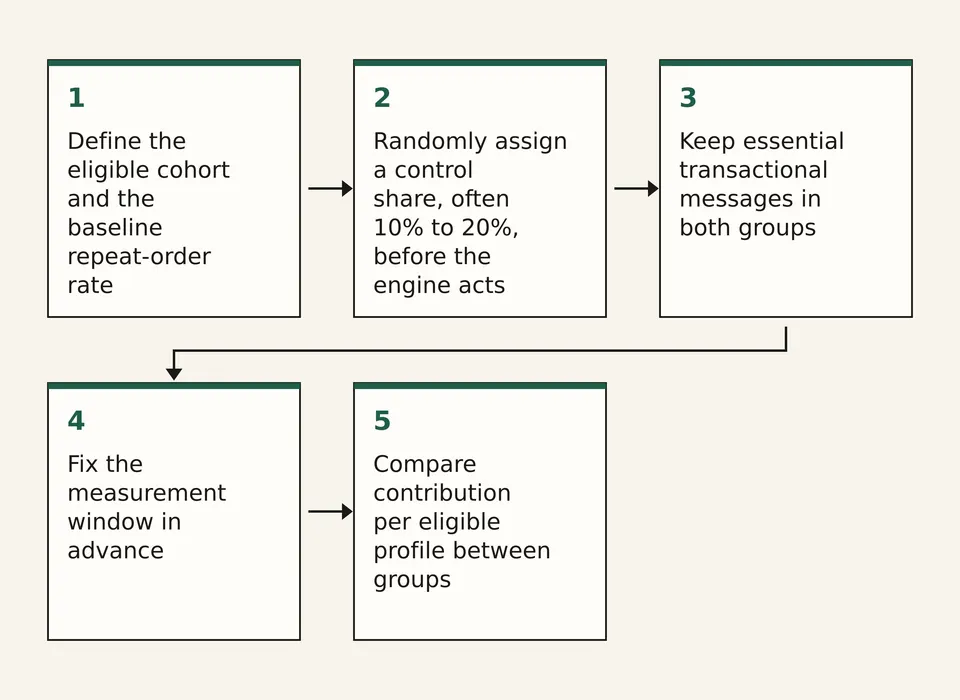
We recommend this sequence:
- Define the eligible cohort and the baseline repeat-order rate.
- Randomly assign a control share, often 10% to 20%, before the engine acts4.
- Keep essential transactional messages in both groups. Order confirmations, safety notices, consent messages and service updates should not be removed6.
- Fix the measurement window in advance.
- Compare contribution per eligible profile between groups.
Tag both groups before the first send. Without a tag, the holdout group cannot be identified later, because nobody in it received anything to report on5. Change nothing else in the flow while the test runs, since testing more than one variable at a time can skew results5. Do not run the test across Black Friday, a price change, a stock clearance or another event that affects the groups unevenly6. Do not compare open or click rates with the holdout group, because it received no email5.
Our analysis: is the upgrade worth its price?
The sources do not publish a price for Maestro 2.0, so this section gives a decision rule rather than a price comparison. We recommend making the decision only after the holdout result is in.
Multiply the eligible profile count by the measured incremental repeat-order rate and the average contribution per order. The result is the extra contribution the upgrade could add per period. Compare that with the quoted annual cost, implementation time and any integration work.
Two scenarios follow:
- Small uplift on a small file. The extra contribution may not cover the cost. The store should not buy on the vendor's figures.
- Clear uplift on a larger file. The extra contribution may justify the cost. The store then has its own evidence to take into the purchase decision.
An inconclusive test is also a result. It means the claim is unverified, which argues against paying until a larger or longer test is possible.
What to watch next
- Whether Replenit publishes absolute revenue, sample sizes and the holdout design behind the Escentual figures, and reconciles the 9x, 9.1x and 32% numbers1,2.
- Whether Maestro 2.0 becomes available to smaller retailers. At present it is described as available to enterprise customers1.
- Whether independent case studies from stores below the 400,000-profile threshold report holdout results rather than before-and-after comparisons. The threshold is as LiftSignals reported it on 18 November 20265. Confirm it on Klaviyo's global holdout groups guide, which LiftSignals says was updated on 29 October 2026, before relying on it.
Questions readers ask
Does the 9x revenue figure show what a store would earn with Maestro 2.0?
No. The figure compares Escentual's performance with its own initial performance, and the sources give no control group or absolute revenue figures1. It is one vendor's account of one customer.
Can a small store run a holdout test on its customer emails?
Possibly for one flow. LiftSignals reports that smaller stores can test one flow with a random sample split, though global holdouts need at least 400,000 profiles5. The store should first calculate the minimum detectable effect.
What should the control group receive?
A control share, often 10% to 20%, is assigned at random before the engine acts4. Essential transactional messages such as order confirmations should remain in both groups6.
Is Maestro 2.0 available to smaller retailers?
The sources do not say. Maestro 2.0 is described as available to Replenit's enterprise retail customers1.