
Customer Behaviour · Analysis
Dollar Tree's holiday 'closer to need' comment: what a small store can test
Dollar Tree expects holiday shoppers to buy closer to need, but its evidence is one store-based quarter and an expectation, so a small store should test order timing before changing stock or ad budgets [S1][S2].
- By
- The Cart Plot Editorial
- Published
- Sources checked
- Evidence
- 6 sources
At a glance
- Dollar Tree told analysts on 24 November 2026 that it expects holiday shoppers to buy closer to need1.
- Dollar Tree's comparable store net sales rose 4.6%, driven by a 3.8% traffic increase and a 0.8% average ticket increase, which are store-based figures rather than online orders2.
- USPS lists Thursday 17 December as the last recommended send-by date for Ground Advantage in the contiguous US for delivery before 25 December4.
- Carrier cutoff dates do not move with shopper timing, so a small store should test weekly order patterns before changing stock buys or order-by dates4,6.
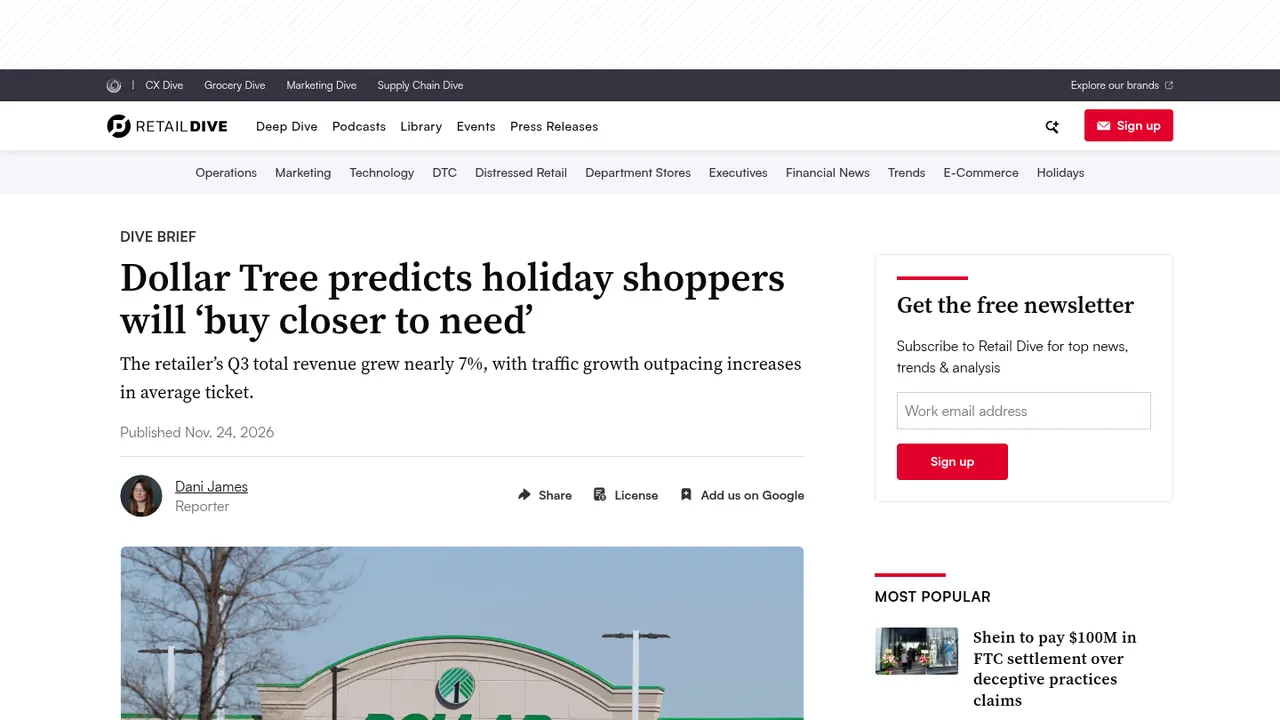
On 24 November 2026, Dollar Tree, a US discount store chain, told analysts it expects holiday shoppers to "buy closer to need"1. Its third-quarter net sales rose 6.9% to $5.1 billion, and comparable store net sales rose 4.6%2. These are store results for one large retailer. Carrier cutoff dates do not move with shopper timing, so a small online store should test the pattern in its own weekly orders before it changes stock buys, order-by dates or paid-search budgets.
What Dollar Tree actually reported
Dollar Tree ended the quarter with 9,511 stores across its Dollar Tree U.S. and Dollar Tree Canada banners2. Its headline measure is comparable store net sales, a store-based measure2, so the results describe in-store trading rather than online orders.
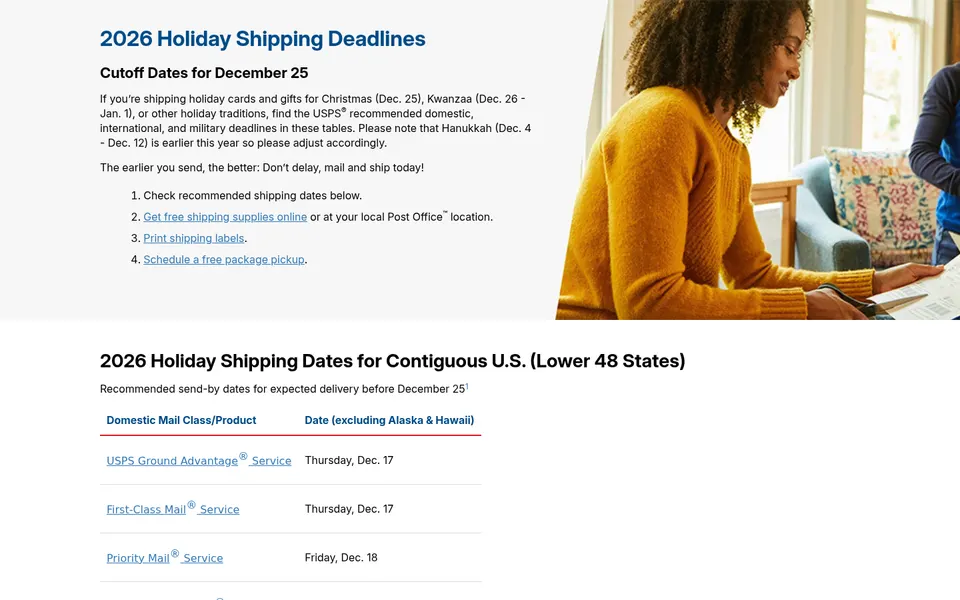
- Net sales rose 6.9% to $5.1 billion1. Comparable store net sales rose 4.6%, driven by a 3.8% increase in traffic and a 0.8% increase in average ticket2.
- Consumables comparable sales rose 8.9%, while discretionary comparable sales rose about 0.4%, "despite higher inflation pressuring customer budgets"1.
- Halloween sales were "modestly below" the retailer's plan, though sell-through improved versus last year1.
- The Q4 fiscal 2026 outlook assumes comparable store net sales growth of 3% to 4%2. Retail Dive reported that full-year comparable guidance was nudged up to 3.5% to 4%, from 3% to 4%1.
Yahoo Finance's call highlights report that multi-price mixed baskets were about 25% of transactions but nearly half of sales3.
Carrier cutoffs set the ship-by dates
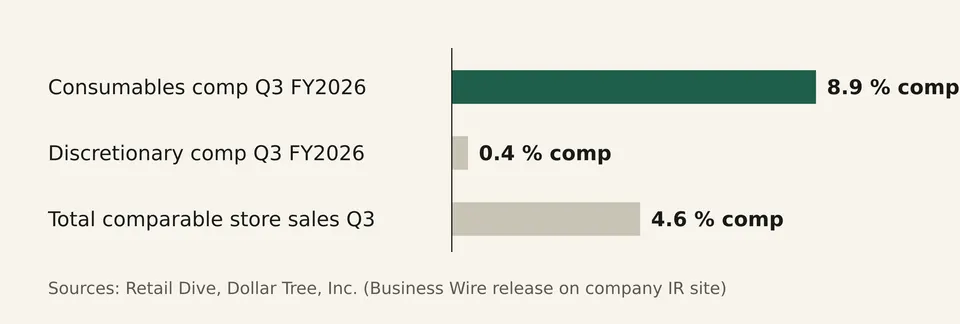
Shopper timing changes when customers buy. It does not change the last day a carrier will accept a parcel for Christmas delivery. USPS publishes its 2026 recommended send-by dates for expected delivery before 25 December. For the contiguous US, Ground Advantage and First-Class Mail are both Thursday, 17 December, Priority Mail is Friday, 18 December, and Priority Mail Express is Saturday, 19 December4.
An ecommerce shipping guide lists UPS and FedEx two-day services with a 22 December cutoff, and overnight services with a 23 December cutoff, for Christmas Eve delivery5. A logistics guide adds that FedEx Ground Economy must ship by Tuesday, 15 December, and that UPS publishes no single Ground date6.
| Carrier | Service | Last day to ship | Source |
|---|---|---|---|
| USPS | Ground Advantage (contiguous US) | Thursday, 17 December | 4 |
| USPS | Priority Mail Express | Saturday, 19 December | 4 |
| FedEx | Ground Economy | Tuesday, 15 December | 6 |
| FedEx | 2Day | Tuesday, 22 December | 5,6 |
| UPS | 2nd Day Air | Tuesday, 22 December | 5,6 |
| FedEx | Overnight | Wednesday, 23 December | 5,6 |
USPS dates come from the official page. The other carrier dates come from secondary guides and should be confirmed on carrier sites.
EBB Logistics says every one of these dates falls inside the carriers' highest demand surcharge weeks6. It places those weeks from 23 November at FedEx and 22 November at UPS6. USPS holiday price increases run from 4 October 2026 to 17 January 20276.
Our analysis: what the closer-to-need signal can and cannot show
This section is our interpretation, not reported fact.
The signal is thin. Dollar Tree's evidence is one retailer's quarter, measured in stores. Its holiday comment is an expectation1. One season cannot show a durable shift in buying timing, so treat the claim as a hypothesis to test rather than a planning assumption.
Timing and basket size are different questions. Late buying could mean later clicks, smaller baskets, or both. Dollar Tree's traffic (up 3.8%) and average ticket (up 0.8%) moved by different amounts2. A small store should measure order count and order value by week rather than assume late demand carries the same value.
The cutoffs stay fixed. Late buyers face the same carrier dates as early buyers, so ship-by messages are a firm constraint, not a timing variable.
Scenarios for a small store:
- Long lead-time stock (overseas or multi-week replenishment): Keep stock buy dates where they are. A later buy risks stockouts that late shopper timing may not offset. Use late-season demand to decide markdowns and January reorders.
- Short replenishment (weekly or domestic reorders): If your own weekly data show a final-week spike, consider moving paid-search and promotional spend towards the final 7 to 10 days, and keep the carrier-safe ship-by date as a firm customer message. For paid-social timing tests, see planned peak buyers.
- No clear signal: Change nothing yet. Run a small test on one promotion or ad group and compare it with last year before committing budget.
Most small stores will sit in the first or third scenario for stock, and may only justify moving paid-search spend in the second if their own data support it.
What to check in your own weekly data before December
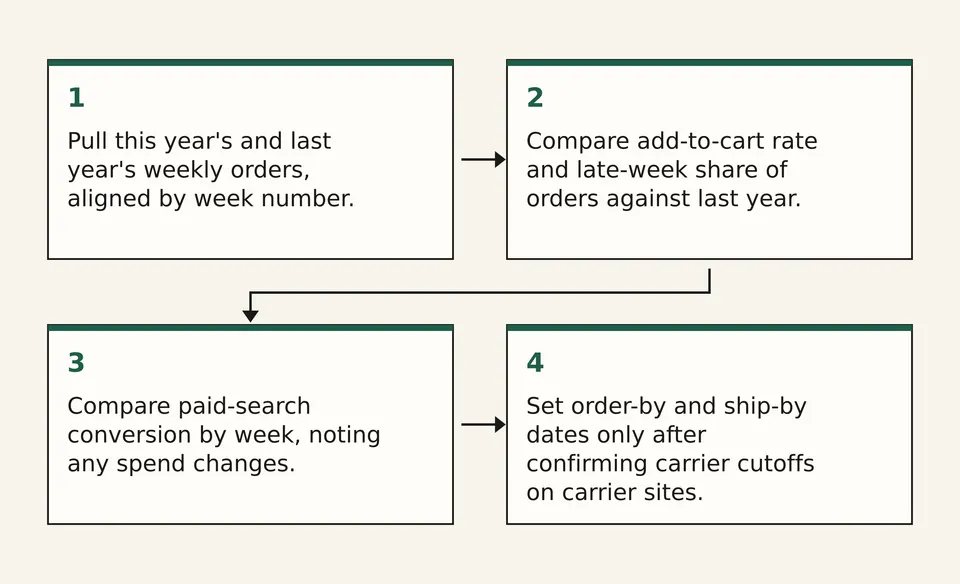
Use the data you already hold. Compare the same weeks last year, aligned by week number rather than calendar date:
- Pull this year's and last year's weekly orders, aligned by week number.
- Compare add-to-cart rate and late-week share of orders against last year.
- Compare paid-search conversion by week, noting any spend changes.
- Set order-by and ship-by dates only after confirming carrier cutoffs on carrier sites.
Before reading that as a change in behaviour, record calendar differences such as a later holiday or an earlier payday. For a cost-per-sale test, see Google Ads cost per sale.
What to watch next
- Dollar Tree's Q4 comparable store net sales against its 3% to 4% outlook2.
- Whether the holiday commentary matches the Halloween pattern, where sales were modestly below plan though sell-through improved1.
- Your own late-week share of orders and paid-search conversion by week, reviewed weekly through December.
Carrier dates in this article were checked against the retrieved pages on 26 November 2026. Confirm them on usps.com, ups.com and fedex.com before you publish any ship-by date. For a UK comparison of order-by planning, see DPD Christmas 2026 cut-offs.
Questions readers ask
What did Dollar Tree say about holiday shopping?
Dollar Tree said it expects holiday shoppers to buy closer to need1. This is an expectation from one retailer, not a measured trend across the market1.
Do the Dollar Tree results apply to online stores?
Not directly. Dollar Tree's headline measure is comparable store net sales, which describes in-store trading rather than online orders2.
Sources
- Dollar Tree predicts holiday shoppers will 'buy closer to need' Primary source
- Dollar Tree, Inc. Reports Third Quarter Results
- Dollar Tree Inc (DLTR) (Q3 2026) Earnings Call Highlights: Comps Beat Guidance as Traffic ...
- 2026 Holiday Shipping Deadlines
- 2026 Holiday Shipping Deadlines: USPS, UPS & FedEx Cutoffs
- Holiday shipping cutoff dates 2026: FedEx, UPS, USPS