
Conversion · Analysis
Retail media ROAS vs incrementality: four design checks before spend
A guest comment argues retail media reports should prove incrementality, not just credited sales. Four design details, from control group to independent review, can be checked from a vendor's written answers, though the Meta figures come from third-party summaries.
- By
- The Cart Plot Editorial
- Published
- Sources checked
- Evidence
- 5 sources
At a glance
- Attributed retail media sales credit the ad even when many purchases would have happened anyway, so attributed return alone cannot show what the budget caused1.
- A randomised holdout compared with a same-period control is the cleanest test, and a comparison with last quarter's sales mixes the campaign with seasonality and promotions1,3.
- Google's Conversion Lift requires at least 1,000 observed conversions and a $5,000 USD minimum budget, and Meta's thresholds are reported only through third-party summaries2,4.
- Epsilon says a well-run incrementality test will almost always show a smaller figure than reported ROAS, which is the point of running it3.

A guest comment published by InternetRetailing on 28 October 2026 argues that retail media reports should prove incrementality, meaning the share of sales a campaign actually caused, not just the sales it was credited with1. Before paying for retail media, a seller should check four design details in any vendor claim: the control group, the holdout length, the measurement window and modelling rules, and who ran and reviewed the test. Most of these can be checked from a vendor's written answers without access to its data.
Attributed sales answer a different question from incremental sales
Attribution records which purchases followed an exposure. Incrementality asks what changed because the ad ran1. Retail media reaches shoppers close to the point of purchase, when intent is already high. A shopper who searches for a product and buys it from a sponsored listing is credited to the ad, even though many such purchases were going to happen anyway1.
The guest comment is by Juan Baron, head of international and global accounts at Decentriq1. It promotes privacy-preserving collaboration, including data clean rooms, which are systems that let two parties analyse combined data without exposing the underlying records1. Read it as advocacy for that approach, not neutral guidance.
Our reading: a high attributed return can sit alongside little or no real lift. The report will credit the ad either way, so the number alone cannot tell a seller whether the budget changed what shoppers did.
Control group: is there a randomised holdout, and how big is it?
The cleanest method is a randomised holdout. A share of the target audience is deliberately withheld from the campaign, and purchases in the exposed and withheld groups are compared1.
Epsilon, which sells retail media products, says a proper test needs a real holdout group running at the same time, not a comparison with last quarter's sales, because time comparisons mix the campaign with seasonality, promotions and weather3. It also says that one of the most common reasons incrementality tests fail is that they are underpowered, meaning the test and control groups are too small to separate a real effect from noise3.
Meta's approach, as summarised by a third-party guide, randomly splits the audience into a test group that can see the ads and a control group that cannot, then compares conversions between them4. Google's Conversion Lift study lists the traffic split, which it calls the holdback percentage, as one of the inputs to its study power estimate2.
We recommend asking the vendor for:
- the holdout share as a number, not a description;
- confirmation that the control and exposed groups ran in the same period. A control drawn from a different month is a before-and-after comparison with extra steps;
- confirmation that test and control groups were comparable before the campaign started1.
Holdout length: does the study outlast the purchase cycle?
How long a test should run depends on the category. Fast-moving everyday groceries can produce a reliable signal in a shorter window than considered purchases such as electronics or homewares, where the gap between intent and purchase is longer3. Epsilon's advice is to set the window from the category's purchase cycle and agree it before launch3.
Timing can mislead in both directions. A promotion can pull purchases forward, looking strong in week one and flat by week six1. Meta recommends a minimum budget of $5,000 USD and at least 28 days to raise the chance of a statistically significant result4. Lift studies, according to one agency guide, capture only direct-response conversions and cannot measure brand awareness or consideration effects5.
Our reading: if buyers in your category take several weeks to convert after first seeing an ad, a short study will miss later purchases, so its result understates the effect. Compare the study length with your own purchase data before accepting a result.
Measurement window and post-period rules: are they stated before launch?
A measurement window is the period over which conversions are counted. Its rules need to be stated before launch, because the same campaign can produce different results depending on which window is used.
Meta offers a post-test window but does not recommend it for calculating results. It says that using post-test windows without keeping holdout groups may increase variance and reduce the measured effect in the post-test period, and it advises reading results from the test period itself4.
Google reports lift as a certainty range from 50% to 95%, in 5% steps2. Below 90%, its tool gives budget guidance to reach 90% certainty2. Results between 50% and 90% can be used as directional results2.
The guest comment recommends agreeing the definition of incremental before launch, because brands and retailers can define it differently. A brand may count a sale when a shopper chose its product after seeing an ad, while a retailer may treat the same sale as a switch from another brand on the same shelf1.
Google also says that tracking set-up should be resolved before launch, and lists consent mode and enhanced conversions among the features to implement2.
Who ran the test: is there an independent check?
Many partnerships rely on aggregated reports prepared by the retailer that is selling the media, which the guest comment says asks the seller to mark its own homework1. Epsilon makes the same point: a platform measuring its own lift has an obvious conflict of interest, so it is worth asking whether the outcomes measurement is independently accredited3.
The guest comment recommends reporting incremental results alongside attributed results, with confidence intervals, so that the gap between the two prompts a conversation rather than suspicion1.
Platform studies are also not open to every account. Google's Conversion Lift is not available for all Google Ads accounts, and advertisers must contact a Google account representative2.
Our advice: a platform-run study is still first-party. Ask whether anyone outside the company selling the ads reviewed the design, the randomisation and the analysis. An independent audit, or a study run by a measurement provider with no stake in the media sale, carries more weight.
What a small seller can check
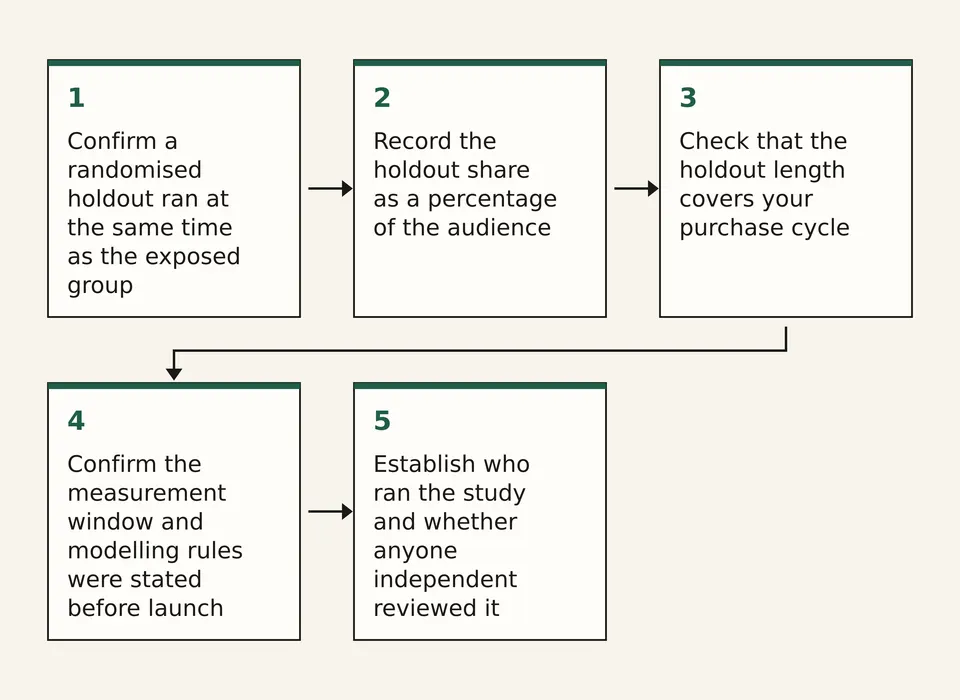
Five steps turn these design details into a check you can run before trusting a claim:
- Confirm a randomised holdout ran at the same time as the exposed group
- Record the holdout share as a percentage of the audience
- Check that the holdout length covers your purchase cycle
- Confirm the measurement window and modelling rules were stated before launch
- Establish who ran the study and whether anyone independent reviewed it
Platform thresholds can block a small seller before any of these checks begin. Google's Conversion Lift requires at least 1,000 observed conversions and a minimum campaign budget of $5,000 USD2. Meta's guidance, as summarised by a third-party site, asks for at least 500 conversions on the campaign and a minimum budget of $5,000 USD4.
These figures come from third-party summaries for Meta, and we did not check Meta's own help pages for this article. Confirm current thresholds on Google's Conversion Lift help page (support.google.com/google-ads/answer/12005564) and in Meta's Ads Manager help before making a budget decision.
Our analysis: what to ask before raising Q4 spend
Before raising spend in the fourth quarter, do not rely on attributed return alone. Ask for the study design, the holdout share and the readout with confidence intervals.
We recommend the following rules:
- Treat a claim with no holdout as attributed, not incremental, however large the reported return.
- Treat a directional result as a reason to test, not to commit. Google's range of 50% to 90% is described as directional2. Plan a budget test that can be reversed, and set a review date using the category's purchase cycle.
- Expect a smaller number. Epsilon says a well-run incrementality test will almost always produce a smaller figure than reported ROAS, and that this is the point of the test3.
Three developments to watch over the next budget cycle:
- whether vendors publish holdout shares as a standard part of reporting;
- whether platforms state minimum observed-conversion thresholds in plain terms;
- whether any retailer-run study is reviewed by an independent party.
Questions readers ask
What is the difference between attributed sales and incremental sales?
Attribution records which purchases followed an exposure, while incrementality asks what changed because the ad ran1. A shopper who buys from a sponsored listing is credited to the ad even if the purchase was likely anyway1.
What should a seller ask a vendor about its control group?
Ask for the holdout share as a number, confirmation that control and exposed groups ran in the same period, and evidence that the groups were comparable before launch1. A control drawn from a different month is effectively a before-and-after comparison1.
How long should a holdout test run?
Epsilon advises setting the window from the category's purchase cycle and agreeing it before launch, since considered purchases take longer than everyday groceries3. Meta recommends at least 28 days and a minimum budget of $5,000 USD, as summarised by a third-party guide4.
Sources
- GUEST COMMENT Proving that retail media sales are truly incremental Primary source
- Set up Conversion Lift based on users - Google Ads Help
- How to prove incrementality in retail media (and why most platforms get it wrong)
- What Is a Meta Conversion Lift Study?
- Meta Ads Conversion Lift Studies: Measuring True Incrementality