
Customer Behaviour · Analysis
Free returns: what the Scurri survey measures for UK shoppers
Scurri's survey found 60% of 1,028 UK consumers rate free returns among the most important factors, but its 150 retailers all had revenues above £100 million, so it does not show what a small store should do.
- By
- The Cart Plot Editorial
- Published
- Sources checked
- Evidence
- 5 sources
At a glance
- Scurri found that 60% of 1,028 UK consumers rate free returns among the most important factors when sending back an online purchase1,4.
- The Scurri retailer survey covered 150 UK businesses with revenues above £100 million, so its priorities do not show what small stores should do4.
- UK law stops a seller refunding by deducting fees unless the item has been used or damaged, and it requires refunding the standard delivery cost2.
- The NRF and Happy Returns report found 9% of all returns are fraudulent, a US figure that a store should use only as a prompt to check its own return reasons3.
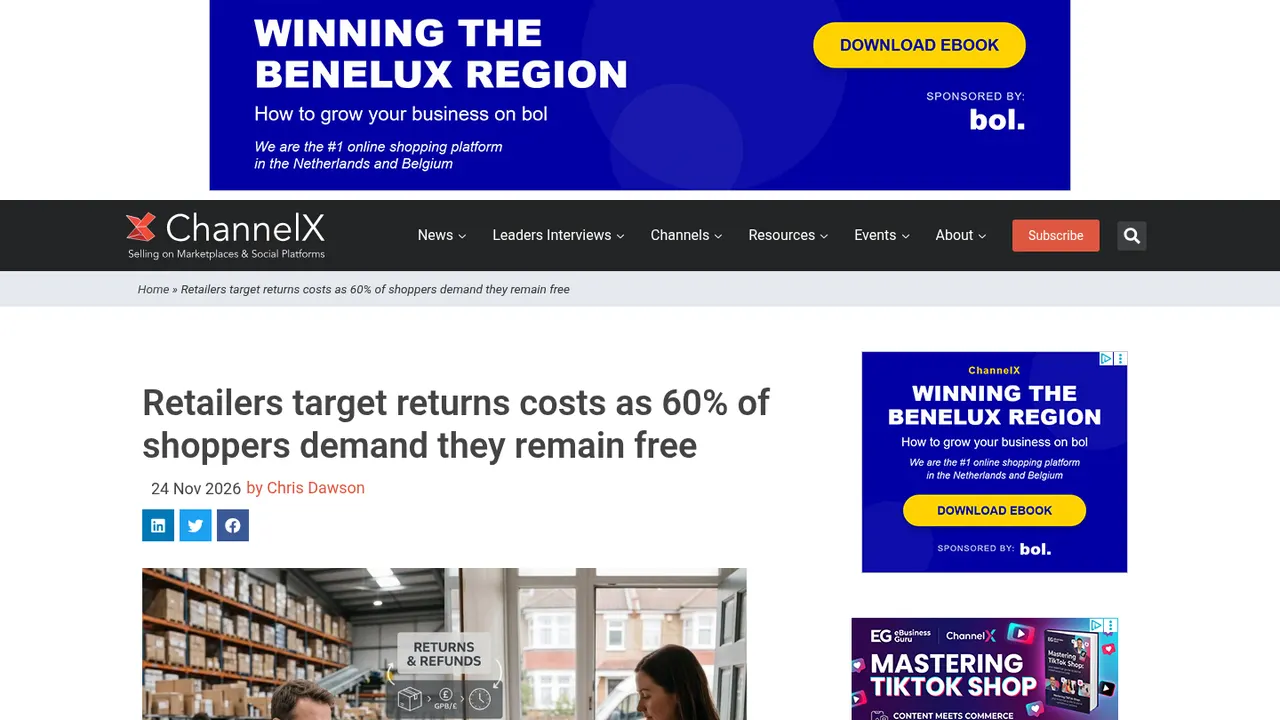
Scurri's research, reported by ChannelX on 24 November 2026, found that 60% of 1,028 UK consumers rate free returns among the most important factors when sending back an online purchase1,4. The retailer survey covered 150 UK businesses with revenues above £100 million, so its priorities do not show what small stores should do4. For a small store, the answer depends on its own cost per return, which must come from its own order data. Our view is that the research does not justify keeping or dropping free returns on its own.
What did the Scurri research actually measure?
Scurri ran two studies: one of 150 UK retailers and one of 1,028 UK consumers1,4. The retailers were pure-play or omnichannel businesses with revenues above £100 million, more than 20% of sales online, at least three years in business and more than 250 employees4. Respondents were at middle manager level or above4.
On priorities, 23% of retailers said they are focusing on more efficient and less costly returns processes over the next 12 months1. That ranked ahead of wider efficiency improvements (14%), protecting margins (12%) and reducing operational costs (11%)1.
On shoppers, 60% said free returns are among the most important factors when sending back an online purchase1. A further 39% prioritised the speed of receiving a refund, and 33% named instant refunds as an important feature1.
The headline says 60% of shoppers "demand" free returns1. The body text says only that they rate free returns as among the most important factors1. Our reading is that the survey measures importance, not a demand that returns stay free.
Why does "free" matter so much to shoppers?
Free returns matter, but they are not the only thing shoppers value. Beyond price, almost three in ten (29%) want to arrange the entire return online, 28% prioritise convenient drop-off locations and 22% value collection from their homes1.
The US figures point the same way but cover a different market. The National Retail Federation (NRF) and Happy Returns reported that 82% of consumers call free returns an important consideration when shopping online, up from 76% the year before3. That survey covered 2,006 consumers who had returned at least one online purchase in the previous 12 months3. It supports the direction of the Scurri finding, not its size.
What does the law require a UK seller to do?
UK law sets a floor that a store cannot waive. For online and distance sales, customers can cancel for a limited period even if the item is not faulty2. The customer must tell the seller within 14 days of receiving the item that they want to cancel, and then has another 14 days to return it2. The seller must refund within 14 days of receiving the item back, and the customer does not need to give a reason2.
Refund deductions are restricted. A seller cannot deduct fees from a refund unless the item has been used or damaged2. The seller must also refund the standard delivery cost if the customer paid for it. If the customer paid for a more expensive delivery option, only the standard delivery cost must be refunded2.
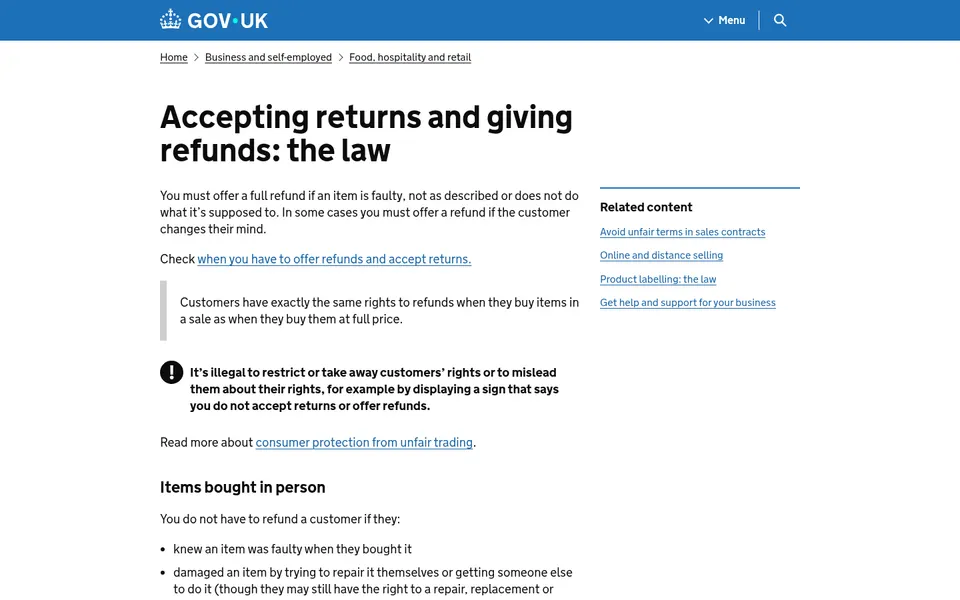
It is illegal to restrict or take away customers' rights, or to mislead them about those rights, for example with a sign saying returns are not accepted2.
The GOV.UK guidance does not say who pays return postage. A store should check its position on that point before it charges for returns. We checked the GOV.UK page on 24 November 2026: https://www.gov.uk/accepting-returns-and-giving-refunds
What does a return really cost a small store?
A return costs more than postage. Scurri's research lists customer service enquiries, processing, inspection, restocking and refunds as costs, along with possible losses when products cannot be returned to sale at their original price1. Rory O'Connor, founder and CEO of Scurri, said: "The answer cannot simply be to transfer those costs to customers."1
Fraud is another cost. The NRF and Happy Returns report found that 9% of all returns are fraudulent3. That is a US figure, so a store should use it only as a prompt to check its own return reasons.
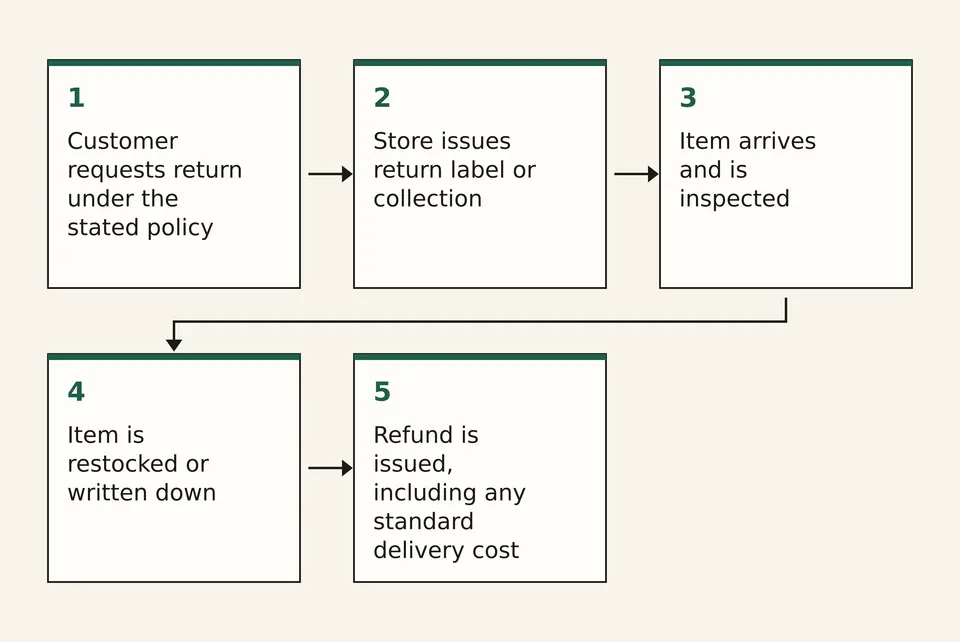
The steps below are our outline of how a store's returns handling typically runs. They are not a source's description:
- Customer requests return under the stated policy
- Store issues return label or collection
- Item arrives and is inspected
- Item is restocked or written down
- Refund is issued, including any standard delivery cost
The table below is a cost model to fill in from your own records. Scurri's research does not give per-return figures for stores of any size.
| Cost component | Source of figure (own data or source) | Your figure (per return, GBP) | Notes |
|---|---|---|---|
| Customer service enquiries | Helpdesk time logs | Listed as a return cost in1 | |
| Processing and inspection | Staff time per return | Listed in1 | |
| Return postage or collection | Carrier invoices | Who pays depends on your stated policy | |
| Restocking | Staff time per return | Listed in1 | |
| Refund, including standard delivery | Order and payment records | Refund rules in2 | |
| Unrecoverable value | Stock write-downs and resale prices | Losses where items cannot be sold at original price1 | |
| Fraud-related losses | Return reason codes | 9% is a US figure3 | |
| Total per return | Sum of the rows above |
Our analysis: which returns model fits which store?
We do not think one returns model suits every small store. There are three realistic options, and each fits a different kind of store.
Option 1: free returns for all. This suits a store where margin per order is high and the return rate is low. The risk is that return costs rise in peak, when volumes increase.
Option 2: free returns for loyalty or threshold members. This protects the benefit for repeat buyers and limits exposure on low-value orders that are often returned. The rule needs plain wording so that customers do not see it as a bait-and-switch.
Option 3: paid returns with clear disclosure. This may be defensible if your modelled cost per return is high and the fee is shown before purchase. The store must still meet the refund rules in2: fees cannot be deducted from a refund unless the item has been used or damaged, and the standard delivery cost must be refunded2.
Fifteen per cent come back, which is 30 returns. Whether that is affordable depends on the store's margin, which is why the table above needs your own figures.
Where shoppers want a self-service process, a store might reduce handling costs without a headline policy change. This is our reading, not a finding of the research, which reports only the preferences in1.
What should a store watch next?
Scurri's separate Peak 2026 research found that two-thirds (67%) of shoppers would accept longer delivery times during peak in return for free or cheaper delivery5. That concerns delivery, not returns, but it suggests cost sensitivity may be a live factor this peak.
Our practical checklist for the coming weeks:
- Track return rate weekly by product, sales channel and order value, rather than checking only at the end of peak.
- Record the reason for each return, and compare any unusual patterns with your own history. For a fraud-testing approach, see our net-dollar test for fraud tools.
- Check the policy you publish against the refund rules in2 before the first peak order.
- Compare any returns policy change with the cost of postage and handling, using the table above. For a worked comparison of a returnless route, see our article on Amazon Returnless Resolutions.
None of the sources reviewed gives return cost data for stores with revenues below £100 million3. Until Scurri publishes small-retailer data or its methodology notes, the enterprise priority finding should not be used to set a small store's returns policy.
Questions readers ask
What did the Scurri research find about free returns?
Scurri found that 60% of 1,028 UK consumers rate free returns among the most important factors when sending back an online purchase1,4. The survey measures importance, not a demand that returns stay free1.
Does the Scurri research show what a small store should do about returns?
No. The retailer survey covered 150 UK businesses with revenues above £100 million, so its priorities do not show what small stores should do4. A small store should base its decision on its own cost per return1.
Can a UK store charge customers to make a return?
UK law restricts refund deductions: a seller cannot deduct fees from a refund unless the item has been used or damaged2. The GOV.UK guidance does not say who pays return postage, so a store should check its position before charging for returns2.
What does a return cost a small store?
A return costs more than postage. Scurri lists customer service enquiries, processing, inspection, restocking and refunds as costs, along with possible losses when products cannot be resold at their original price1.
Sources
- Retailers target returns costs as 60% of shoppers demand they remain free Primary source
- Accepting returns and giving refunds: the law
- Consumers Expected to Return Nearly $850 Billion in Merchandise in 2025
- UK shoppers prefer cheaper delivery over speed, survey finds
- Two thirds of shoppers to trade delivery speed for lower costs during Peak Trading