
Platforms · Analysis
Amazon Returnless Resolutions: what FBA sellers under €75 give up
Enrolment trades return handling costs for the value of the unit, since customers keep refunded items. The sources do not publish a price point where enrolment pays or the return-rate threshold for the high return rate fee.
- By
- The Cart Plot Editorial
- Published
- Sources checked
- Evidence
- 6 sources
At a glance
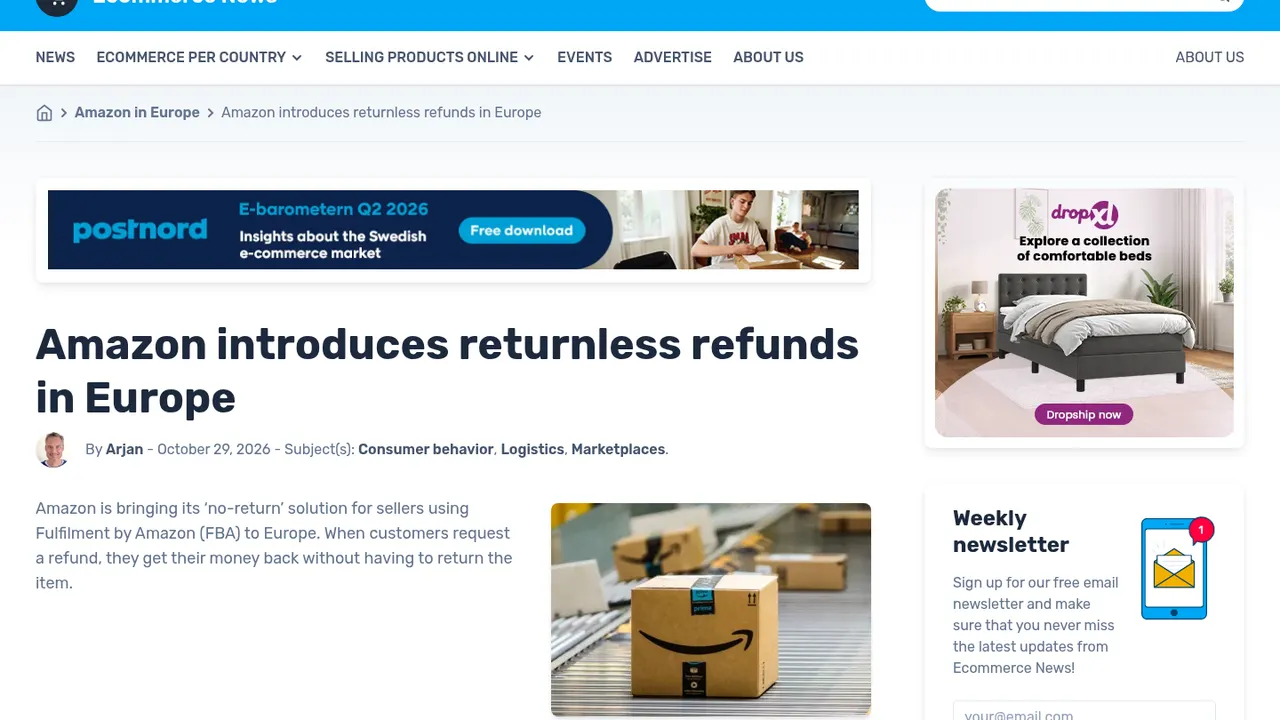
- Amazon's FBA Returnless Resolutions refunds eligible customers who keep the item, for Germany, France, Italy, Spain and the UK, announced on 27 October 20261,2.
- Enrolled sellers avoid return processing, storage and removal costs but lose the unit's value and are not eligible for inventory reimbursement1,2.
- Keep-it returns still count towards the return rate, but Amazon does not apply the high return rate fee to them1,2.
- Amazon's newsroom says the programme may suit low-cost items, but neither source gives a price point at which enrolment pays4,1.
Should an FBA seller with items under €75 enrol in Returnless Resolutions1? The sources show a trade: Amazon refunds the customer and the customer keeps the item1,2, so the seller avoids return handling costs but loses the unit's value and gets no inventory reimbursement1,2. Amazon announced the programme for Germany, France, Italy, Spain and the UK on 27 October 20262. Our analysis: enrolment is most likely to make sense for low-value items whose return costs exceed their resale value, so we suggest starting with a narrow band of ASINs and measuring the results.
What Returnless Resolutions actually does
Amazon launched FBA Returnless Resolutions (Fulfilment by Amazon, with returns handled through Amazon's network) for its Germany, France, Italy, Spain and UK marketplaces1,2. The programme had already been available on Amazon.com1.
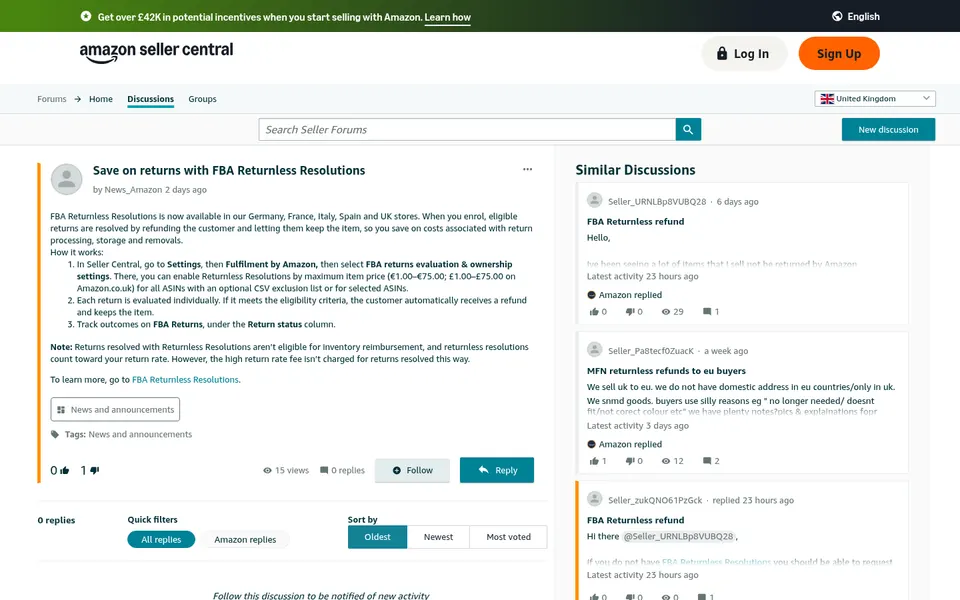
Under the programme, an eligible return is resolved by refunding the customer, who keeps the item2. Sellers can use it to save on return shipping, processing and storage costs1.
Sellers enable it in Seller Central under Settings, then Fulfilment by Amazon, then FBA returns evaluation & ownership settings2. They can set a maximum item price between €1.00 and €75.00 (£1.00 to £75.00 on Amazon.co.uk) and apply it to all ASINs with an optional CSV exclusion list, or to selected ASINs only2.
Amazon assesses return requests automatically. It considers the product price, the customer's return history, the product category and the seller's account status1. If a return does not meet these criteria, the customer must return the item to an Amazon fulfilment centre as normal1. Sellers cannot resell items that customers are allowed to keep1.
What it costs you: the accounting trade-off
Returns where the customer keeps the item still count towards the return rate, but Amazon does not apply its high return rate fee to them1,2. Amazon also does not compensate sellers for lost inventory value, in full or in part1, and these returns are not eligible for inventory reimbursement2.
The table compares the two outcomes using only what the sources state.
| Cost or effect | Returned item restocked (not enrolled) | Keep-it refund (enrolled) | Source |
|---|---|---|---|
| Return processing, storage and removal costs | These are the costs enrolment is designed to save2 | Saved on eligible returns1,2 | 1,2 |
| Value of the item | Returned to Amazon's fulfilment centre, where it is evaluated for sellability5 | Lost; no compensation, in full or in part, and the customer keeps the item1 | 1,5 |
| Inventory reimbursement | Not addressed in these sources | Not eligible2 | 2 |
| High return rate fee | Exemption applies only to returns resolved this way2 | Not charged2 | 2 |
| Return rate | Not addressed in these sources | Counts towards the return rate1,2 | 1,2 |
Amazon's US seller community post also states that there are no programme fees and that the referral fee refund still applies5. That post describes the US store, so check whether the same applies in your European store.
Is Returnless Resolutions a fit for low-cost items?
Amazon's newsroom said in 2024, about its US store, that ‘international sellers and sellers of low-cost items may find this a more cost-efficient option for handling returns’4. The European launch coverage says the solution ‘can be particularly beneficial for sellers of relatively low-priced products’1. Neither source gives a price point at which enrolment pays.
Some sellers question whether the savings on return processing outweigh the loss of products customers keep, and there are concerns about abuse because Amazon decides which returns qualify without the item coming back1.
How to set it up without catching the wrong returns
Changes take effect immediately, but only returns created after the setting is enabled qualify3.
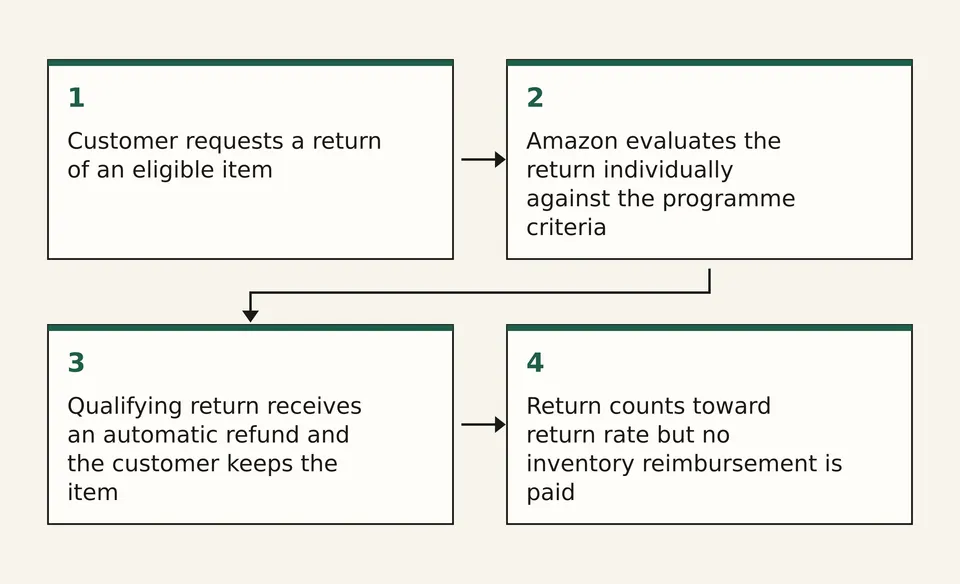
A return moves through four steps:
- Customer requests a return of an eligible item.
- Amazon evaluates the return individually against the programme criteria1,2.
- A qualifying return receives an automatic refund and the customer keeps the item2.
- The return counts toward the return rate, but no inventory reimbursement is paid2.
To turn the setting off for selected ASINs, a seller uploads a CSV file with one ASIN per row, or disables it for all ASINs, then clicks Update3. Outcomes appear on the FBA Returns page under the Return status column2.
We recommend starting with one category of low-cost ASINs, recording return volume and handling cost for a month, and then widening the scope.
Separately, a different rule applies to seller-fulfilled cross-border orders. Sellers fulfilling orders from outside the destination country into Amazon's UK, Germany, France, Italy or Spain marketplaces must either provide a domestic return address for items valued at £20 or €25 or less (including VAT), or offer a returnless refund6. This is not the optional FBA programme, so keep the two separate when you read return data.
Which approach fits which store
Our analysis: the sources do not rank these options. The reasoning below is ours.
The programme swaps a handling cost for the value of the unit. A keep-it refund costs you the €5 unit only5. The refund itself is paid either way and is left out of the comparison. The calculation changes if the item can be resold, which is why per-ASIN resale rates matter. For the per-unit cost inputs, see our guide to comparing EU wholesale supplier quotes on one cost per unit.
Based on this reasoning, we see three broad fits:
- Sub-€20 items with high return costs: enrolling the low-price band is most likely to pay, since handling costs are likely to exceed the unit value1.
- Mid-priced resaleable goods (€40–€75): keep the programme off, or limit it to selected ASINs, because the lost unit value is larger and may exceed the handling saving5.
- Cross-border sellers: the newsroom's cost-efficiency point is most relevant here, but check the separate low-value order rule first.
Our analysis: the fee exemption only helps if your return rate is high enough to attract the high return rate fee, and the sources do not publish that threshold. Track your return rate before and after enrolment.
What to watch next
These sources were checked on 29 October 2026. Open items:
- The return-rate threshold for the high return rate fee in these European stores is not published in these sources. Check the FBA Returnless Resolutions page that Amazon links from its announcement2.
- Changes to FBA fees for returned units, or to the processing, storage and removal charges the programme aims to avoid, are not covered here.
- Approval volume: how many returns Amazon approves under individual evaluation determines how much value is recovered.
- European exclusions: the US community post excludes dangerous goods, recalled products, gift cards, heavy and bulky items, non-returnable items and items above a $75 average sales price5. Whether Amazon publishes comparable European exclusions is not yet known.
Questions readers ask
Which items can an FBA seller enrol in Returnless Resolutions?
Sellers can set a maximum item price between €1.00 and €75.00 and apply it to all ASINs or to selected ASINs only2. Amazon assesses each return against price, customer return history, product category and account status1.
Sources
- Amazon introduces returnless refunds in Europe Primary source
- Save on returns with FBA Returnless Resolutions
- Returnless refunds
- Amazon expands options for sellers to handle customer returns
- Returnless Refunds: When to Use Them and How to Set Thresholds
- Amazon International Returns Policy: What Sellers Need to Know