
Customer Behaviour · Analysis
Fashion is 46.2% of EU cross-border spend: what the figure measures
ECDB's 46.2% share is a modelled category mix of spending at non-EU retailers, not evidence that shoppers prefer them on delivery, returns or service. The sources give no data on those three points.
- By
- The Cart Plot Editorial
- Published
- Sources checked
- Evidence
- 7 sources
At a glance
- ECDB's 46.2% figure is fashion's share of revenue EU-27 shoppers spend at third-country retailers, not the share of fashion budgets spent abroad1,2.
- ECDB's market figures are modelled by its analysts from transaction and other data, and no consumer survey or fashion methodology note was found behind the split2,3.
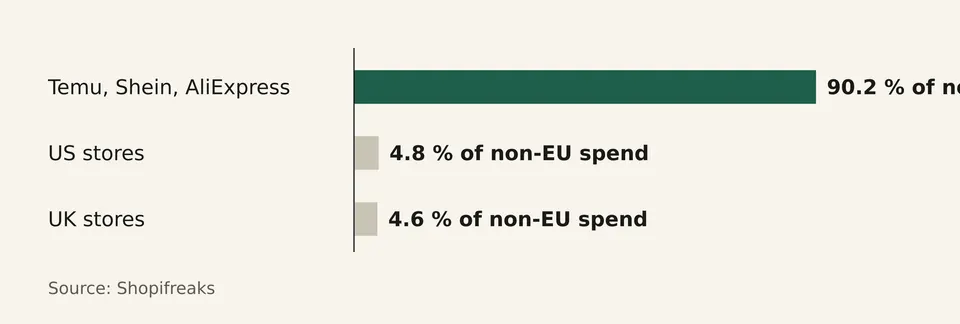
- Non-EU online spending on physical goods reached €55.1 billion in 2025, 13.1% of EU online physical-goods spending, with Temu, Shein and AliExpress taking 90.2%4,5.
- The sources contain no evidence on delivery times, returns or service that would show EU shoppers prefer non-EU retailers on those points1,2.
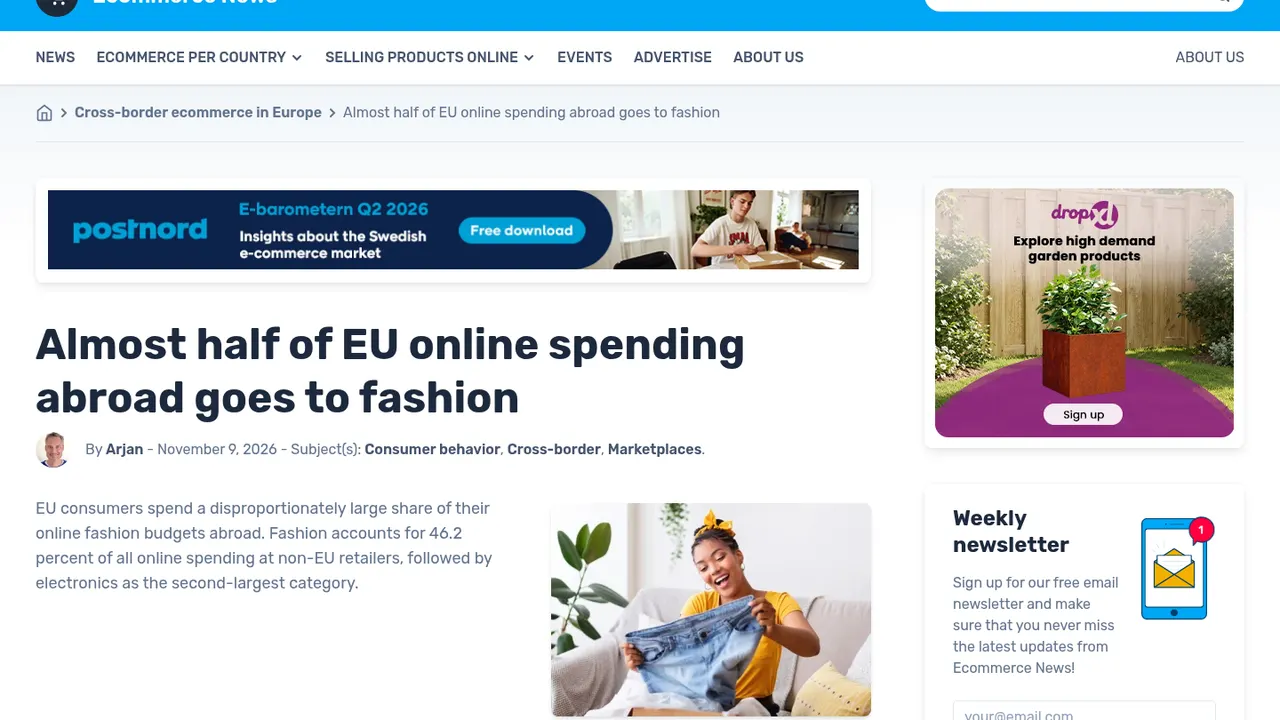
ECDB, a data provider that models e-commerce spending, says fashion accounts for 46.2% of the revenue EU-27 shoppers spend with retailers outside the EU2. In 2025, EU shoppers spent €55.1 billion on physical goods with non-EU online stores, and Temu, Shein and AliExpress took 90.2% of that5. The 46.2% figure describes the category mix of cross-border spending1. It does not show that EU shoppers prefer non-EU fashion retailers on delivery, returns or service, and the sources offer no evidence on those three points.
What does the 46.2% figure actually measure?
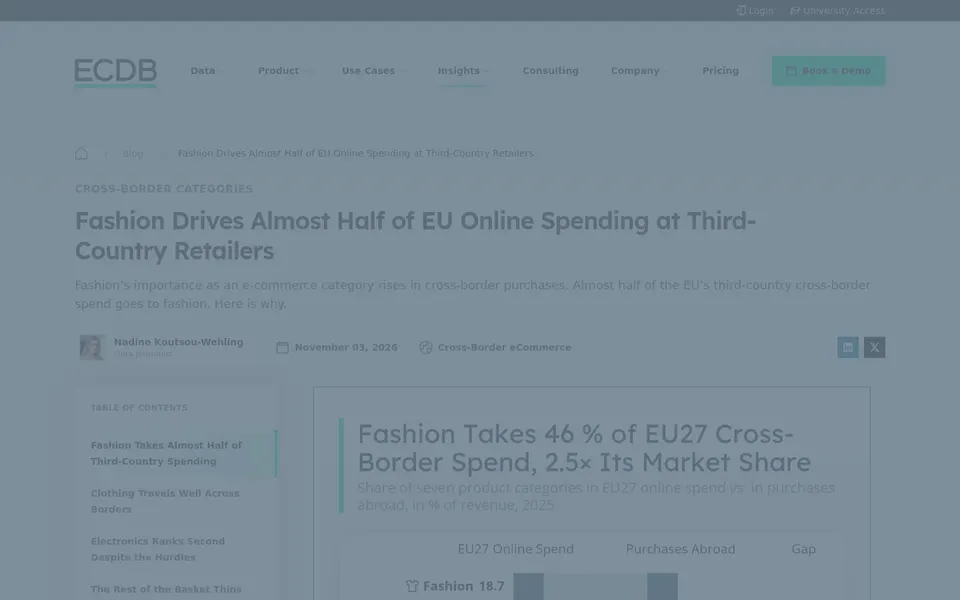
The 46.2% share is fashion's portion of cross-border spending, not the portion of EU fashion budgets spent abroad1. ECDB defines it as fashion's share of the revenue EU-27 shoppers spend at third-country retailers2. Ecommerce News summarises it as "Fashion accounts for 46.2 percent of all online spending at non-EU retailers"1. Do not read either version as a benchmark for how much of a shopper's fashion budget goes abroad.
The weighting is clear. Across all online spending in the EU-27, fashion holds 18.7%, so its weight in cross-border purchases is roughly two and a half times its weight in the overall market2.
The method is also a caveat. ECDB says its market figures are "Built on real transaction data and modeled by our analysts"2. Its methodology lists transaction data from "Card issuers and processors" alongside traffic, retailer, market and scraped data3. We found no published consumer survey behind the 46.2% share, and no ECDB methodology note for the fashion split1. Treat the figure as a modelled, transaction-based estimate of category mix: useful for direction, not a measured consumer preference. The Commission's customs guidance is a reference for how the duty applies to declarations and customs systems6.
Is leakage a demand signal for a single-country store?
It is a price and assortment signal. Non-EU online spending on physical goods reached €55.1 billion in 2025, which was 13.1% of EU online physical-goods spending4. Temu, Shein and AliExpress received €49.7 billion of it5.
ECDB gives two reasons for fashion's weight. First, "When the biggest third-country players are fashion-first, the category mix of cross-border spending follows them"2. Second, clothing is light and compact, and "Shipping costs per item stay low"2. ECDB also says European fashion retailers face competition "as much in Shenzhen as on the local high street"2. That is ECDB's explanation, not measured data on delivery, returns or service.
What this means (our analysis): the sources support reading leakage as a signal of demand for low-priced, wide-range fashion, not as evidence that shoppers prefer overseas retailers on service. A UK or EU store competes most directly for the price-sensitive shopper who wants range. Shoppers who value local service are not represented in these sources.
Delivery: what benchmark should a store match?
The sources contain no measured delivery times for non-EU platforms or for single-country stores. The only delivery-related point is ECDB's note that shipping costs per item stay low2. Ecommerce News reports that the platforms "are opening warehouses on European soil" to avoid the new charges and speed up deliveries1.
Our analysis: if platforms hold stock in the EU, in-EU stock is the realistic speed benchmark for a single-country store. Check your own dispatch and delivery times against that benchmark before promising faster delivery to customers. For packaging obligations on EU shipments, see EU packaging rules from 12 August 2026.
Do the new duties give a store a landed-cost argument?
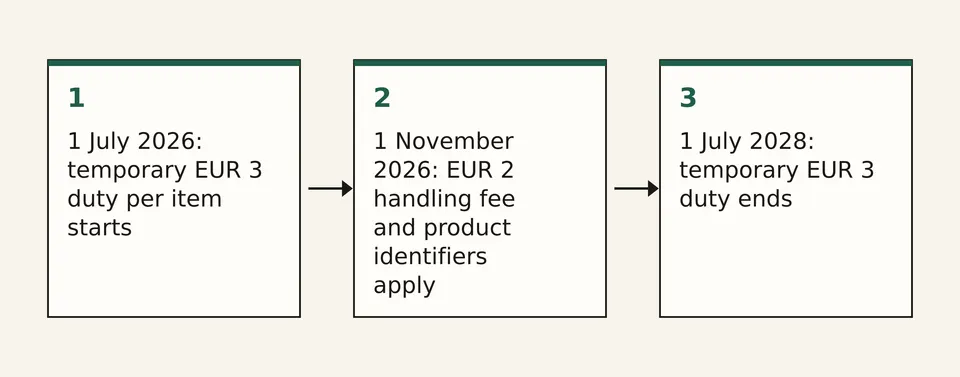
Yes, on some lines, but the argument is narrower than it looks. The EU's temporary duty is €3 per item on consignments worth €150 or less, and it applies from 1 July 20266. The key dates are:
- 1 July 2026: temporary €3 duty per item starts6
- 1 November 2026: €2 Union handling fee applies7
- 1 July 2028: temporary €3 duty ends and the normal tariff is due to apply6
Council Regulation (EU) 2026/382 introduces the €3 duty6. The handling fee's delegated act is Delegated Regulation (EU) 2026/21527. From 1 July 2028, goods are to be subject to the normal tariff, unless the temporary arrangement is extended because the EU Customs Data Hub is not running in time6.
Declaration type changes the bill. The Commission gives an example of three goods with the same HS code but different TARIC codes: under declaration H6 they can sit on one line and attract €3, but under H1 they generate three lines and €96. Grouping goods to reach a higher rate is not permitted while the €3 duty applies6. Implementing Regulation (EU) 2026/1200 adjusts product identification obligations6.
What a store can say (our analysis): a store in the EU can argue that landed cost on non-EU parcels is now closer to its own, because the same per-item charge applies to those consignments6. A UK store selling into the EU is outside the EU, and the Commission's scope wording covers distance sales (B2C) of imported goods6. We have not seen a source that states how the rules apply to UK sellers. Confirm your position with a customs adviser before you use it in marketing.
Returns: what the evidence does not support
No source addresses returns for cross-border fashion. The Commission's reform page sets out no returns treatment7, and none of the ECDB or news pieces covers return rates or costs.
Our analysis: do not build a returns offer on the 46.2% figure1. Treat local returns as unproven for fashion until returns data is published. Test return costs and rates on your own cross-border orders instead.
Price: will the fee structure narrow the gap?
The €3 duty is applied per declaration line, and that line-based charge applies regardless of how many items the line contains, as long as the consignment is worth €150 or less6. Declaration type and how items are grouped therefore determine the charge.
Our analysis: the effect is likely uneven. Single low-value items from non-EU platforms may get more expensive, which could narrow the price gap on some lines. Multi-item baskets and higher-value items may be affected differently, so the gap may not close evenly across a range. Verify with your own landed-cost data on specific SKUs before repricing anything.
What to watch next
- The Commission's Q3 2026 parcel report. The reform page lists "Import of e-commerce parcels - situation for Q3 2026" as a report7. It may show whether flows are shifting.
- ECDB's 2026 forecast. ECDB expects 15.2% of EU online physical-goods spending to leave the EU this year, up from 13.1% in 20254.
- A published ECDB fashion methodology. A disclosure of how the 46.2% split is modelled would show whether it can be relied on1.
- The end of the temporary duty. From 1 July 2028 the normal tariff is due to apply, which changes the price comparison again6.
Checked on 10 November 2026. Customs rules may change; the official reference is the European Commission's EU Customs Reform page.
Questions readers ask
What does the 46.2% fashion figure measure?
It measures fashion's share of the revenue EU-27 shoppers spend at third-country retailers, not the share of EU fashion budgets spent abroad1,2.
Does the 46.2% figure show that shoppers prefer non-EU fashion retailers?
No. The sources do not show that EU shoppers prefer non-EU fashion retailers on delivery, returns or service, and offer no evidence on those three points1,2.
How big is non-EU online spending on physical goods?
Non-EU online spending on physical goods reached €55.1 billion in 2025, which was 13.1% of EU online physical-goods spending4.
When does the EU's temporary €3 duty apply?
The temporary €3 duty per item on consignments worth €150 or less applies from 1 July 2026 and is due to end on 1 July 20286.
Sources
- Almost half of EU online spending abroad goes to fashion Primary source
- Fashion Drives Almost Half of EU Online Spending at Third-Country Retailers
- E-Commerce Store & Retailer Data: Methodology
- Over 90% of purchases abroad made on Temu, Shein or AliExpress
- Temu, Shein, and AliExpress took 90% of the EUR 55.1B that EU shoppers spent with online stores outside the bloc in 2025, per ECDB
- EU applies €3 customs duty per item on low-value e-commerce consignments
- EU Customs Reform