
Platforms · Analysis
EU packaging rules from 12 August 2026: what sellers must document
The EU Packaging and Packaging Waste Regulation has applied since 12 August 2026, but none of the sources requires sellers to stop EU sales; the obligations are documentary and set per destination. The sources are secondary, and the EUR-Lex text was not checked.
- By
- The Cart Plot Editorial
- Published
- Sources checked
- Evidence
- 6 sources
At a glance
- The EU Packaging and Packaging Waste Regulation has applied since 12 August 2026, but none of the sources requires sellers to stop EU sales2,4.
- EPR registration is required in each member state where a producer first makes packaging available, and it is a separate obligation from the packaging Declaration of Conformity4,1.
- Some sellers, including many in the UK, have paused EU sales, but the pause reports are anecdotal and no source counts how many sellers have stopped1,6.
- Side-Line's total for all 27 member states is around €17,860, and a 2026 Eldris price list ranges from about €360 a year for Germany to €1,485 for Slovenia5.
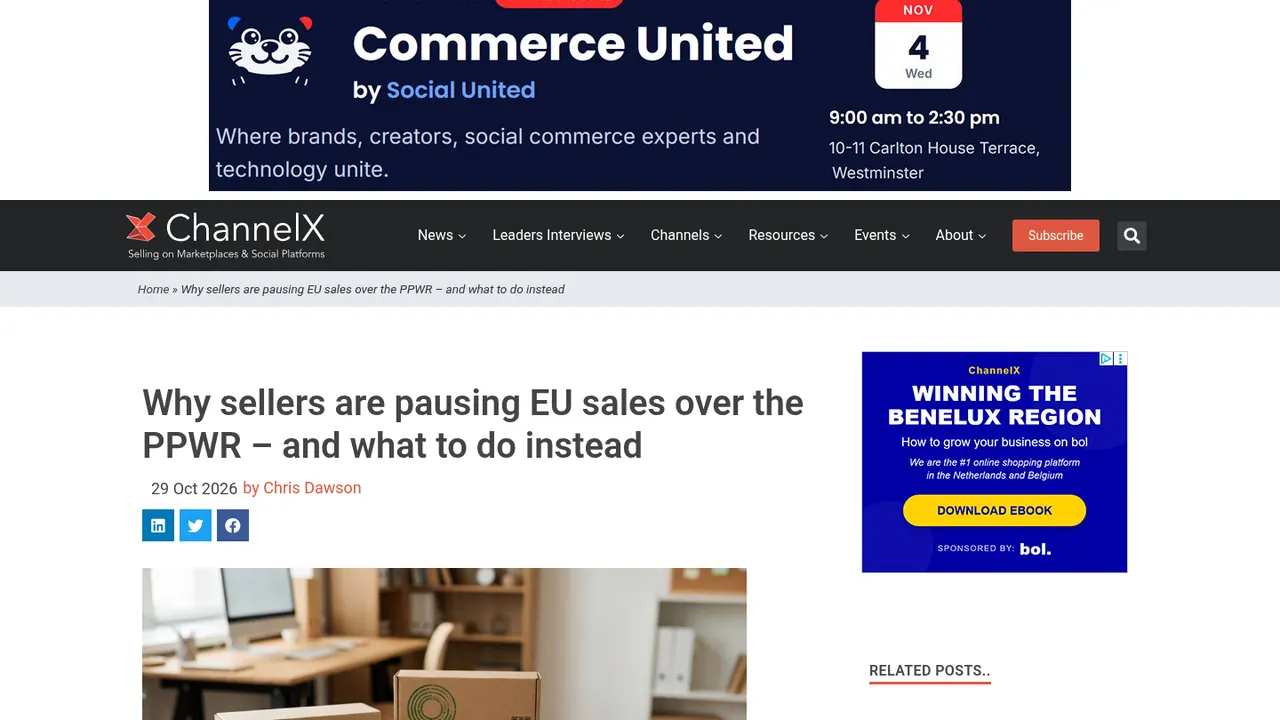
The EU Packaging and Packaging Waste Regulation (PPWR), Regulation (EU) 2025/40, has applied since 12 August 20262,4. None of the sources requires a seller to stop EU sales. What they describe is a set of documentary and per-destination obligations, so a small seller should check its packaging paperwork and national registrations before deciding whether to pause any country. Most of the sources were written for other audiences: S3 for GS1 users, S5 for independent record labels and mail-order sellers, and S6 for a tabletop games publisher.
What has actually taken effect, and what is still pending
The PPWR applies across the EU from 12 August 20262,4. It is a regulation rather than a directive, so its baseline obligations apply uniformly across member states, with no national grace periods2. The secondary sources agree on the date, but this article has not checked the EUR-Lex text, so verify dates there before relying on them.
Enhesa lists the substance restrictions, the Declaration of Conformity (DoC), technical documentation and manufacturer identification as enforceable now2. Several implementing and delegated acts are still outstanding. Enhesa says some are overdue or due by 31 December 2026, and harmonised labelling rules depend on acts whose adoption is planned for Q4 20262.
The European Commission published a 69-page guidance document and an updated FAQ nine days before the PPWR began to apply3. The EU is also negotiating a suspension of the authorised representative requirement for small EU producers, but until that is adopted, the obligation applies2.
Why are some sellers pausing EU sales?
Some sellers, including many in the UK, have paused EU sales because they are unsure what is required1. Other sellers have reported stopping cross-border shipments or considering switching EU destinations off entirely4.
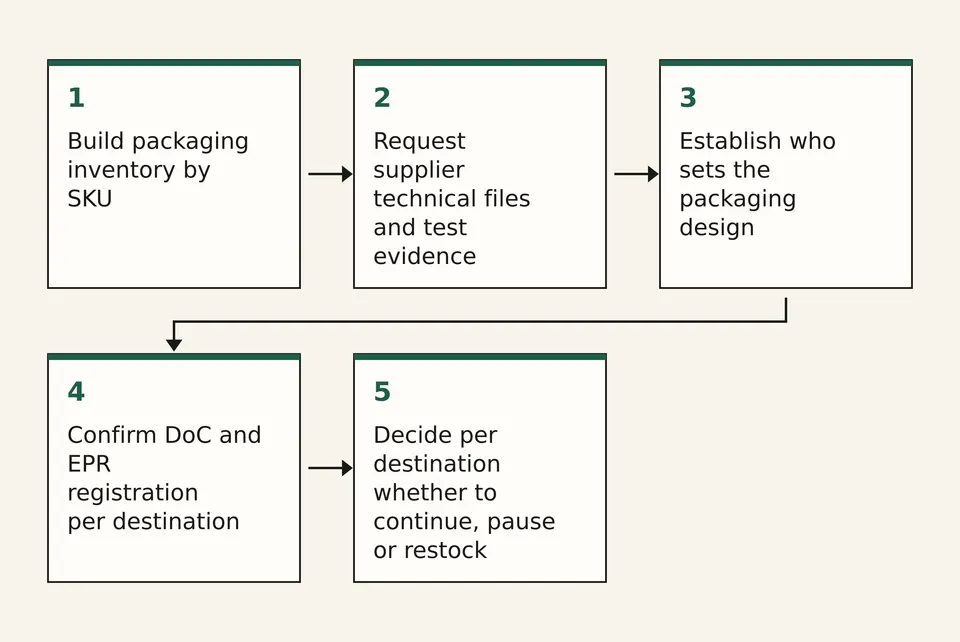
GeekNative reported on 25 October 2026 that Atlas Games, a US tabletop publisher, had indefinitely suspended direct-to-consumer physical sales to the EU and Brazil. The decision was announced on 23 October 2026 by its president, John Nephew6. GeekNative attributes the decision to soaring customs charges, unpredictable carriers and upcoming European regulatory overhead6. In our view, Atlas Games' circumstances may differ from those of a small seller.
In our reading, the evidence is limited. The pause reports are anecdotal, and the most detailed account, from GeekNative, is written from the publisher's side of the decision6. None of the sources gives a count of sellers that have paused.
Two obligations that are often confused
EPR (extended producer responsibility) is the principle that the producer placing packaging on a national market carries financial and organisational responsibility for that packaging when it becomes waste4. EPR registration and the packaging DoC are separate obligations, and one does not replace the other1.
A common EU regulation does not mean a single EU registration. Producers must register in each member state where they first make packaging or packaged products available4. National registration systems remain in place, and their transition rules vary, so each market where you sell has to be checked2.
The DoC must be supported by technical documentation that can be made available to authorities on request2. Each type of packaging needs its own declaration, in the language or languages required by each country where the product is sold1. Test reports or substantiated supplier declarations can be used as evidence, and testing is needed where such evidence is missing1. Nadezda Walz, a packaging-compliance consultant writing for ChannelX, describes a "we are compliant" letter without data as "weak evidence"1.
Who is the producer? The design test
The producer is, as a starting point, the entity that determines the packaging design. That is not necessarily the company that physically manufactures or fills it3. The Commission's FAQ says a company's name or trademark can be an important indicator of who the producer is3.
Producer responsibility can shift between the physical manufacturer, the filler and the brand or name owner when trading across EU countries3. A webshop selling packaged goods directly to an end user in another member state is, according to Side-Line's reading of the Commission's 2026 guidance, the producer for EPR purposes in that destination5.
For importers, from 12 August 2026 the obligation is to ensure that packaging from third countries meets the PPWR requirements and is accompanied by the necessary documentation, including verification of the conformity assessment, the DoC and information about the manufacturer3.
What to verify before the next EU restock
The sequence below is our suggested order, not a requirement in the sources.
- Build packaging inventory by SKU
- Request supplier technical files and test evidence
- Establish who sets the packaging design
- Confirm DoC and EPR registration per destination
- Decide per destination whether to continue, pause or restock
Start with the inventory, because each component counts: Walz lists boxes, bags, filling material, labels and tape1. Then ask suppliers for technical documentation for each one. Confirm that the DoC matches the current packaging, not an earlier design.
Stock already placed on the market before 12 August 2026 can continue to circulate without meeting the new sustainability or labelling requirements. Stock not yet placed on the market by that date must be assessed and, if necessary, reworked or repackaged before it is supplied2. Whether a product counts as placed on the market determines which rules apply2, so record the date each batch first entered the EU.
Fees vary by destination. One 2026 price list from the EPR compliance provider Eldris, cited by Side-Line, ranges from about €360 a year for Germany to €1,485 for Slovenia, depending on the country and services included5. Side-Line's total for all 27 member states is around €17,8605. Cross-border distance selling can trigger authorised representative requirements in destination markets4.
Packaging must display the manufacturer's registered trade name and contact details2. Labelling is already mandatory, and harmonised sorting pictograms will follow later1.
Confirm your obligations for each product and destination with a packaging-compliance professional. This article is not a legal opinion.
For the cost step, see our guide to comparing EU wholesale supplier quotes on one cost per unit.
Scenarios for a small seller (our analysis)
This section is our interpretation. The scenarios are illustrative and are not drawn from any seller's data.
Scenario A (illustrative): documents are complete and EPR registrations exist in every destination. The sensible course is to keep selling and monitor the suspension decision.
Scenario B (illustrative): documents are complete but registrations are missing in some states. Pause those destinations only, and register before restocking there.
Scenario C (illustrative): documents are missing and the supplier is unresponsive. Pause the affected SKUs and destinations until testing or declarations are obtained.
Our view is that a blanket EU pause is the least evidence-based response. The obligations vary by component and by destination, and the Commission says non-compliance should not automatically lead to a general ban on selling products. Member states should first give companies the chance to put things right3. Atlas Games cited customs charges, carrier problems and upcoming EU rules6; its circumstances may not match a small seller's.
Our recommendation is to write to each supplier now, asking who sets the design of each packaging item and for test evidence or declarations. The answers will show which destinations can continue.
What to watch next
- The suspension. Whether the proposed suspension of the authorised representative requirement for small EU producers is adopted2.
- Implementing acts. The producer register format, labelling rules and recycled-content rules are still pending. Enhesa says the recycled-content rules are due by 31 December 20262.
- National registers. Registration practice in each destination you ship to, since national systems remain in place2.
- Low-volume rules. Producers placing less than 10 tonnes of packaging a year on a national market get lighter reporting, but that does not remove national EPR obligations5.
- Pause decisions. Whether more operators announce pauses and whether they cite documentary or fee reasons.
Questions readers ask
Does the PPWR require sellers to stop selling in the EU?
None of the sources requires a seller to stop EU sales. They describe documentary and per-destination obligations, so a small seller should check its packaging paperwork and national registrations before deciding whether to pause any country2,4.
Is EPR registration the same as the packaging Declaration of Conformity?
No. EPR registration and the packaging DoC are separate obligations, and one does not replace the other1.
Does one EU-wide regulation mean one EU registration?
No. Producers must register in each member state where they first make packaging or packaged products available, and national registration systems remain in place4,2.
Is a 'we are compliant' letter from a supplier enough evidence?
Not on its own. Packaging-compliance consultant Nadezda Walz describes a 'we are compliant' letter without data as 'weak evidence', while test reports or substantiated supplier declarations can be used1.
Sources
- Why sellers are pausing EU sales over the PPWR – and what to do instead Primary source
- Frequently Asked Questions on the PPWR (Packaging and Packaging Waste Regulation)
- PPWR: 5 key clarifications in the European Commission's updated FAQ
- Why PPWR is stopping sellers from shipping to the EU and what larger brands should do differently
- EU PPWR hits indie record labels and mail orders
- Atlas Games halts direct-to-consumer sales to the EU and Brazil as PPWR rules bite