
Platforms · Guide
DPD Christmas 2026 cut-offs: how a UK store should set its order-by date
No source reviewed gives a DPD account collection cut-off for Christmas 2026, and published Post Office counter dates conflict. Get DPD's written account times, then subtract your own pick, pack and handover buffer.
- By
- The Cart Plot Editorial
- Published
- Sources checked
- Evidence
- 7 sources
At a glance
- ChannelX reported on 17 November 2026 that DPD's next-day service runs as normal up to and including Christmas Eve1.
- Published Post Office counter dates for DPD services conflict between sources, with Pango and Dealcomparer listing Monday 21 December for Next Day and Post Office Hours listing Monday 22 December3,5,6.
- Rajapack says counter dates may differ from DPD business account dates, so a store with a DPD account should check its account dates with DPD7.
- The order-by time should be DPD's written account collection time minus the store's own pick, pack and handover buffer, not a copied published table7.

As of 22 November 2026, none of the sources reviewed gives a DPD account collection cut-off for Christmas 2026, so a UK store with its own DPD account should not copy a published table into its checkout. ChannelX reported on 17 November 2026 that DPD's next-day service runs as normal up to and including Christmas Eve1. The store's order-by date should come from DPD's written collection times for its own account, minus its own pick, pack and handover buffer.
Short answer: do not copy a published table into your checkout
Rules checked 22 November 2026. The sources disagree on the dates that apply to a DPD account, and none of them is DPD's own written schedule for account customers.
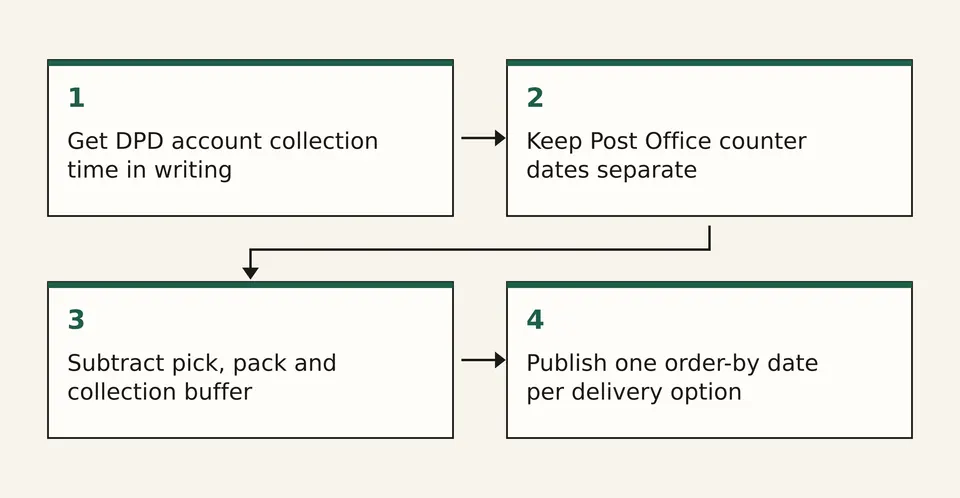
The method has four steps, set out below: get DPD's account collection time in writing; keep Post Office counter dates separate; subtract your pick, pack and collection buffer; publish one order-by date per delivery option.
The published third-party tables do not give a DPD account cut-off. Pango reported on 10 November 2026 that DPD UK's own pages had no 2026 Christmas last posting date3. Dealcomparer said on 15 November that dpd.co.uk had no UK Christmas dates yet5. We could not open dpd.co.uk directly, so these two reports are the basis for that statement and should be re-checked before publication.
What each source actually tells you
The sources measure different things, which is why their dates conflict. The Post Office's Christmas last posting dates page links to DPD services under its branch services2, but the copy we reviewed shows no DPD date table. Pango and Dealcomparer both list DPD 2 Day as Saturday 19 December, DPD Next Day as Monday 21 December and DPD Gold as Wednesday 23 December, all for handing in at a Post Office3,5.
Those are counter dates. Rajapack says they are counter dates and that a store with a DPD business account with collections should check its account dates with DPD, because they may differ7. The Post Office says parcels must be received before its branches' final acceptance times3. Check the branch's time before you quote a counter date to customers.
Post Office Hours gives different DPD dates: DPD Two Day on Saturday 20 December, DPD Next Day on Monday 22 December and DPD Gold on Tuesday 23 December6. The same page says remote postcodes may need to post one to two days earlier6. Pango quotes the Post Office's wording that remote postcodes should be sent earlier3.
The Post Office page copy we reviewed was cut off before its dates table, so the Post Office figures above are as quoted by Pango, Dealcomparer and Post Office Hours. ParcelsApp's DPD page quotes 2014 rates4, so we do not use it for dates.
| Source | Type | Service dates given | What it measures | Status for store use |
|---|---|---|---|---|
| Post Office, Christmas last posting dates2 | Official carrier-partner page | Links to DPD services at branch counters; no dates in the copy reviewed2 | Branch counter drop-off | Official, but no DPD dates confirmed in the copy reviewed |
| Pango, read 10 November 20263 | Third-party compiler | DPD 2 Day Saturday 19 December; Next Day Monday 21 December; Gold Wednesday 23 December3 | Counter drop-off | Counter dates only |
| Dealcomparer, checked 15 November 20265 | Third-party | Same counter dates as Pango5 | Counter drop-off | Counter dates only |
| Post Office Hours, Royal Mail page reviewed 30 September 20266 | Third-party | DPD Two Day Saturday 20 December; Next Day Monday 22 December; Gold Tuesday 23 December6 | Counter drop-off, as the page presents it | Differs from S3 and S5; do not use |
| Rajapack, updated 18 November 20267 | Third-party | Counter dates; says account dates may differ7 | Counter drop-off | Confirms the counter-versus-account split |
| ChannelX, 17 November 20261 | Trade news | Next-day service runs as normal up to and including Christmas Eve1 | Service operation | Confirms service, not a cut-off |
How do I get the right collection cut-off from DPD?
Ask DPD in writing for the last collection time on your account for each service you sell, including any changes for Christmas Eve, Boxing Day or New Year. No public source reviewed gives this figure for a DPD account, so it is the first thing to obtain.
Ask for the reply to be confirmed by email or by your account manager, and file it with the date you received it. Ask separately whether remote postcodes have a different collection or delivery promise. Pango and Post Office Hours both say remote postcodes can need earlier dates3,6, but neither gives a DPD account figure for them.
Do not accept a verbal answer without a reference. Rajapack reported on 13 November that DPD's account dates had not been confirmed on carrier websites7.
How do I keep Post Office dates from mixing in?
Keep Post Office counter dates in a separate field labelled as counter posting only. Use them only if you tell customers they can drop parcels at a Post Office branch, and check the branch's final acceptance time before you quote it3.
Do not let a Post Office date replace your DPD account collection date, even when a third-party table lists the two side by side. Post Office Hours gives different DPD dates from Pango and Dealcomparer3,5,6.
How do I calculate the order-by time?
Subtract your pick, pack and collection buffer from DPD's account collection time. The order-by time is the latest moment an order can enter your system and still be collected in time.
The example below uses illustrative numbers only. They are not DPD's dates.
- DPD account collection time (illustrative): 16:00
- Your team needs 24 hours to pick, pack and hand over (illustrative)
- Order-by rule: the order must be placed before 16:00 on the day before collection
Record the buffer you used, the source of the collection time and the date you checked it. Review the figure if DPD confirms any change.
How should I publish the dates to customers?
Publish one order-by date for each delivery option you sell, such as next-day and two-day, rather than one date for the whole store. Show each date with its cut-off time on product and checkout pages, and state the date the rule was last checked.
For remote postcodes, add an earlier date. Pango, quoting the Post Office, and Post Office Hours both say remote postcodes should post earlier3,6. Confirm the earlier date against DPD's written answer for remote areas before publishing it.
We recommend a check in early December. Public sources were still inconsistent in mid-November, so compare DPD's written confirmation with any updated public pages and change the published dates if they differ.
What to do if DPD never publishes a cut-off
If DPD's written answer is delayed, publish a conservative order-by date based on your own buffer and state that it is subject to confirmation. Do not adopt a third-party table as your deadline without checking it against DPD's written answer. Note the unresolved conflicts in internal records, so the team can explain any late delivery to customers.
Questions readers ask
Can a UK store copy a published DPD Christmas table into its checkout?
No. The sources reviewed disagree on dates, and none is DPD's written schedule for account customers3,5,6. Get DPD's account collection times in writing first.
Why do the published DPD dates differ?
The sources measure different things. Pango and Dealcomparer list counter drop-off dates, while Post Office Hours gives different dates, and Rajapack says counter dates may differ from account dates3,5,6,7.
How is the order-by time calculated?
Subtract the store's pick, pack and handover buffer from DPD's account collection time. The article's example uses illustrative figures, not DPD's dates7.
Sources
- DPD ready for record peak with more EVs and greater depot capacity Primary source
- Christmas Last Posting Dates
- Last Posting Dates for Christmas 2026 (UK): Royal Mail, Evri, Parcelforce, DPD and Big Retailers
- DPD UK Tracking in United Kingdom - Great Britain
- Christmas 2026 Last Order and Posting Dates UK
- Royal Mail Christmas Posting Dates 2026: Last Day to Post 1st Class, 2nd Class and International UK
- Christmas delivery times 2026: last posting dates for Royal Mail and every major courier