Customer Behaviour · Analysis
Wishlist purchases: 81% happen within a week, per one vendor's data
ChannelX reports 81% of wishlist purchases within seven days of a save, citing one vendor's dataset of about 300,000 products; the methodology and denominator are not published, so the figure is a hypothesis to test on a store's own data.
- By
- The Cart Plot Editorial
- Published
- Sources checked
- Evidence
- 4 sources
At a glance
- ChannelX reported that 81% of wishlist purchases happen within a week of an item being saved, citing Visualsoft's VS Labs dataset of almost 300,000 products1.
- The reported breakdown is 52% of saves converting on the same day and 28% between one and seven days later, which sums to 80% rather than 81%1,4.
- Products under £25 were almost four times more likely to convert from a wishlist than products priced between £100 and £2501.
- The methodology and denominator are not published in the sources reviewed, so the figure should be treated as a hypothesis to test rather than a benchmark1,2.
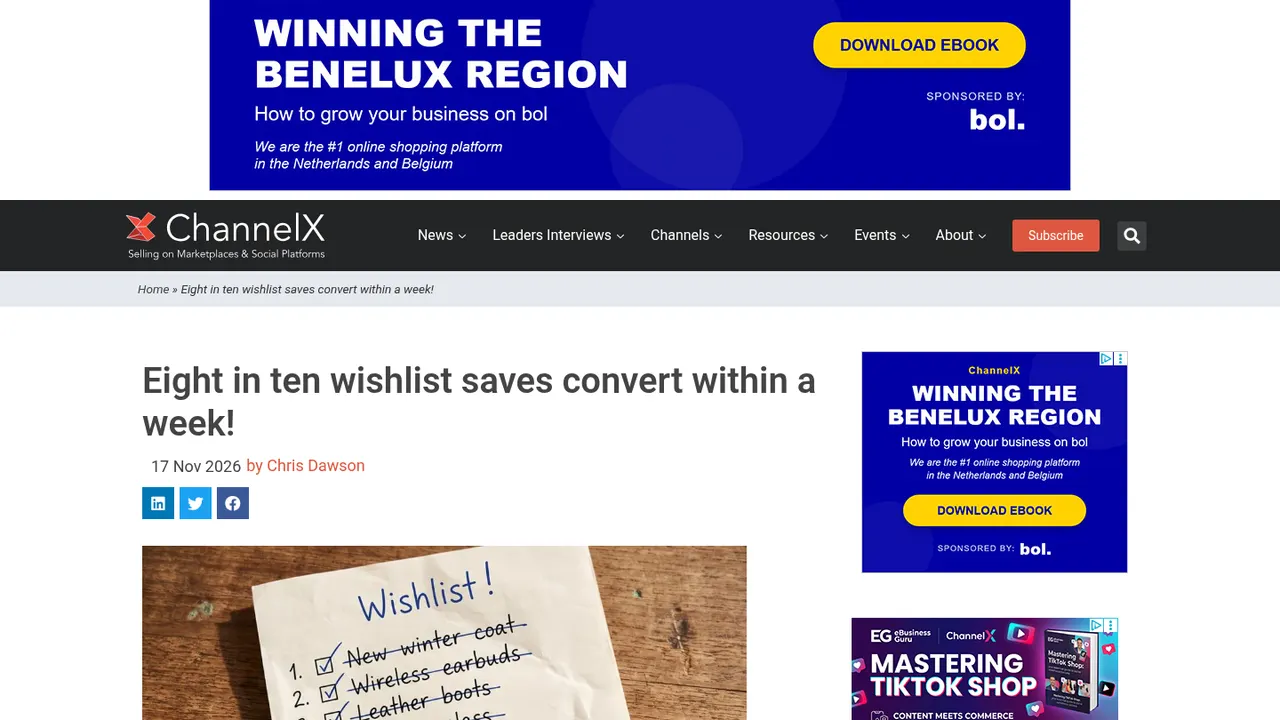
The Cart Plot's reading of the ChannelX report: on 17 November 2026, ChannelX reported that 81% of wishlist purchases happen within a week of an item being saved, citing Visualsoft's VS Labs1. The dataset covers almost 300,000 products saved through the Wysh wishlist app1. For a small store, this supports testing a short follow-up window. The methodology is not published in the sources we reviewed, so treat the figure as a hypothesis to test, not a benchmark.
What the 81% figure shows
ChannelX states that 81% of wishlist purchases happen within seven days of an item being saved1. The analysis covered almost 300,000 products saved through Wysh, the wishlist technology from VS Labs by Visualsoft1.
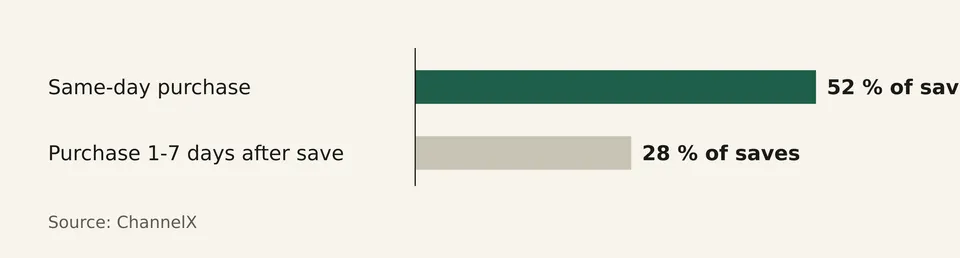
The breakdown reported alongside it is 52% of saves becoming purchases on the same day, and a further 28% happening between one and seven days later1. Those two components add up to 80%, one point short of the headline figure4. The sources do not define the denominator or the exact date range, and they do not explain the gap.
Where the figure comes from
The figure comes from one vendor's dataset, reported secondhand. The Visualsoft page we reviewed is a May 2026 launch post for VS Labs, which it describes as "the product and innovation arm of Visualsoft"2. That post does not contain the 81% figure or its methodology2.
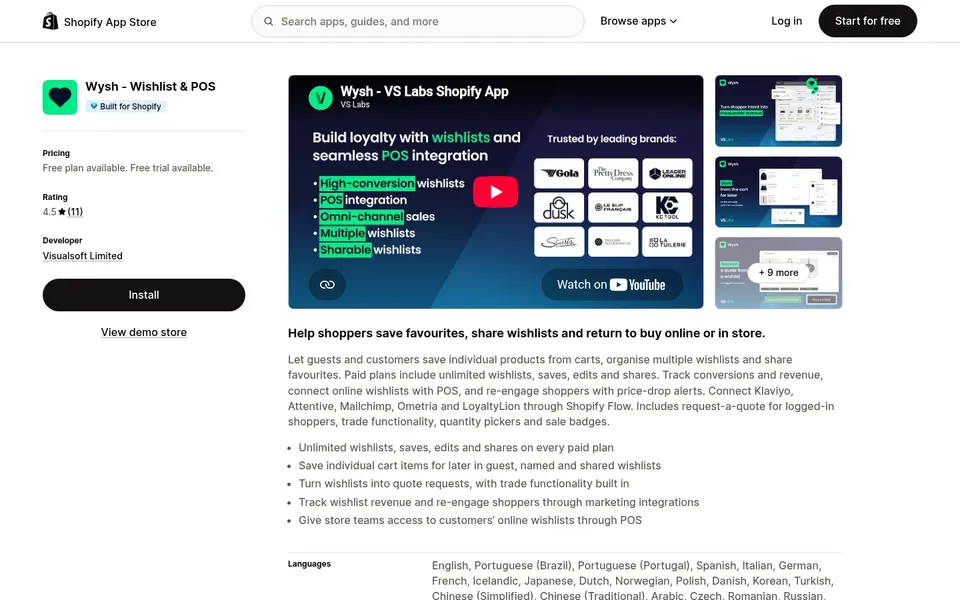
Visualsoft describes Wysh as bringing "multiple, shareable wishlists into the unified retail journey"2. The Shopify App Store listing says it lets shoppers save individual products, organise multiple wishlists and share favourites, and that paid plans track conversions and revenue3. A seller can check the pattern in their own data, but the published numbers cannot yet be reproduced from the sources.
Same-day and one-week timing
Most wishlist buyers in this dataset act quickly. In the ChannelX reporting, 52% of saves became purchases on the same day, and a further 28% converted one to seven days after saving1.
ChannelX describes this as "a relatively small window where a customer has shown clear interest and is actively considering what to buy"1.
Price band changes the picture
Price appears to change the pattern. Products costing under £25 were almost four times more likely to convert from a wishlist than products priced between £100 and £2501. ChannelX suggests that for higher-value products, the wishlist can mark the start of a longer decision process, which gives retailers a chance to provide information, reassurance or experience1.
The sources do not say whether the price-band gap holds within the same-day and one-to-seven-day windows, and they do not split the timing figures by product type1.
Our analysis: when a small store should follow up
This section is our interpretation of the cited evidence, not a finding from the sources.
Low-priced items. If the same-day pattern holds for a store's low-priced products, a reminder within the first 24 hours reaches shoppers while their intent is still active. We would send one reminder and stop, rather than building a longer sequence.
Higher-priced items. The ChannelX reporting suggests a longer decision window1. An early nudge may do less here. A later message that answers likely questions, such as delivery, returns, sizing or reviews, may fit better across the week. The sources do not name these topics; they are our suggestions.
Price-drop alerts. These are a separate lever. The Shopify listing says price-drop alerts are available on the Core plan at $10 per month, delivered via Shopify Flow, and that Klaviyo, Attentive, Mailchimp, Ometria and LoyaltyLion can be connected through Shopify Flow3. All charges are billed in USD3. A store should compare that cost with the expected uplift before enabling alerts.
Mixed catalogues. A store with both cheap and expensive items should split saves by price band and run separate sequences, rather than applying one timing rule to everything.
How to test this before changing spend
We recommend a simple test on the store's own data before changing paid or email spend.
- Export save events and matching orders for the last 90 days, if the store records them. Bucket each purchase by the time between save and order.
- Split the buckets using the same price bands for saves and orders.
- Compare the same-day and one-to-seven-day shares with the ChannelX figures of 52% and 28%1. Because the denominator is undefined in the source, a different catalogue or method may produce a different split.
- Count all saves in the period, not only the saves that later converted. Calculate the share on that full base, so the figures match the denominator.
- Change one variable at a time. Test reminder timing first, then content, so each effect can be seen.
What to watch next
Several open questions would settle whether the 81% pattern is usable for other stores:1
- Whether VS Labs publishes its methodology, including the denominator and exact date range.
- Whether the figures are broken down by store category, price band and channel.
- Whether the gap between 80% (the sum of the same-day and one-to-seven-day shares) and the headline 81% is explained4.
- Whether independent merchant data reproduces the same-day and one-week pattern across other wishlist tools.
Questions readers ask
What does the 81% wishlist figure measure?
ChannelX states that 81% of wishlist purchases happen within seven days of an item being saved, based on almost 300,000 products saved through the Wysh app1. The sources do not define the denominator or exact date range1.
Why is the 81% figure not a benchmark?
The figure comes from one vendor's dataset, reported secondhand, and the Visualsoft launch post does not contain it or its methodology2. The breakdown of 52% and 28% also adds to 80%, one point short of the headline4.
Does the price of a product change the wishlist pattern?
Products under £25 were almost four times more likely to convert from a wishlist than products priced between £100 and £2501. ChannelX suggests higher-value items may involve a longer decision process1.
How can a small store test this pattern?
Export save events and matching orders for the last 90 days, bucket purchases by time between save and order, split by price band, and compare the shares with the 52% and 28% figures1. Count all saves in the denominator, not only those that converted.