
Customer Behaviour · Analysis
ThredUp's live shows: what the 75% new-buyer share measures
The first ThredUp TikTok Shop shows drew buyers who were 75% new to ThredUp, but the published figures do not cover repeat purchases, margins or whether those buyers would have found the store anyway [S2][S3].
- By
- The Cart Plot Editorial
- Published
- Sources checked
- Evidence
- 3 sources
At a glance
- ThredUp reported that 75% of shoppers in its first six TikTok Shop shows were new to ThredUp2.
- The 75% figure is a share of buyers, and the sources give no order count behind it, so it cannot show reach3.
- ThredUp's chief financial officer said willingness to pay has softened and that the company expects to rely more on promotions1.
- No retention or margin figure has been published, so whether live buyers return or stay profitable remains untested1,2.
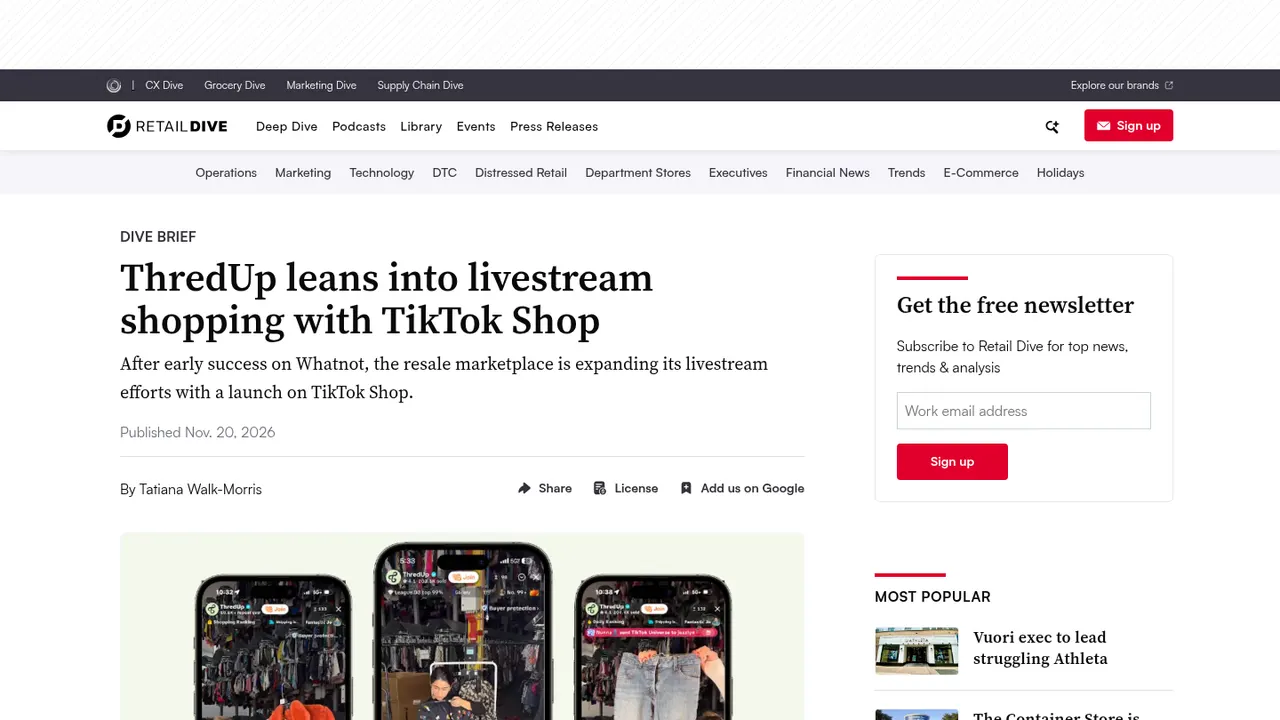
New-buyer shares from the first ThredUp livestreams do not show that live selling reaches customers a small resale store would otherwise miss. The published figures cover who bought in the first shows, not whether those buyers return, what they pay after markdowns, or whether they would have found the store anyway. ThredUp reported that 75% of shoppers in its first six TikTok Shop shows were new to ThredUp2.
What ThredUp has actually reported
ThredUp, a US resale marketplace, launched livestream shopping on TikTok Shop in a press release issued on Wednesday, 18 November 20261,2. The company hosts 10 live shows a week from studios in Atlanta and Dallas and says it will double that number in the coming weeks1. Modern Retail reports that the first show, which lasted four hours, aired on 11 November 2026 and that ThredUp plans to increase the schedule to 20 livestreams a week2.
The shows feature curated selections. ThredUp picks items by brand, such as Anthropologie, or by category, such as denim or sweaters, isolates them in its warehouse and removes them from its regular marketplace to avoid overlap2. Orders ship from ThredUp's distribution centres1.
The reported results are as follows:
- TikTok Shop: By the end of the first six shows, 75% of shoppers were new to ThredUp2. Shopifreaks attributes the same figure to ThredUp and uses the word "buyers"3.
- Whatnot (late September 2026): Three in four buyers from the initial shows were new to ThredUp, and items sold in those shows had a median selling price 52% higher than comparable items on ThredUp's marketplace, per ThredUp, though exact figures were not provided2. Retail Dive describes the same new-buyer result as three out of four buyers being new to "the recommerce app"1.
We found no separate ThredUp newsroom release for the TikTok launch. The TikTok details in this article come from press coverage of the company's release1,2.
What the new-buyer figures do not establish
The 75% figure is a share of buyers, not a measure of reach3. The sources do not give the number of orders behind it, so a high share from a small base cannot be told apart from a high share from a large one. No repeat-purchase or margin figure was published.
ThredUp's head of product, Danielle Vermeer, said: “That's what draws new shoppers in. Over time, they get to know our hosts and return for their shows”1. That is a statement of expectation. No retention figure was published to test it.
ThredUp's chief financial officer, Sean Sobers, said on the Q3 earnings call that willingness to pay has softened and that ThredUp expects to rely more on promotions than originally planned1. Our reading, which is not sourced: promotion-led demand can also produce new buyers, so a new-buyer share on its own does not show whether those buyers were attracted by the show format or by price.
The shows are also still experimental. ThredUp is testing formats with some items starting at $1 and others at $5, and experimenting with time of day2. The company says it is still doing “a lot of trial and error” on which items to feature and how many units to include2.
How to test it in your own data
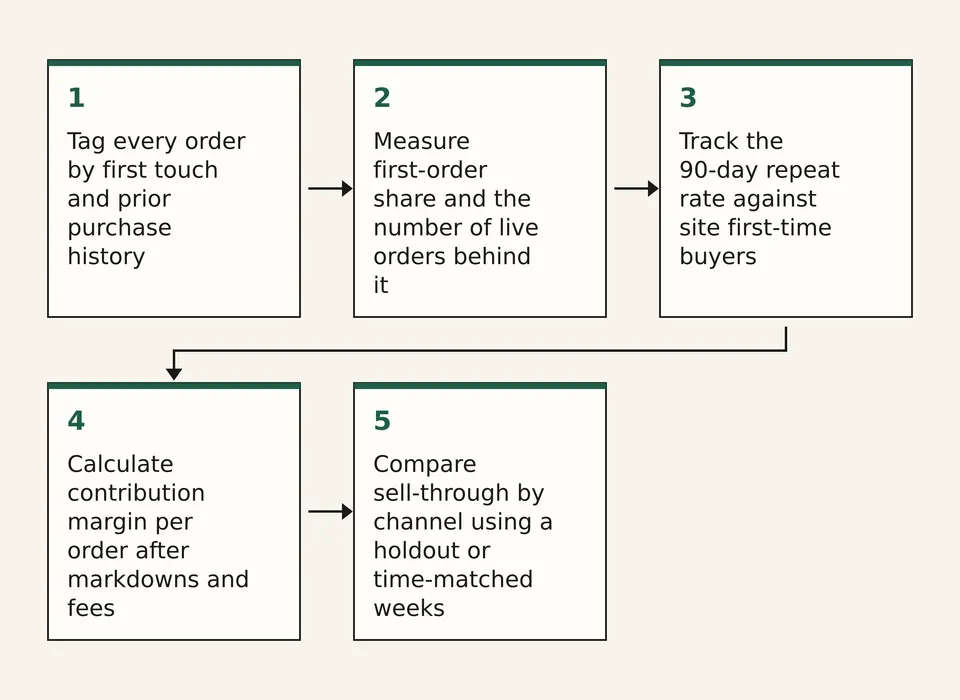
A small store can test the claim with its own order records. Our method, which is not sourced, has five steps:
- Tag every order by first touch and prior purchase history.
- Measure first-order share and the number of live orders behind it.
- Track the 90-day repeat rate against site first-time buyers.
- Calculate contribution margin per order after markdowns and fees.
- Compare sell-through by channel using a holdout or time-matched weeks.
The table sets out the metrics to compare live and site buyers in the same way. Fill the cells with your own figures; the sources contain no benchmarks.
| Metric | Definition to use | Live cohort | Site cohort | Decision signal |
|---|---|---|---|---|
| First-order share | Buyers with no earlier order ÷ all buyers in the cohort | Your figure, with live order count shown | Your figure | Share alone is not enough; read with the order count |
| Live orders behind the share | Number of live-show orders in the test period | Your count | Not applicable | Small counts make any share unstable |
| 90-day repeat rate | First-time buyers who order again within 90 days ÷ first-time buyers | Your figure | Your figure, same period | Near site rate suggests a retention channel |
| Contribution margin per order | Price paid minus cost of goods, markdowns, shipping, packaging and platform fees | Your figure | Your figure | Lower margin at similar repeat rates points to discounting |
| Sell-through by channel | Units sold ÷ units available, for the same SKUs | Your figure | Your figure | Higher live sell-through with weak repeat suggests an inventory channel |
Some results are harder to read than others. Use a holdout, such as pausing live for matched weeks, where you can. Where you cannot, use a time-matched comparison and say so in your notes. If most live buyers had already visited through search or social, the incremental reach is small, whichever way the repeat rate looks.
Which stores this fits and which it does not
ThredUp has more than 20 hosts across platforms, some of them existing employees and some creators or professional live sellers2. Its catalogue includes around 5 million items, according to Vermeer2. Vermeer described the shows as a way for a shopper to ask a host directly for items, such as holiday dresses, and to be asked in return what sizes they want, rather than searching and filtering alone2.
Our view, which is not from the sources: live selling suits a store whose stock is unusual or hard to find, and whose products a host can explain in a few minutes. A store with a narrow range of standard, easily searched products has less to show on camera and less reason to expect a new audience to stay. A small store should also expect the same trial-and-error phase that ThredUp describes, and a thin sample in its first shows.
For fee comparisons across live platforms, see TikTok Shop vs Whatnot: what resale sellers can compare on live fees.
Our analysis: what the evidence can support
Our reading, which is not sourced: the ThredUp figures support a narrower claim than the headlines suggest. They show that the first live buyers were mostly new to ThredUp. They do not show that live brought in customers who would not otherwise have bought, or that those customers will return.
Three scenarios are worth keeping apart for a small store:
- Acquisition channel: Live buyers repeat at close to site rates, with similar margin after markdowns and fees. Live then adds customers the store keeps.
- Inventory channel: Live buyers purchase once, often at deep discounts. Live then clears stock and attracts bargain buyers, with limited return to the store.
- Overlap: Most live buyers already reach the store through search or social. The new-buyer label then overstates the incremental reach.
Our reading, which is not sourced: ThredUp's design, which keeps live stock separate from its marketplace inventory2, makes its own results easier to read than a store that shows the same products in both places. A small store that wants a clean read would need to copy that separation, or log which SKUs were offered live and which were not.
What to watch next
- Denominators and repeat data. Whether ThredUp publishes order counts behind the 75% share, or repeat-buyer and margin data, in its next quarterly results3. Sobers' comments on promotions1 are the reason margin is worth watching.
- Holiday streams. ThredUp plans holiday-themed streams during TikTok Shop's Black Friday and Cyber Monday event2. Whether the new-buyer share holds as promotions intensify is the test to watch.
- Scale. Whether the planned increase to 20 weekly shows2 changes the mix of new and returning buyers, or the price gap ThredUp reports for live items.
- The 52% figure. Whether ThredUp publishes the exact figures behind the 52% median price claim1. Modern Retail reports that they were not provided2.
Questions readers ask
Does the 75% new-buyer figure show that live selling reaches customers a store would otherwise miss?
No. The figure covers who bought in the first shows, not whether those buyers would have found the store anyway or whether they return2,3.
What did ThredUp report about the 52% price figure?
ThredUp said items sold in its Whatnot shows had a median selling price 52% higher than comparable marketplace items, but exact figures were not provided2.
How can a small store test whether live buyers are worth acquiring?
Tag orders by first touch and prior purchases, then compare first-order share, 90-day repeat rate, contribution margin and sell-through against site buyers over the same period1.
Which stores is live selling likely to suit?
Our view, which is not from the sources: stores with unusual or hard-to-find stock that a host can explain in a few minutes are better placed than stores with narrow ranges of easily searched standard products2.