
Store Breakdowns · Analysis
Revolve's permanent stores: what a small apparel store can test first
Revolve discloses store sizes and openings but no store sales, margins or payback, so the sources cannot show whether its stores pay. The evidence supports a staged, low-cost test with a store's own measures.
- By
- The Cart Plot Editorial
- Published
- Sources checked
- Evidence
- 5 sources
At a glance
- Revolve has three permanent stores, in Aspen, Los Angeles and Aventura, but the sources reviewed publish no store sales, store margins or payback figures1,2,3.
- Revolve's Aventura store reportedly generates almost 60% of net sales from private labels, according to co-founder Michael Mente, though this is a management remark rather than a disclosed metric1.
- Revolve's Q3 2026 margin fell 75 basis points to 53.9%, and the company attributed the decline mainly to fewer full-price sales and higher inventory adjustments1,5.
- A small store should test with a pop-up or one local market and track its own sales per square foot, margin after occupancy and cross-channel customer share before committing to fixed costs4,1.
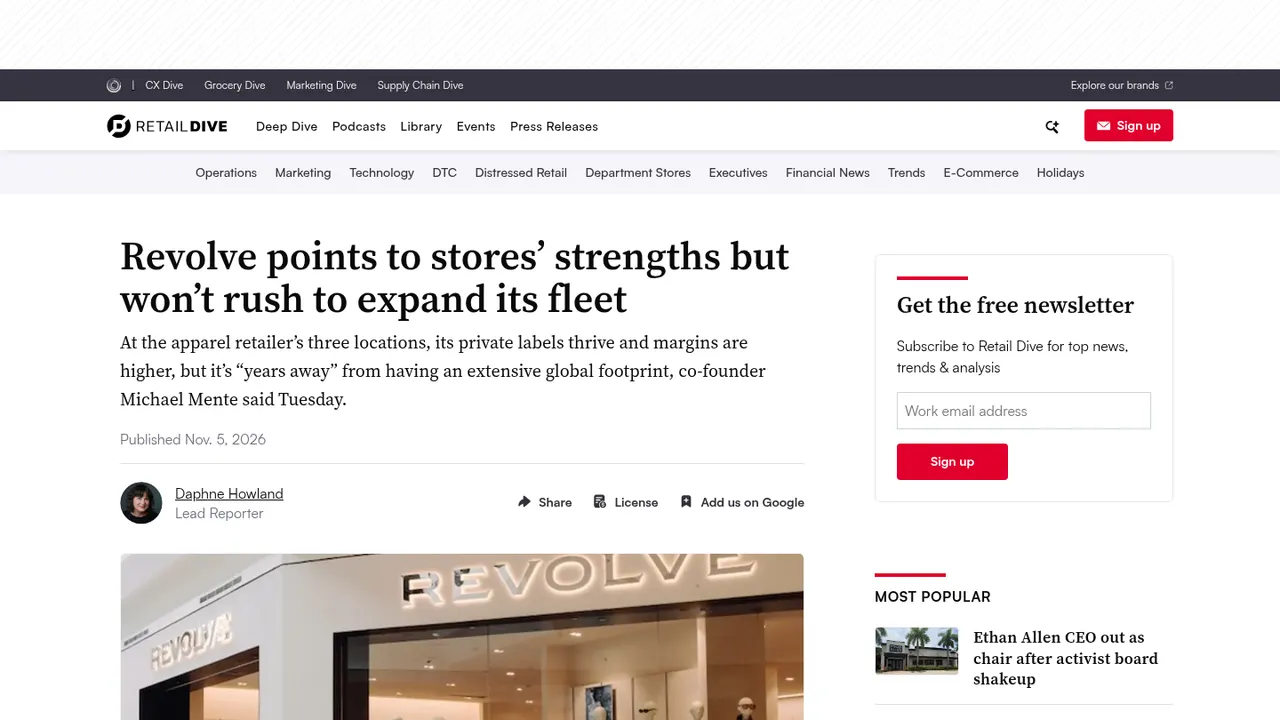
Revolve, which sells its own brands and other fashion labels mostly online1, has three permanent stores: Aspen, Colorado, which has operated since 20241; The Grove in Los Angeles, which opened in January 20261,3; and Aventura Mall near Miami, which opened on 29 September 20262. None of the sources reviewed reports store sales, store margins or payback on store costs, so a small online-first apparel store cannot tell from these results whether a store pays. Our reading, which is interpretation rather than reported fact, is that the evidence supports a staged, low-cost test with the store's own measures rather than a copy of Revolve's approach.
What Revolve has disclosed about its stores
The sources reviewed here were written for investors, analysts and trade press, not for store operators. They describe store size, opening dates and strategy in broad terms, and give little store-level data.
| Store | Size (sq ft) | Status and opening | Reported role or private-label note | Sources |
|---|---|---|---|---|
| Aspen, Colorado | 3,1001 | Permanent store running since 20241; followed a December pop-up4 | Being expanded under a new multiyear lease, with construction expected early next year1 | S1, S5 |
| Aventura Mall, Miami | 4,5122 | Opened 29 September 2026; the brand's third permanent store2 | Private labels generate almost 60% of net sales there, according to co-founder Michael Mente1 | S1, S3 |
| The Grove, Los Angeles | 8,450, two storeys3 | Opened January 20261,3 | No store-level figure published in the sources reviewed | S1, S4 |
The Aspen pop-up was the test that preceded the permanent store. Revolve's 2024 announcement said the pop-up “drove substantial sales” and was “an exceptional channel for brand building and acquiring new customers”4. Retail Dive reports that the company experimented with a series of pop-ups before Aspen1.
Revolve describes each store as tailored to its market. The Aventura store has “a thoughtfully curated assortment tailored to the Miami customer” and is said to build on The Grove and Aspen2. The Grove stocks REVOLVE and FWRD assortments from established and emerging brands, including in-house labels such as SRG, Helsa and Eaves3.
Retail Dive reports that the Aventura store is “surpassing the company's expectations”1, and that margins are higher at the three locations1. These are management and press remarks, not disclosed metrics.
Mente also told analysts that customers who shop in stores and online spend nearly three times more than those who shop one channel alone1. This is a management remark reported by Retail Dive, and no supporting data appears in the sources reviewed.
The sources reviewed do not include store-level margins, store sales, occupancy or staffing costs, or payback on fit-out. Treat store performance claims as unverified until the company publishes them.
What the company-wide numbers can and cannot show
Revolve's third-quarter 2026 net sales rose 20% to $356.0 million, and active customers rose 18% to 3.24 million5. Net income fell 27% to $15.5 million1. Gross margin narrowed by 75 basis points to 53.9%1,5.
The company attributed the margin decline primarily to a lower proportion of full-price sales and higher inventory valuation adjustments, partly offset by a greater mix of owned-brand sales5. Owned-brand mix therefore helped margin, but the consolidated figure does not separate stores from online sales.
Revolve's general and administrative expense remained near 13.0% of sales, as revenue growth counterbalanced investment in physical retail and GrowGood beauty products5. The figures do not isolate store costs.
Cash flow weakened. Free cash flow for the first nine months of 2026 fell to $7.0 million from $59.0 million, and Revolve said working capital movements primarily drove the decline5. Inventory was $293 million at quarter-end, up 23% year on year5.
The TradingKey summary used here is a secondary source with partly AI-generated text5. Check the figures against Revolve's own filings before relying on them.
Our analysis: three scenarios for a small apparel store
This section is our interpretation, not reporting. Revolve's scale is far beyond a small seller's. Its 3.24 million active customers5 are a base a small store is unlikely to match, so its expansion logic cannot be copied directly. It can be tested in smaller form.
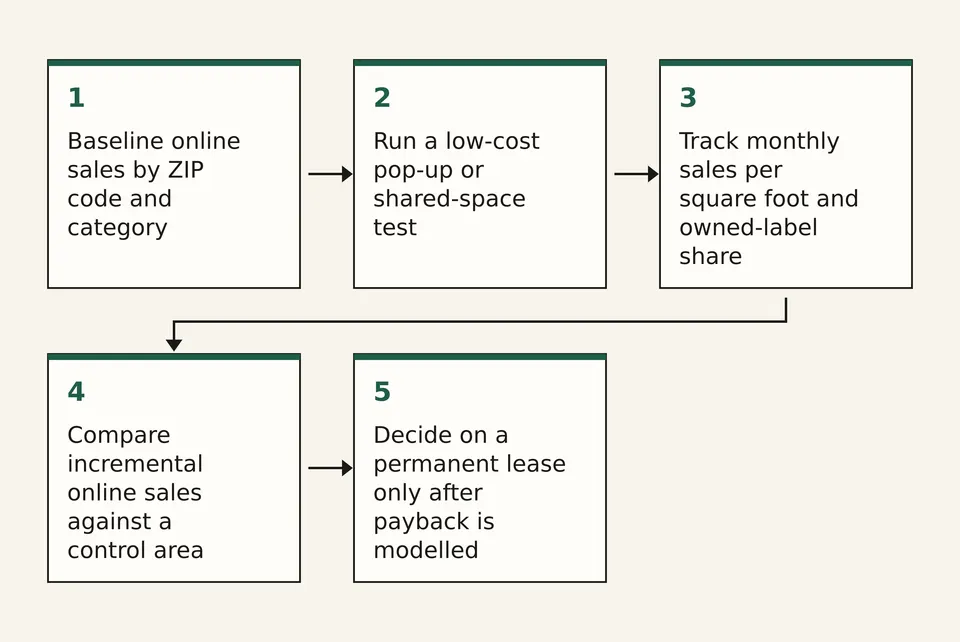
Scenario 1: start with a pop-up. Revolve ran pop-ups before committing to a permanent store1,4. Our view is that a store without much fixed-cost headroom should begin with a temporary space or shared retail, because it limits the lease and build commitment while demand is tested.
Scenario 2: test one market with a local customer cluster. Revolve's Aventura store uses local events and an assortment that caters to local lifestyle and culture1. Our reading is that this approach rests on local demand rather than national reach. A brand with a concentrated group of customers in one city can test that one market before opening a second site. Our view is that a single location in a city where online sales are already strong is a more defensible test than several locations at once.
Scenario 3: check whether your range supports the margin case. Revolve's private-label margin story depends on owned labels. Its stores also carry other brands3. A store whose range would be mostly third-party brands cannot assume the owned-label margin applies. Our view is that a store should model margin on its actual mix before deciding.
Our overall reading is that the evidence supports a small, staged test in a market where the brand already sells well, not a fleet strategy.
Store-level evidence to gather first
Revolve has not published these figures for its stores, so a small store must build its own baseline. The list below is our recommendation, not a requirement stated in any source.
- Monthly sales per square foot, rather than an annual average, so seasonality and ramp-up show.
- Owned-label share of store sales, compared with online sales of the same products.
- Gross margin after occupancy and staffing, not only product margin.
- Incremental online sales within the store's ZIP-code area during and after the test, compared with a control area. For a method, see our piece on incrementality design.
- Cross-channel customer share: the percentage of store buyers who also buy online, and the reverse.
- Payback period on fit-out, using the actual lease and build cost rather than a projection.
What to watch next
- Aspen rebuild. Revolve has signed a new multiyear lease in Aspen, expects construction to begin early next year, and is moving into a temporary store of more than 8,500 sq ft in the meantime1. Watch whether this expansion is supported by published sales data or by brand presence.
- Store disclosure in future results. If Revolve starts reporting store sales, occupancy costs or payback, the margin claims can be tested directly.
- Location of the next openings. Retail Dive reports that Mente expects fleet expansion to remain relatively slow and methodical1. Openings outside Aspen, Miami and Los Angeles would suggest a broader rollout. Further clustering would support the cautious reading.
We recommend that a small store re-check Revolve's investor site at investors.revolve.com each quarter for new store disclosure, and that it sets its own review date before opening any site.
Questions readers ask
Do Revolve's sources show whether its physical stores are profitable?
No. None of the sources reviewed reports store sales, store margins or payback on store costs, so profitability cannot be confirmed from them1,2,3.
Why did Revolve open a pop-up in Aspen first?
Revolve ran a pop-up in Aspen before opening the permanent store. Its 2024 announcement said the pop-up drove substantial sales and was an exceptional channel for brand building and acquiring new customers4.
What should a small store measure before opening a physical location?
Our recommendation is to track monthly sales per square foot, owned-label share, gross margin after occupancy and staffing, incremental online sales in the store's area, cross-channel customer share and payback on fit-out. Revolve has not published these figures for its stores1,3.
Is Revolve's margin improvement caused by its stores?
Not shown. The company attributed its margin decline mainly to a lower share of full-price sales and higher inventory adjustments, partly offset by owned-brand mix. The consolidated figure does not separate stores from online sales5.
Sources
- Revolve points to stores’ strengths but won’t rush to expand its fleet Primary source
- REVOLVE Opens New Store at Aventura Mall, Expanding Its Physical Retail Presence
- REVOLVE Group Opens Permanent Store at The Grove in Los Angeles
- RVLV Announces Permanent Aspen Store Location as First Brick and Mortar Following Successful Pop-Up Experience
- Revolve Q3 2026 Sales Rise 20% as Profit Declines