
Platforms · Comparison
Marketplace vs own checkout: EU packaging records each route needs
Selling into Germany through a marketplace or your own checkout asks for different packaging records. The German rules are official and published, but the Amazon requirements and representative fees are not in the sources reviewed.
- By
- The Cart Plot Editorial
- Published
- Sources checked
- Evidence
- 6 sources
At a glance
- Since 12 August 2026, a company based abroad without a German branch must appoint an authorised representative to sell packaged goods directly to German end users3,4.
- LUCID registration is free of charge for anyone distributing packaged goods in Germany3.
- ChannelX reports that some marketplaces, including Amazon, may revoke storefront access in certain markets if the seller cannot provide packaging registration details1.
- The retrieved Amazon notice shows only a headline, so most Amazon packaging requirements are not published in the sources reviewed2.
- Representative fees are charged but not published, and the IOSS intermediary fee is also not published in the sources reviewed4,6.
Before a store sells into a new EU country in 2027, it has to decide whether to sell through a marketplace or its own checkout, because each route asks for different compliance records. For Germany, the most detailed published rules come from the LUCID Packaging Register, which says that since 12 August 2026 a company based abroad without a German branch must appoint an authorised representative4. The marketplace side is thinner: the retrieved Amazon notice shows only a headline2, so most Amazon requirements are not published in the sources reviewed. This article was checked on 9 November 2026.
Source note: the ChannelX article is trade news that also promotes a SimplyVAT offer running until 1 December 20261. The Packa article is a vendor guide that says it is not legal advice5. The German register pages are official3,4.
What does a marketplace listing ask you to prove?
A marketplace listing (Route A) can require the seller's packaging registration details. Extended producer responsibility (EPR) is the principle that whoever places packaging on the market finances its collection and recycling5. Each country has its own EPR system1. ChannelX reports that some marketplaces, including Amazon, will revoke storefront access in certain markets if the seller cannot provide registration details1.
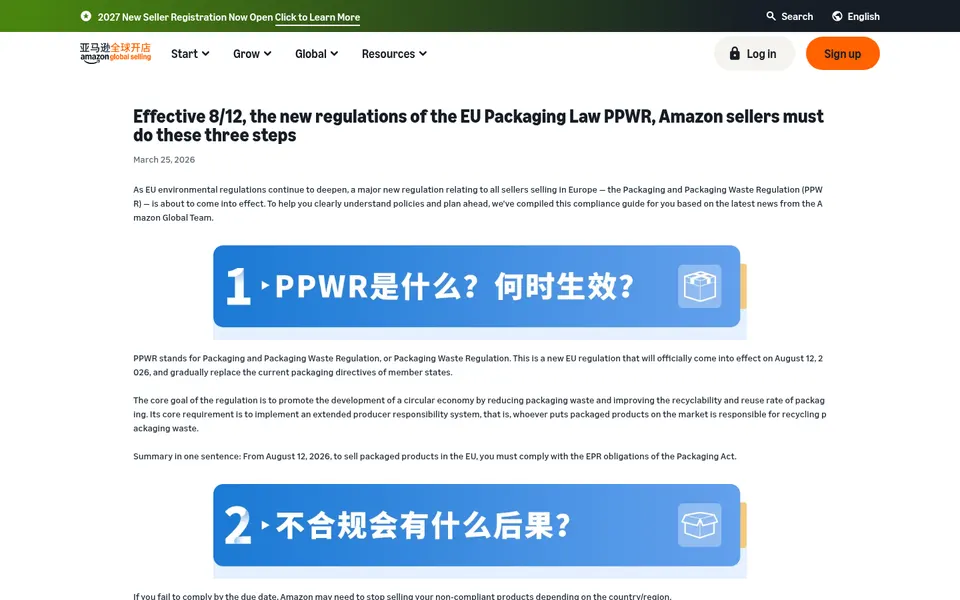
Amazon's Global Selling notice is headed 'Effective 8/12, the new regulations of the EU Packaging Law PPWR, Amazon sellers must do these three steps'2. The PPWR is the EU Packaging and Packaging Waste Regulation, which enters into force on 12 August 20263. The retrieved copy of the notice does not list the three steps, so readers should open the live notice before relying on any detail.
The LUCID register asks registrants to enter the same master data they used in their system participation agreement or when working with a marketplace3.
On the sourced material, Route A's clearest advantage is reach: Amazon says a Europe account lets sellers reach customers in 10 countries2. Amazon's fees, reporting deadlines and per-country waste-stream terms are not published in the sources reviewed, so this article cannot compare the compliance workload or cost of Route A with Route B.
What does Amazon publish on payment and reporting deadlines?
The retrieved Amazon material does not publish a reporting deadline, a fee for any payment arrangement or a list of which waste streams each country covers.
ChannelX gives the general timing: EPR reporting and contributions run on an annual calendar, and a seller who registers mid-year may have to account for products from the start of the period, which would be January rather than the registration date1.
What does your own checkout require?
Under an own checkout (Route B), anyone distributing packaged goods in Germany must be registered with the LUCID Packaging Register, and registration is free of charge3. A company based abroad that sells packaged goods directly to end users in Germany, without a German branch, must appoint an authorised representative3.
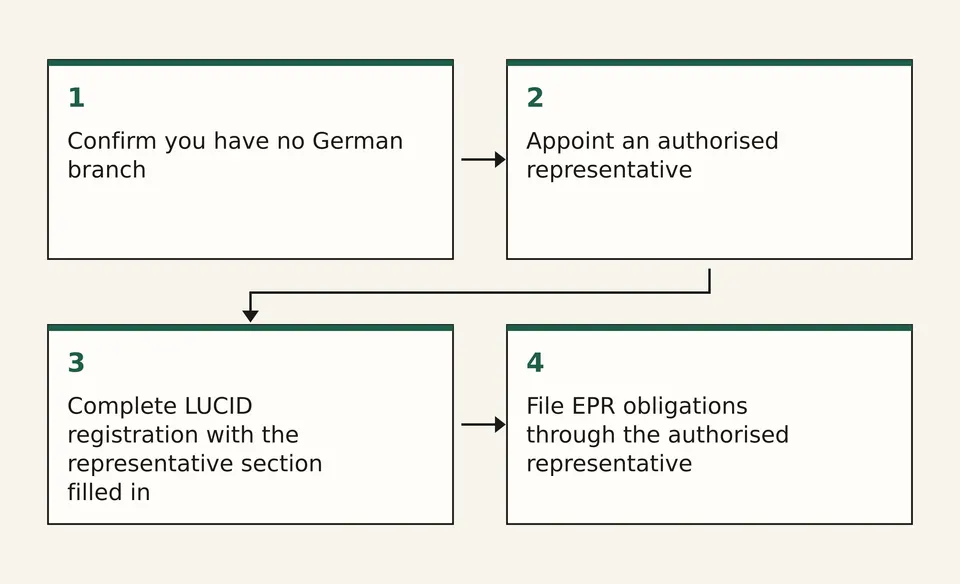
The sources describe the appointment in this order:
- Before packaging is first made available on the German market, appoint an authorised representative. This applies to a company without a German branch4.
- Enter the representative in the 'Authorised Representative' section of the LUCID registration. Registration cannot be completed without those details3,4.
- Let the authorised representative take over EPR obligations, except LUCID registration, which you must complete yourself4.
The representative must have a registered office or branch in Germany, sign a written agreement in German and hold a separate LUCID login4. S5 says the representative can be any natural or legal person with a German office, and also that only individuals not affiliated with your company can offer the service4. A company can appoint only one representative4. Representatives charge fees, and the amounts are not published4.
The obligation is framed around direct sales. It covers companies selling 'directly – without using an intermediary retailer' to end users in Germany4. The retrieved sources do not say whether a marketplace counts as an intermediary retailer, so check this with the German authority before relying on either route.
How does VAT work on each route?
VAT depends on where stock is when it is sold, where customers are, where the business is based and which sales channel was used, such as Amazon or the seller's own website1. Changing a third-party logistics provider can mean registering for VAT in a new country1.

The One-Stop Shop (OSS) is an EU VAT reporting system introduced on 1 July 2021. The seller registers in one EU country and declares sales to other member states in one quarterly return6. On a marketplace, the marketplace often acts as the deemed supplier and uses its own IOSS number6. IOSS covers B2C imports into the EU worth €150 or less, and non-EU sellers usually need an EU-based IOSS intermediary to register for it6.
The fee for an IOSS intermediary is not published in the sources reviewed. ChannelX says the German tax authority's advised processing time for non-EU registrations is six months1. The official pages reviewed do not confirm that figure, so treat it as a planning estimate.
What fits which seller?
Neither route is a clear winner on the published facts. The table summarises what the sources state and what they leave unpublished.
| Criterion | Route A: Marketplace listing (Amazon EU) | Route B: Own checkout | Source |
|---|---|---|---|
| Registration needed | Registration details the platform may request | LUCID registration for anyone distributing packaged goods in Germany | 1,3 |
| Registration cost | Not published | Free of charge | 3 |
| Authorised representative | Not published | Required for a company abroad without a German branch selling directly to German end users, from 12 August 2026 | 4 |
| Who files reports | Not published | Representative, except LUCID registration | 4 |
| Consequence of a missing record | Storefront access revoked in certain markets | Registration cannot be completed without representative details | 1,3 |
| Representative fees | Not published | Charged; amount not published | 4 |
| Public listing | Not published | ZSVR publishes registered companies; does not publish a list of representatives | 3,4 |
| VAT route | Marketplace often acts as deemed supplier | Non-EU seller usually needs an EU-based IOSS intermediary | 6 |
| Processing time | Not published | Six months advised (not confirmed by an official page) | 1 |
Our advice, which is not a finding from the sources:
- Marketplace listing suits a store that already has its national packaging registration and EPR details ready, because the platform can revoke storefront access without them1. It also suits a store that values Amazon's Europe account route to customers in 10 countries2.
- Own checkout suits a store that can appoint a German-based authorised representative before its first German sale. Its clearest sourced advantage is that LUCID registration is free3. The appointment takes effect only once the representative confirms it in the register4. A non-EU seller using IOSS for low-value B2C imports usually needs an EU-based intermediary6.
Not published in the sources reviewed: EPR fees by country, an official-page confirmation of the German VAT processing time, Amazon's fees and IOSS intermediary fees. Check the live pages on the dates you plan to register. For background on the packaging rules, see EU packaging rules from 12 August 2026: what sellers must document.
Questions readers ask
Does a marketplace listing need packaging registration details?
A marketplace listing can require the seller's packaging registration details. ChannelX reports that Amazon may revoke storefront access in certain markets if those details cannot be provided1.
Is LUCID registration free for sellers distributing packaging in Germany?
Yes. Registration with the LUCID Packaging Register is free of charge for anyone distributing packaged goods in Germany3.
When must a company based abroad appoint an authorised representative in Germany?
A company based abroad without a German branch must appoint an authorised representative before its packaging is first made available on the German market4.
Are authorised representative fees published?
No. Representatives charge fees, but the amounts are not published in the sources reviewed4.
Sources
- Expanding in 2027? Get the Compliance Sorted Now Primary source
- Effective 8/12, the new regulations of the EU Packaging Law PPWR, Amazon sellers must do these three steps
- Registering with the LUCID Packaging Register
- Packaging Act: Authorised representatives
- LUCID Packaging Register 2026: Obligations, Common Pitfalls, and Digital Reporting Channels
- IOSS and OSS Explained: EU VAT Rules for Ecommerce Sellers in 2026