
Customer Behaviour · Analysis
Gifted demos out-engaged sponsored demos in one 2026 creator index
In Modern Retail's index of 20 hand-picked campaigns, gifted demos were the one format where gifted posts beat sponsored ones. The index does not capture TikTok views, and its results describe one period, not a general benchmark.
- By
- The Cart Plot Editorial
- Published
- Sources checked
- Evidence
- 3 sources
At a glance
- Modern Retail's Creator Marketing Index analysed 1,755 posts from 20 branded campaigns posted between January and September 20261.
- Gifted demos were the one format where gifted posts beat sponsored posts on engagement, while sponsored posts led on most other content types1.
- Partnership ads run from a creator's handle and are paid for by the brand, and Meta's 71 percent lift claim is Meta's own figure, not an independent result3.
- Gifted product posts can count as a material connection that must be disclosed under FTC guidance, which was published in 2019 and may have changed2.
Modern Retail's Creator Marketing Index, published on 12 November 2026, analysed 1,755 posts from 20 branded campaigns posted between January and September 20261. For a small brand, the most usable finding is narrow: gifted product demos drew higher engagement than sponsored demos1.
What the Index measured, and what it did not
The Index analysed the top posts linked to each campaign's hashtag and scored them across several dimensions1. Modern Retail says the results depend on its campaign list and collection window, so they are a snapshot of one period rather than a general benchmark1. The campaigns were chosen by Modern Retail's editorial team, not drawn at random1.
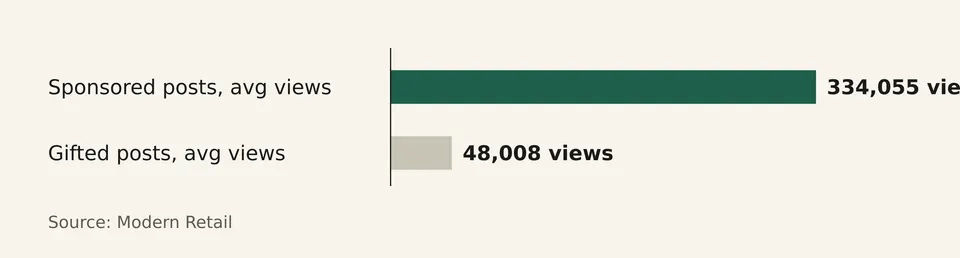
Two measurement limits matter for any comparison. TikTok views were not captured because of data restrictions1. Average engagement rate, defined as engagement divided by follower count, was measurable only on Instagram1.
Which signals can a small brand test cheaply?
Gifted demos. The Index defines a gifted post as one featuring products a brand has sent to creators, typically as part of a PR effort, without a paid content agreement1. A demo is content about a single product that shows a person using it1. Gifted posts performed best on engagement in the demo format, the one format where they beat sponsored posts1.
Reel engagement. Among Instagram formats, Reels performed best at an 11% engagement rate, ahead of still posts at 7% and carousels at 5%1. Views were not counted in those averages for Reels or still posts1, so the figure measures engagement against followers, not reach.
Testing these costs little beyond the product, the creator brief and staff time. The gifted-versus-sponsored test is the cheapest way to check whether the Index's pattern appears in your own audience.
Where sponsored content still leads
Sponsored posts are content created through a direct partnership, usually paid1. Across most content types, sponsored posts outperformed gifted posts on engagement, with demos the exception1. Style shots, which showcase a product in a styled setting without explaining its use, appeared more often in gifted posts, by 19 to 151.
The Index also suggests that production level may explain part of the gap. Gifted style shots were often simple flat lays or product images, while sponsored style shots frequently included product videos1.
Partnership ads. A partnership ad is a paid ad that runs from a creator's Instagram or Facebook handle, with the creator's permission3. The brand builds and pays for it in its own Ads Manager, the same as any other campaign3. The creator's name and face appear on the ad3. It therefore needs a funded budget, which a small brand should weigh before starting.
Setup has prerequisites. Meta's eligibility page requires professional accounts on both sides, and the brand needs a connected, funded ad account3. S3 also advises installing a Meta Pixel or Conversions API before launch, because a Pixel added later does not see earlier sales3. Creators can revoke permissions at any time3.
Meta's own figures, quoted by S3, claim a 71 percent lift in intent and brand awareness from partnership ads, based on a meta-analysis of 14 brand lift studies3. These are Meta's claims, not independent results, and S3 does not show the budgets behind them.
Platform choice: Instagram or TikTok?
The Index describes Instagram as the more consistent platform, offering a more predictable environment for longer campaigns1. It describes TikTok as having greater reach potential and a higher engagement ceiling1. TikTok posts in the top 75 generated higher average engagement than posts on other platforms, though Instagram appeared more often among the top posts overall1.
For smaller brands or those with limited budgets, the Index says TikTok is likely the better platform choice for creator marketing1. That recommendation rests on the data limits noted above.
Compliance is a cost of every test
The US Federal Trade Commission (FTC), the consumer protection regulator, says a material connection includes a financial relationship, such as a brand giving you free or discounted products2. Gifted products can therefore count as a material connection that must be disclosed2. The FTC says an endorsement should make a relationship with the brand obvious2.
The FTC brochure this section relies on was published on 24 October 20192. Platform label rules and the FTC's current guidance may have changed since, so check the FTC's business guidance pages and your platform's current paid-partnership label rules before launch.
Our analysis and a pre-holiday test plan
Our view is that the Index is most useful as a source of hypotheses, not a performance target. A small store cannot reproduce a 20-campaign snapshot, and the selection method means the top-ranked campaigns may not represent typical results.
The gifted-demo finding is the one signal a small brand can test without a large budget. The platform guidance is a reasoned hypothesis, not a result a small store should rely on yet. Partnership ads are the signal most likely to need a real budget, and a small brand should test them only with a fixed amount it can afford to lose, paired with conversion tracking.
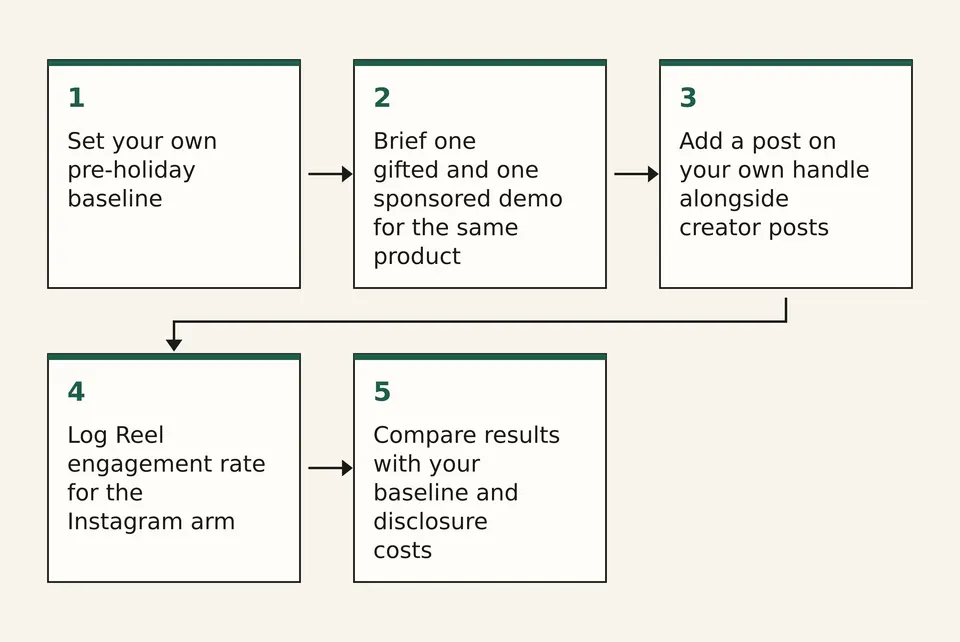
A sensible sequence before holiday spend is:
- Set your own pre-holiday baseline before testing, so results are compared with your store's history rather than the Index's top campaigns.
- Brief one gifted and one sponsored demo for the same product, using the same creator brief.
- Add a post on your own handle alongside the creator posts.
- Log Reel engagement rate for the Instagram arm, since that is the only platform where the Index measured this metric.
- Compare results with your baseline and disclosure costs.
For context on pacing paid social against peak demand, see our test for moving paid-social spend earlier. For a store that already runs creator programmes, Bodycare's creator network shows one approach to copy selectively.
What to watch next
- Whether Modern Retail publishes the campaign-level list and per-platform sample sizes. That would show whether the gifted-demo result holds across campaigns, rather than in an aggregate.
- Whether holiday-period creator campaigns show the same gifted-demo pattern. The Index covers January to September 2026 only1.
- Whether TikTok view data becomes available, which would allow a direct platform comparison.
Questions readers ask
What did the Creator Marketing Index find about gifted versus sponsored posts?
Gifted demos drew higher engagement than sponsored demos, the one format where gifted posts beat sponsored ones1. Across most other content types, sponsored posts outperformed gifted posts on engagement1.
Why should a small brand treat the index as a hypothesis rather than a benchmark?
Modern Retail says the results depend on its campaign list and collection window, so they reflect one period1. The campaigns were chosen by the editorial team, not drawn at random1.