
Platforms · Comparison
Five marketplaces compared on pre-listing safety documents and test records
Four of five marketplaces publish some pre-listing or pre-shipment safety requirement; eBay US's US Customs filing starts 8 July 2026. Temu and Etsy rules are thinly documented in the sources retrieved, and Amazon's are partly secondary.
- By
- The Cart Plot Editorial
- Published
- Sources checked
- Evidence
- 8 sources
At a glance
- eBay US sellers exporting certain regulated products to the US must electronically submit product safety information from 8 July 20264.
- Amazon's forum reply says children's toys must pass approved third-party testing verification, defined as products for children 12 years or younger in the US6.
- The CPSC's Children's Product Certificate is generally based on CPSC-accepted third-party laboratory results, and the rule applies whichever marketplace the seller uses2.
- Temu's safety requirements are documented only through trade press and a sponsored article, and its published material names test categories but not specific documents1,8.


The five marketplaces reviewed are Temu, Amazon, eBay US, eBay UK and Etsy. Amazon names specific documents for some product categories7, and eBay US sellers exporting certain regulated products to the US must, from 8 July 2026, submit product safety information electronically to US Customs4. Temu's and Etsy's requirements are less clearly documented in the sources we could retrieve. The Temu detail comes from trade press and a Temu-sponsored article1,8. Rules were checked on 28 October 2026, and sellers should confirm each current page before listing.
Which marketplaces publish pre-listing or pre-shipment safety requirements?
Four of the five publish some requirement that applies before a listing goes live or a parcel ships. Etsy's retrieved text does not give a listing-stage requirement.
- Temu. Sellers must complete onboarding and verification before listing products, including submitting required documentation8. For certain products, additional documentation, certification, labelling, safety-warning or age-related requirements may apply8. Temu's warehouse laboratories, located in fulfilment partners' warehouses, run spot checks on selected products, including electrical safety tests on appliances, performance checks on textiles and tests against toy safety requirements1. Temu describes this as a checkpoint in addition to its pre-listing checks and post-sale monitoring1.
- Amazon. An Amazon staff reply in a seller forum says all children's toys, including licensed products, must pass approved third-party testing verification6. The same reply defines children's toys as products for children 12 years of age or younger in the US6. A summary of Amazon.de's help pages says that for CE-marked products, sellers need a test report through one of Amazon's authorised testing providers and technical documentation on request7.
- eBay US. From 8 July 2026, sellers who export certain clothing, toys or other regulated products to the US must electronically submit product safety information. The requirement has existed since 2008, but the information now goes to US Customs4. eBay recommends collecting these documents now4.
- eBay UK. Products missing required CE or UKCA marking are not allowed5. For some micromobility devices, such as e-scooters and e-bikes, business sellers must upload documentation from a recognised testing lab or the manufacturer5.
- Etsy. The seller handbook states that sellers are ultimately responsible for the safety and compliance of their products3. The retrieved text ends before its requirement sections, so it does not show what Etsy asks for before listing.
Which test documents does each channel accept or name?
The named documents differ by channel. Amazon names test reports for toys and some other categories. eBay UK names CE or UKCA marks and documents from a testing lab or manufacturer. The US Consumer Product Safety Commission (CPSC) framework names the Children's Product Certificate (CPC), a statement of compliance that a manufacturer or importer issues and that is generally, though not always, based on results from a CPSC-accepted third-party laboratory2.
- Temu. The sources retrieved name test categories only: electrical, textiles and toys1. Specific test documents are not published.
- Amazon. For EU children's toys, the Amazon.de summary names a test report from an ISO 17025-accredited laboratory showing compliance with EN 71, with the result 'Pass' or 'Not applicable'7. Sellers also supply images of all sides of the product and packaging, labels, manufacturer details, instructions and the CE mark7. An Amazon-authorised testing provider submits these for the seller7. This is a secondary summary and has not been checked against the original page. The Amazon.de summary gives an age limit of under 14 for toys7, while the forum reply uses 12 years for the US6.
- eBay US. The retrieved eBay export text does not name specific documents4. The CPSC FAQ describes the CPC and the CPSC-accepted laboratory results it is generally based on2.
- eBay UK. Sellers must show CE or UKCA marks where they are required5. For new micromobility devices other than e-bikes and hoverboards, eBay requires certification to BS EN 17128:2020 and CE or UKCA marking5.
- Etsy. Not published in the retrieved text.
| Marketplace | Pre-listing / pre-shipment document demand | Test or certificate documents named | Official published rule retrieved? |
|---|---|---|---|
| Temu | Onboarding and verification before listing, with extra documentation for certain products8. Warehouse spot checks on selected products1 | Test categories only: electrical, textiles, toys1. Specific documents: Not published | No. Trade press1 and an advertorial8 only |
| Amazon | Approved third-party testing verification for children's toys6. Category document lists7 | For EU children's toys: ISO 17025-accredited test report showing EN 71 compliance7 | Partly. Forum reply6 and a summary of help pages7. Help pages not retrieved directly |
| eBay US | Electronic submission of product safety information to US Customs for certain regulated products from 8 July 20264 | Not published in the retrieved text4 | Yes, eBay Export page4 |
| eBay UK | Products missing CE or UKCA marking not allowed5. Lab or manufacturer documentation for some micromobility devices5 | CE or UKCA marks5. Certification to BS EN 17128:2020 for new micromobility devices other than e-bikes and hoverboards5 | Yes, eBay UK policy page5 |
| Etsy | Not published in the retrieved text | Not published in the retrieved text | Partly. Handbook retrieved but cut off before its requirements3 |
What does the US rule mean across channels?
The CPSC rules that drive CPC files are set by the US regulator, not by any marketplace2. A marketplace can change how and when a seller submits documents. In our reading, the underlying obligation to certify US children's products is the same on every channel.
- The CPSC defines a children's product as a consumer product designed or intended primarily for children 12 years of age or younger2.
- Small batch manufacturers who register may get relief from some third-party testing requirements, but they must still certify in a CPC that their children's products comply with the applicable rules2. The CPSC states: 'you still need to comply, and (2) you still need to prove compliance'2.
- 'Group A' requirements must always be met through third-party testing at a CPSC-accepted laboratory2.
- Submission processes may vary by carrier. If the required information is not provided, the shipment could be delayed or refused at the border4.
The retrieved CPSC FAQ text ends before its answer on retesting, so this article does not state a retesting interval.
Where do the channels differ most?
The main differences are whether documents are uploaded at listing, filed per shipment or requested later, and whether verification applies per listing or per product code (ASIN).
- Upload at listing. Amazon requires approved third-party verification for children's toys6. For some eBay UK micromobility devices, business sellers must upload documents5.
- Per shipment. eBay US requires safety information to be filed when the item ships, through the seller's carrier or eBay's managed shipping services4.
- On request. Amazon states that it 'may, in certain cases, request proof of compliance'7. For CE-marked products, Amazon's summary lists technical documentation at short notice on request7.
- Per ASIN. Once an ASIN is verified through an approved testing provider, that verification covers all sellers of that ASIN, and other sellers do not need to verify an ASIN that another seller has already verified6.
Sample matching. Temu's warehouse spot checks test selected products before shipment1. Temu's published material does not set a sample-matching rule. We recommend keeping the tested sample's reference with the stock sent to the warehouse, so a spot check can be matched to the product on the shelf.
Where does each option have an advantage?
- Temu adds a warehouse-based testing checkpoint on top of its pre-listing checks and post-sale monitoring1. Its warehouse tests cover the categories sellers most often ask about: electrical goods, textiles and toys1.
- Amazon lets one verified ASIN serve every seller of that ASIN, so later sellers do not repeat the verification6.
- eBay US publishes its export requirement on a single page with a stated start date4.
- eBay UK sets out category rules in one policy page, including which micromobility devices business and private sellers can list5.
- Etsy has no advantage that can be assessed from the retrieved text.
What should sellers keep on file?
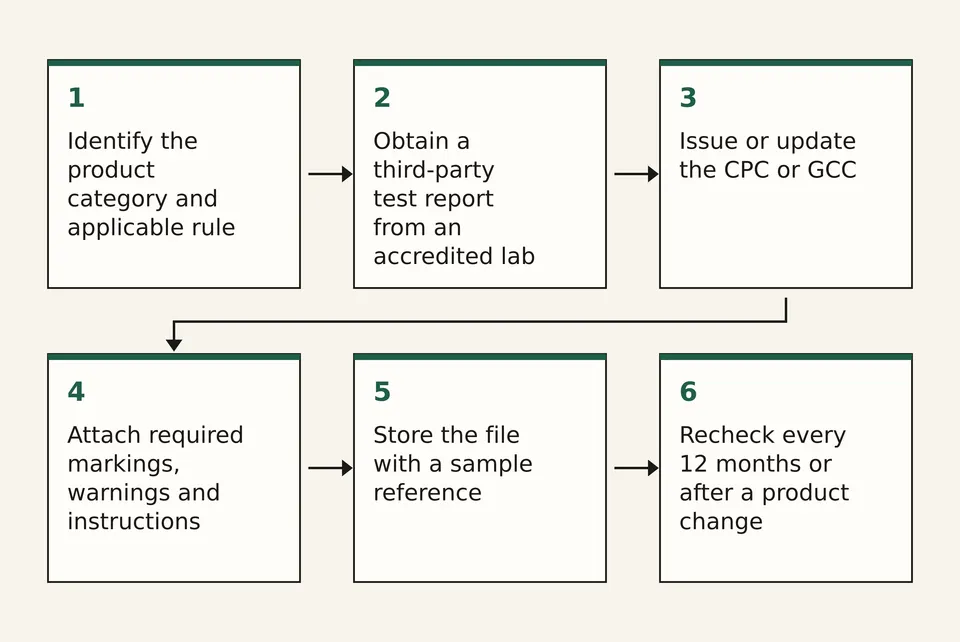
Keep one file for each product and version, with the category rule, the test report, the CPC, the markings and warnings, and a sample reference. The steps below are a practical workflow for any channel. The sources do not set them as a single standard.
- Identify the product category and applicable rule
- Obtain a third-party test report from an accredited lab
- Issue or update the CPC for US children's products
- Attach required markings, warnings and instructions
- Store the file with a sample reference
- Review the file when the product changes
Our recommendations for each step:
- Check the category in each destination market separately, because a product can fall under different rules in the US, the UK and the EU.
- For US children's products, keep the CPC with the test results it is generally based on.
- Before shipping to the US, confirm with your carrier how safety information is submitted4.
- Confirm the retesting interval on the CPSC website, because the retrieved CPSC text does not state one.
Who does each option suit?
No single marketplace is the clear fit. The right choice depends on the product category and the destination market.
- Amazon suits sellers of children's toys who can supply the test reports Amazon names for their category. If several sellers offer the same ASIN, the verification covers all of them6. For Amazon's own rules, see the Amazon brand approval records guide.
- eBay suits sellers shipping to the US who can file safety information for each eligible shipment4. For UK sellers, it suits those whose products carry CE or UKCA marks5.
- Temu suits sellers of electrical goods, textiles and toys, the categories its warehouse spot checks cover1. The article states that the warehouse labs complement independent testing and do not replace the seller's responsibility to meet applicable rules1.
- Etsy cannot be judged on safety paperwork from the retrieved text. Read the full handbook article before deciding whether it fits a children's product range3.
Questions readers ask
Which marketplace has a dated documentation requirement for US exports?
eBay US requires sellers exporting certain clothing, toys or other regulated products to the US to submit product safety information electronically from 8 July 2026, sent to US Customs4.
What test document does Amazon name for EU children's toys?
According to a summary of Amazon.de's help pages, a test report from an ISO 17025-accredited laboratory showing compliance with EN 71 is required, with the result 'Pass' or 'Not applicable'7.
Does the US rule differ by marketplace?
The CPSC rules that drive Children's Product Certificate files are set by the US regulator, not by any marketplace, although a marketplace can change how and when documents are submitted2.
What does Etsy's safety requirement cover?
The retrieved Etsy seller handbook text states that sellers are ultimately responsible for product safety and compliance3, but it ends before its requirement sections, so pre-listing documents cannot be confirmed.
Sources
- Temu Strengthens Proactive Product Checks with Bureau Veritas Primary source
- Online Sellers Safety Guide FAQs
- Product Safety Essentials: Requirements when selling children's products on Etsy
- Consumer Product Safety Commission regulations and product safety information
- Product safety policy
- CPC requirements for a products intended for adults
- Amazon Compliance Requirements & Documents 2026
- How Temu works in Europe: sellers, shoppers, rules and accountability