
Platforms · Comparison
Etsy vs eBay vs Amazon vs Temu: what each requires for AI listings
Etsy has the strictest published AI rule, requiring at least one unedited product photo in most listings, while eBay has no AI-specific clause. Temu's AI rules could not be verified because its page returned no readable text.
- By
- The Cart Plot Editorial
- Published
- Sources checked
- Evidence
- 8 sources
At a glance
- Etsy requires most listings to include at least one unedited photo of the product against a real background, according to Retail Dive1.
- eBay's picture policy has no AI-specific clause, so its accuracy rules apply to AI-edited images in the same way as any other image3.
- Amazon's published AI rule covers only photorealistic AI-generated people, which must carry a metadata tag before upload5.
- Temu's AI rules could not be verified because the partner documentation retrieved returned no readable text7.
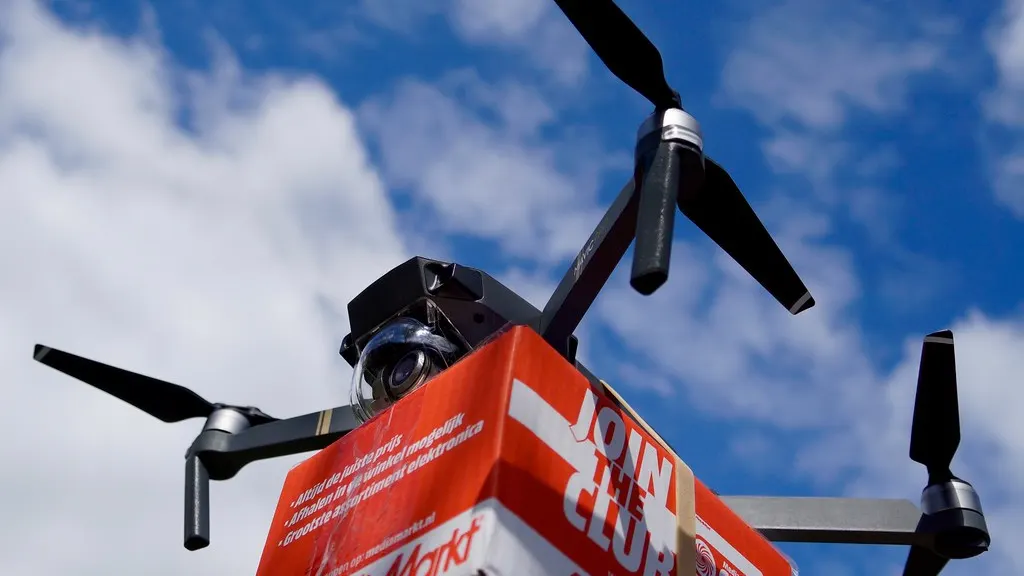
Etsy has the strictest published AI rule of the four marketplaces. Retail Dive reports that its handbook update dated 22 October 2026 requires most listings to include an unedited photo of the product against a real background1. eBay's picture policy has no AI-specific clause, so its accuracy and photo rules apply to AI-edited images as they do to any image3. Amazon's published AI rule covers only photorealistic AI-generated people, which must carry a metadata tag5. We could not verify Temu's AI rules, because the Temu page retrieved returned no readable text7.
What do the four marketplaces actually require for AI-assisted listings?
This article treats primary platform pages and official notices as rules. Secondary sources are used only where they quote a platform directly or are labelled as third-party readings. Where no rule was found, the table says “Not published” rather than inferring one.
| Criterion | Etsy | eBay | Amazon | Temu |
|---|---|---|---|---|
| Real or unedited product photo | Most listings need at least one unedited photo of the product against a real background1 | Not published as an unedited-photo rule; photos must not misrepresent the item3 | Not published in the official notice5 | Not published on pages reviewed7 |
| AI editing or AI backgrounds | Not published in retrieved text | Not published; general accuracy rule applies3 | Not published in official notice5 | Not published on pages reviewed7 |
| Disclosure for AI-made items | Not published in retrieved text; listing form flags images Etsy detects may use AI1 | Not published on picture policy3 | Tag rule covers AI-generated people only5 | Not published on pages reviewed7 |
| AI-generated people | Not published | Not published3 | Metadata tag required5 | Not published on pages reviewed7 |
| AI-generated guides or copy | Functional guides cannot be AI-generated; bot-generated listings are removed1 | Not published3 | Not published in official notice5 | Not published on pages reviewed7 |
| Stated enforcement | Possible buyer refunds and listing removal1 | Removal, warning, restriction or suspension3 | Penalty not published in official notice5 | Not published on pages reviewed7 |
Some secondary claims conflict with, or cannot be checked against, the platforms' own text. These are excluded except where flagged below.
Where does each marketplace have a genuine advantage?
Etsy's rule is the most explicit, and the company frames it as protecting buyer trust2. For a maker who can photograph real items, a clear written standard is an advantage, because the seller knows exactly what is required.
eBay's picture policy contains no AI-specific ban or disclosure requirement3. A third-party blog calls eBay “one of the more permissive big marketplaces” on AI product photography4. For sellers who use AI editing, that gives more room than the other platforms' published rules, provided the image stays accurate.
Amazon's rule is narrow. It applies only to photorealistic AI-generated people, and images without people, or with real people altered by AI, are outside it5. Where the tag applies, Amazon says it will show shoppers an indicator5.
Temu has no verified advantage or rule in the pages reviewed7, so it cannot be compared on this basis.
How strict is Etsy on listing photos?
Etsy's rule is strict, and the wording differs between sources. Retail Dive reports that Etsy “now requires at least one authentic, non-AI generated image in most seller listings”1. The body of the same article says most listings must include “at least one unedited photo of the product against a real background”1. The handbook text retrieved for this article is cut off before its detailed rules, so the exact wording could not be checked against Etsy's own page2.
A third-party blog summarising Etsy's listing image requirements says they require original photos of the actual product, “not renderings or stock photos”4. Where the wording is unclear, the safer reading is that the main listing photo should be a real, unedited photo of the item. This is our recommendation, not Etsy's wording.
Etsy has also changed how AI is flagged. Its listing form now includes guidance that flags images Etsy detects may use AI1. Functional guides such as patterns, recipes and instructions can no longer be AI-generated and must show real results made by using the guide1.
What does eBay require, given it has no AI picture rule?
eBay's picture policy requires at least one photo that is 500 pixels on the longest side3. It bars photos that do not accurately represent the item, stock photos for used, damaged or defective items, and added text, artwork or marketing material3. Watermarks of any type are also barred3.
The policy does not mention AI generation or AI disclosure3. An AI-edited image is therefore judged by the same test as any other: does it show the item the buyer will receive? A generated image that adds a detail the product does not have would fail that test. This is our reading of the policy.
A third-party blog states that eBay's User Agreement makes sellers responsible for listing content created with generative AI tools4. The User Agreement itself was not checked for this article, so treat that reading as unverified.
What does Amazon's synthetic-people rule require in practice?
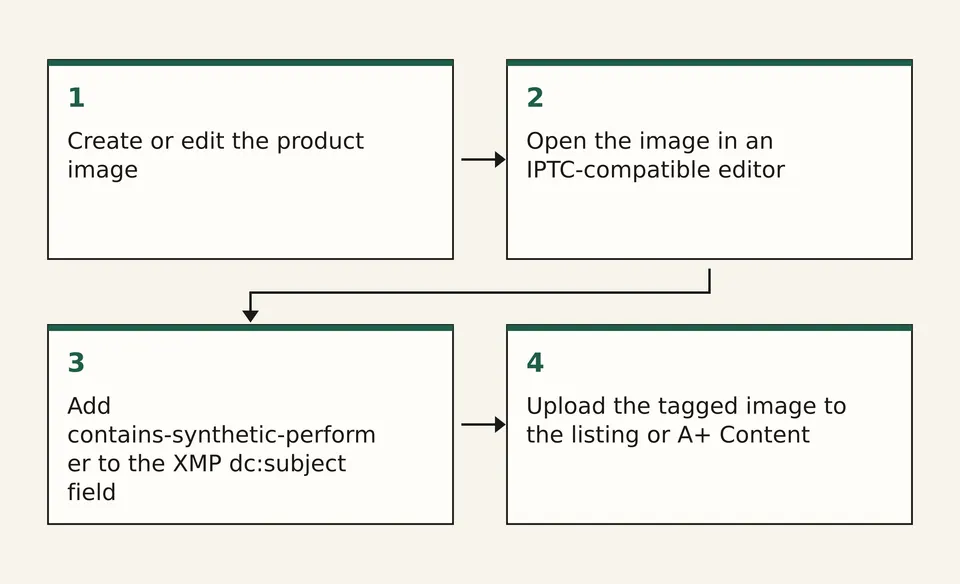
Amazon requires sellers to tag product images containing photorealistic AI-generated people before adding them to listings and A+ Content, in all of its worldwide stores5. The tag is the keyword “contains-synthetic-performer”, added to the dc:subject (XMP) field with an IPTC-compatible metadata editor before the file is uploaded5.
No tag is needed if the image or video only features real people, even if altered with AI tools; only features characters from movies, TV programmes, games or other expressive works; does not feature any people; or does not feature photorealistic people5. An AI-generated background without people therefore falls outside the rule5. Amazon says it will add an indicator for shoppers where the image includes AI-generated people, “where applicable”5.
The official notice does not cover AI-made products or AI copy5. A third-party guide from Seller Labs says Amazon's main image must show the real product on a pure white background, with AI backgrounds not allowed there, while secondary images have more flexibility6. This is a third-party reading of Amazon's image guidance, not an official notice.
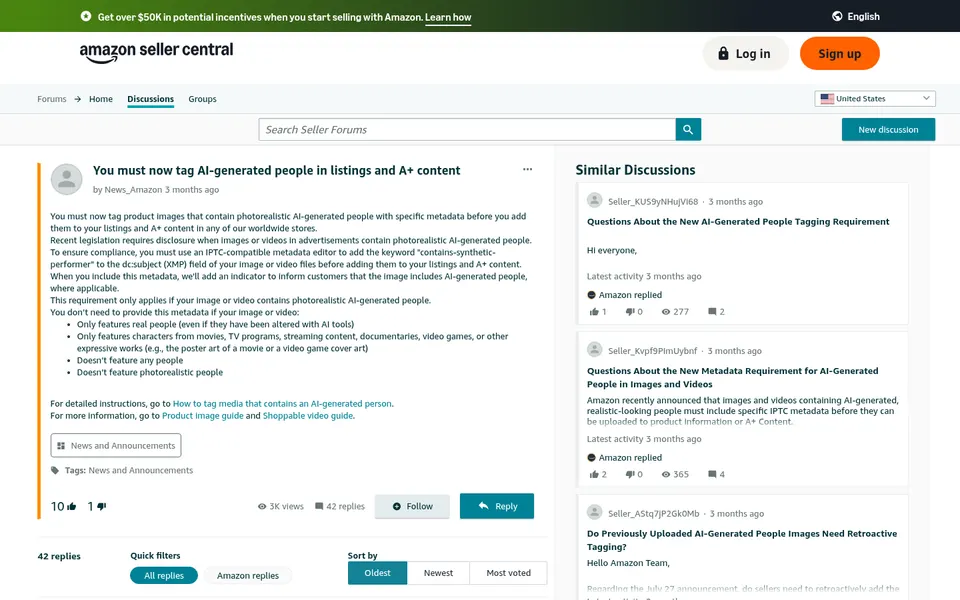
In the Seller Central thread for the announcement, sellers asked whether existing images need re-tagging and how partly visible people are treated. The retrieved thread shows only an acknowledgement that the questions had been received5.
What could not be verified for Temu?
The Temu partner documentation retrieved for this article returned no readable text7. No AI-specific Temu rule was therefore verified on Temu's own pages.
A vendor blog states that Temu Europe will require visible traceability labels on AI-generated model images8. This claim was not confirmed on any Temu policy page reviewed. The same post promotes its own image software8, so it should be treated as unverified. Sellers should check the Temu Seller Center before listing AI imagery.
How do the enforcement consequences compare?
Retail Dive reports that Etsy buyers who open cases because a product is materially different from the listing may receive a refund from the seller if the listing did not meet Etsy's updated image requirements. Bot-generated listings are removed1. eBay may remove a listing or other content, issue a warning, restrict activity or suspend the account3. Amazon's official notice does not publish a penalty5. Temu's enforcement is not published on the pages reviewed7.
Which approach suits which seller? Our analysis
The published rules do not make one marketplace unambiguously best for AI-assisted listings. The answer depends on which AI use a seller relies on. The points below are our view, not a source's.
- Etsy suits makers and designers who can photograph real, unedited items and who accept the handbook's rules on AI use. Etsy's published rule requires at least one unedited photo in most listings1. The retrieved text does not set limits on other images, so the main listing photo should be a real photo.
- eBay suits sellers who use AI editing or AI backgrounds, provided every image matches the item exactly3. Used-goods sellers should note the stock-photo ban3.
- Amazon suits sellers who use AI for layout and graphics in secondary images and keep the main image as the actual product6. Sellers who use AI people must apply the tag correctly5.
- Temu cannot be assessed from its own published AI rules in this research. Check its Seller Center before listing AI imagery.
Before listing, confirm that each image shows the item the buyer will receive, keep a record of which images were AI-edited, and apply the Amazon tag wherever AI-generated people appear.
For related reading on how shoppers respond to AI-influenced product information, see AI shopping research: which checks shoppers make after an AI suggestion.
Questions readers ask
Which marketplace has the strictest published AI rule for listing photos?
Etsy has the strictest published rule, which Retail Dive reports requires at least one authentic, non-AI generated image in most seller listings1.
Does eBay ban AI-edited product photos?
eBay's picture policy contains no AI-specific ban or disclosure requirement3. An AI-edited image is judged by the general rule that it must accurately represent the item3.
What does Amazon require for AI-generated people in listing images?
Sellers must add the keyword contains-synthetic-performer to the dc:subject (XMP) field with an IPTC-compatible metadata editor before uploading the file5.
Can Temu's AI rules be confirmed from its own pages?
Not from the pages retrieved, because the Temu partner documentation returned no readable text7. Sellers should check the Temu Seller Center before listing AI imagery.
Sources
- Etsy updates AI use policies to emphasize craftsmanship Primary source
- Important updates to AI use on Etsy
- Picture policy
- eBay AI Product Photo Rules for Sellers (2026) - Masonry
- You must now tag AI-generated people in listings and A+ content
- Generating Product Images and Lifestyle Shots With AI (What's Allowed) - Seller Labs
- Product Basic Introduction
- Temu Europe 2026 AI model image traceability label new rule