
Customer Behaviour · Analysis
AI shopping research: which checks shoppers make after an AI suggestion
Surveys suggest AI assistants start product research while reviews and return policies still decide purchases. The sources do not measure conversion effects of reviews or policy changes, and the audit order is our judgement.
- By
- The Cart Plot Editorial
- Published
- Sources checked
- Evidence
- 7 sources
At a glance
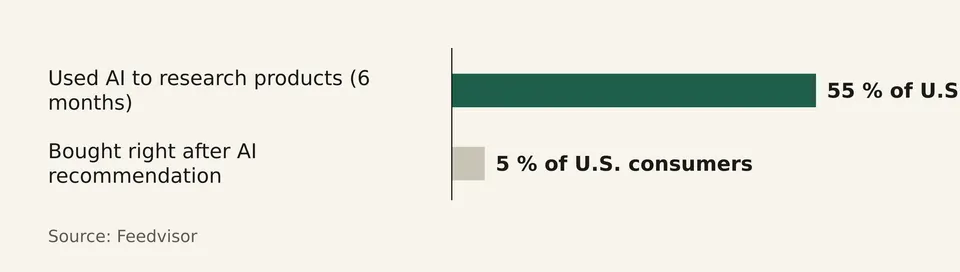
- Feedvisor's survey of 1,006 U.S. consumers found 55% had used AI to research or compare products in the past six months, and only 5% buy immediately after an AI recommendation2.
- After an AI suggestion, the most-named next step is checking existing reviews, at 33% of shoppers1.
- 33% of shoppers say shipping and return policies often or always change what they buy1.
- Google requires at least 50 reviews across products before ratings show on Google Shopping or Google Ads5.
- Google requires return policies to be consistent in Merchant Center and across the website, and accessible without login6.

Surveys reported in October 2026 suggest that AI assistants mainly start product research, and that reviews and retailer policies still decide many purchases. Feedvisor's survey of 1,006 U.S. consumers, fielded in August 2026, found that 55% had used AI to research or compare products in the past six months, and only 5% buy immediately when an AI recommends a product2. For a small store, the review feed and return policy are the first fields to audit. That ordering is our judgement, not a finding of these surveys.
Do AI assistants replace the product page, or just start the journey?
AI assistants appear to start the journey rather than finish it. Modern Retail, reporting on 22 October 2026, said that after an AI recommendation, shoppers still check reviews, compare prices, visit retailer and brand sites, and look at shipping and return policies before deciding1. The Feedvisor survey found that ChatGPT is where 16% of shoppers start looking for products, but only 9% go there to buy1.
Which checks do shoppers name?
After an AI suggestion, PartnerCentric's survey found the following next steps, as reported by Modern Retail1:
| Next step after an AI suggestion | Share of shoppers |
|---|---|
| Check existing reviews | 33%1 |
| Compare prices | 22.3%1 |
| Search Amazon or another retailer | 18.8%1 |
| Visit the brand's website | 14.8%1 |
| Look for creator content about the product | 7.6%1 |
Shipping and return policies are also named. Modern Retail reports that 33% of shoppers say these policies often or always change what they buy1. PartnerCentric's founder and CEO, Stephanie Harris, said: "And that question usually gets answered in the reviews, on the retailer page, or in the shipping and return terms."1
On reviews, PartnerCentric's white paper says that 44% of surveyed shoppers want reviews before acting on an AI recommendation3. Modern Retail reports a narrower base: 42.2% of shoppers in the top two AI-trust categories still want reviews before acting1. Feedvisor says that trusted brands and product reviews close much of the gap left after price, which one third of shoppers name as the single factor that decides where they buy2.
Where the evidence stops
- The Feedvisor figures come from one survey of 1,006 U.S. consumers2. Modern Retail attributes its ChatGPT figures of 16% and 9% to that same survey1.
- The PartnerCentric material does not describe its sample design in the sources we reviewed, so its percentages describe what surveyed shoppers said, not what the wider market does.
- None of the sources measures conversion lift from a review count or a policy change. None shows how reviews affect AI recommendations specifically, or reports results for small stores.
Which review feed rules come first?
Google's Product Ratings programme allows eligible merchants to show aggregate star ratings on Shopping ads, once their reviews are shared with Google5. The Google rules below were retrieved on 22 October 2026. Check Google's Merchant Center Help pages before you change a feed, because the rules may change4,5.
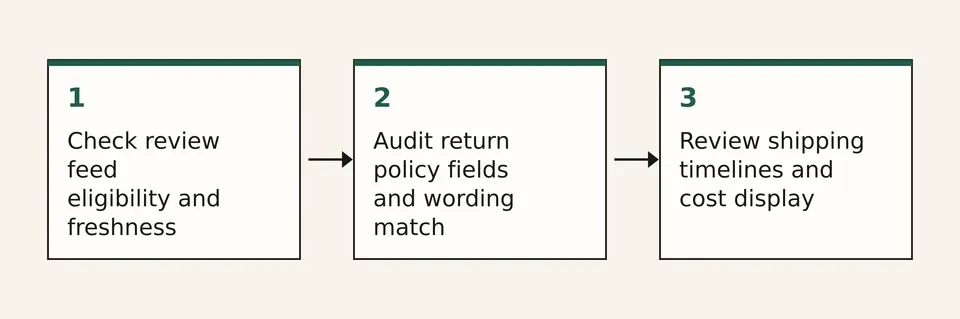
The audit order is:
- Check review feed eligibility and freshness
- Audit return policy fields and wording match
- Review shipping timelines and cost display
For the first step, Google's rules are:
- Minimum reviews: "You must have a minimum of 50 reviews across all of your products. If you have less than 50 reviews, your product ratings will not show on Google Shopping or Google Ads."5
- Monthly upload: The review data source must be uploaded at least once a month and must contain updated reviews to stay eligible5. A feed that is not refreshed monthly is deemed stale and loses eligibility4.
- Complete sharing: Retailers must share all their reviews, including low-star reviews, and may not delete old reviews from the feed4.
- Matching identifiers: Product identifiers must be consistent between the product feed and the reviews feed4. GTINs are the most important identifier. Without them, Google may not match all reviews to products5.
- Domain match: The domains in the review data source's product URLs must match the registered domain in the Merchant Center account5.
- Timing: Reviews typically go live two to four weeks after a successful review5.
Which return policy fields need to match?
Google states that "Return policy is a key factor for people who are making a purchasing decision", and that showing policies on ads, listings and Gmail "may help the performance of your products"6.
Google's requirements for the policy itself include:
- Access: The policy must be accessible to all users "without having to log in, sign up, or enter any personal information"6.
- Consistency: Policies must be consistent in Merchant Center and across the website, "for example, in the footer, returns page, and web banner"6.
- Fields stated on the website: The site must state the time frame for returns, the return method and return fees6.
- Scope: The policy must apply "not just to defective products, but also to more general cases, such as buyer's remorse"6.
- Exceptions: Items that cannot be returned need an exception policy, applied through a label in the product data. Personal care items, safety equipment and customised production are given as common examples6.
- Verified uploads: A verified policy uploaded to Merchant Center takes precedence over what Google has collected from the website6.
Google's structured data for return policies can display return policies alongside products. It can specify conditions for return, return methods, return fees and refund options7.
Shipping timelines and cost display come third
The sources say less about shipping than about reviews or returns. Modern Retail reports that AI assistants read the same information shoppers use to check a product, including "reviews, product pages, retailer listings, creator content, pricing, shipping and returns"1. The sources do not separate the effect of shipping from the effect of return terms, so we place shipping third in the audit order on judgement, not on evidence.
What this means for a small store
Our analysis, not a sourced finding. If most AI-influenced shoppers check before buying, the product page and its trust signals still do the closing work. AI raises the value of being recommended, but reviews and policies decide whether the recommendation holds. On the reader's question, the sources show that shoppers still check reviews and return terms after an AI suggestion. They do not show that these checks matter more than before.
Three illustrative scenarios follow. The numbers are invented for explanation and are not drawn from any store.
- Scenario A: A store has 32 reviews across its catalogue. Under Google's rule, its ratings will not show on Shopping ads until it reaches 50 reviews5. A shopper who arrives from an AI assistant finds no rating signal on that listing.
- Scenario B: A store stops updating its review feed and deletes old reviews. Google treats the feed as stale and it loses eligibility4. Its review data then looks thinner than the reviews the store actually holds.
- Scenario C: A store states its return window, method and fees in the same words on its site and in Merchant Center. Shoppers name return terms as a check1, and Google sets the consistency requirement for how the policy is stated6. The sources do not measure how much sales change.
We recommend working through the three audit steps in order. Start with the review feed, because eligibility problems stop ratings from showing at all. Then match the return policy wording across the site and Merchant Center. Put new AI-facing content last. None of the cited surveys shows that such content addresses what shoppers verify.
What to watch next
- Whether Feedvisor publishes its full methodology or conversion data, which would allow a direct test of its 5% and 55% figures2.
- Whether PartnerCentric publishes its sample design or projectable figures3.
- Whether Google changes the Product Ratings minimums, feed rules or return-policy requirements4,5,6.
- Whether any study measures how reviews affect AI recommendations, rather than shopper behaviour after a recommendation.
Questions readers ask
Do AI assistants replace the product page?
The sources suggest AI assistants mainly start the journey rather than finish it. Shoppers still check reviews, compare prices, and read shipping and return policies before deciding1.
Which checks do shoppers name after an AI suggestion?
Checking existing reviews is most common at 33%, followed by comparing prices at 22.3%1. Shipping and return policies also change what a third of shoppers buy1.
How many reviews does a store need for Google ratings to show?
Google's Product Ratings programme requires a minimum of 50 reviews across all products, otherwise ratings will not show on Google Shopping or Google Ads5.
Sources
- AI boosts discovery but reviews still seal the deal, new research shows Primary source
- 2026 Consumer Buying Behavior Report (The 2026 E-commerce Consumer Behavior Report)
- Shoppers Who Trust AI Are 6x More Likely to Trust Creators, New PartnerCentric Research Finds
- Product Ratings policies - Google Merchant Center Help
- Product Ratings eligibility - Google Merchant Center Help
- Set up your return policies for Shopping ads and free listings - Google Merchant Center Help
- Merchant Return Policy Structured Data (MerchantReturnPolicy)