
Platforms · Analysis
DoorDash to buy Instacart at $65 a share: what merchants can track now
DoorDash agreed on 29 October 2026 to acquire Instacart for about $17 billion, closing late 2027 or H1 2028 [S2]. The sources publish no seller-facing fee, commission or data-sharing terms, so merchant impact cannot yet be measured.
- By
- The Cart Plot Editorial
- Published
- Sources checked
- Evidence
- 4 sources
At a glance
- DoorDash agreed on 29 October 2026 to acquire Instacart at $65.00 a share, an equity value of about $17 billion2.
- The deal is expected to close in late 2027 or the first half of 2028 and still needs Instacart shareholder and regulatory approval2.
- The sources reviewed publish no seller-facing fee, commission or data-sharing terms for the combined business2.
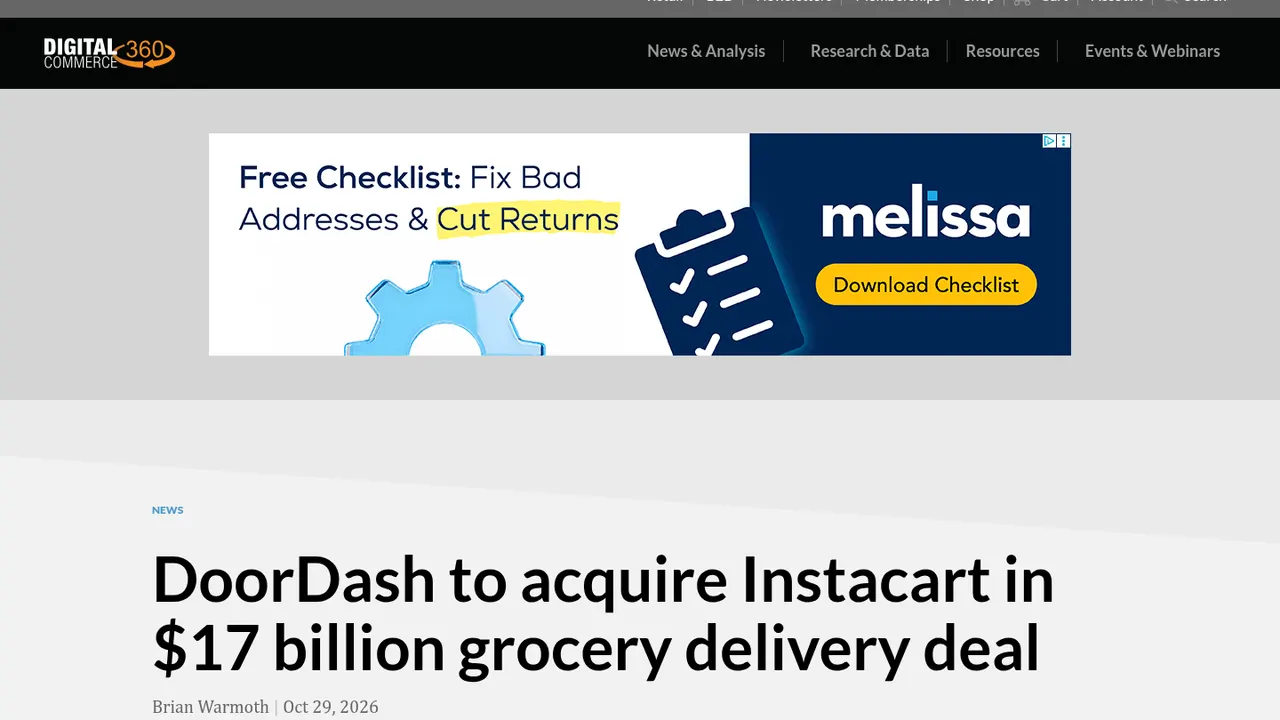
DoorDash agreed on 29 October 2026 to acquire Instacart, the US grocery delivery platform, at $65.00 a share, an equity value of about $17 billion2. The deal is expected to close in late 2027 or the first half of 2028, and it still needs Instacart shareholder and regulatory approval2. The sources reviewed for this article publish no seller-facing fee, commission or data-sharing terms, so a store cannot yet know how its costs or customer records would change.
What has been announced, and what has not?
DoorDash has signed a definitive agreement to buy Instacart. The published details cover price, financing and timing. They do not cover what merchants will pay or what data they will receive.
Instacart shareholders can elect to receive $65.00 in cash, 0.3372 DoorDash shares, or a mix of $48.75 in cash and 0.0843 DoorDash shares, with DoorDash stock capped at 25% of the total consideration2. DoorDash says the cash portion will come from cash on hand and debt, backed by a 364-day bridge loan commitment from JPMorgan Chase Bank, N.A.2.
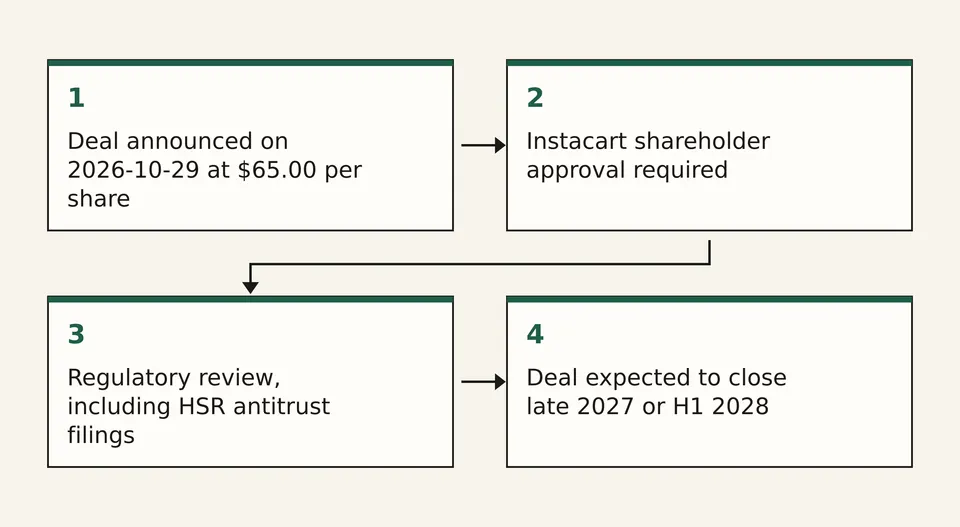
The approval path, as the release describes it, runs through these steps:
- Deal announced on 29 October 2026 at $65.00 per share2
- Instacart shareholder approval required2
- Regulatory review, including HSR antitrust filings, and approvals in Canada and Israel2
- Deal expected to close late 2027 or H1 20282
Stockholders holding about 19% of Instacart's shares have agreed to vote in favour2. Until closing, the two companies "will continue to operate as separate and independent companies"2.
Could your delivery margin change, and where would it show up?
Delivery cost is not one number, so a merger could affect a store's margin through several separate lines. The sources do not say which line, if any, will change.
The release says grocers "could add capacity for online orders through DoorDash's DashMart Fulfillment Services"2. DoorDash also reports that in Q3 2026, its US grocery and retail Marketplace GOV grew at more than double the pace of its US restaurant category3.
Two parts of the release bear on merchants. First, customers "pick a store in their own community, and the store makes the sale" on either app2. Second, DoorDash lists this commitment: "Local grocers can work with any delivery platform they choose to help them grow"2.
What this means (our analysis): A store running direct-to-consumer orders through either app should map its per-order cost by channel now. That means fees, promotions and advertising spend attributed to app orders. Without that baseline, a later change in fees will be hard to measure. Stores that depend on app placement for discovery face a different exposure from stores that use the app for overflow or convenience orders. A bundled membership, which DoorDash estimates would save members about $100 million a year in membership fees2, affects shoppers' costs. A store should check how that changes its own order volume rather than assume it.
Could customer-data exposure change?
Customer-data exposure is the least-disclosed variable. None of the sources reviewed describes how merchant customer records, order-level data or ad-measurement signals would be handled after closing.
The advertising business is large on both sides. DoorDash disclosed that it surpassed $1 billion in ad revenue in 2024, and Instacart announced it earned more than $300 million in ad revenue in Q3 20264. The release says the combined company would offer "the advertising and AI tools each company has built"2, and that more grocers could use Instacart's technology "to run their own websites and retail media networks"2.
What this means (our analysis): A combined advertising and AI stack could change which customer signals a store's records feed into, including audience matching and measurement. No source describes a data-sharing change, so treat this as a risk to monitor, not a finding. Before expanding ad spend, read the measurement logic first, as explained in our piece on retail media ROAS versus incrementality.
Ask both platforms in writing which customer fields, order-level data and ad-measurement signals a merchant receives, and whether any of it is shared across the combined business. Record the answers with dates.
Which store types carry the most reprice risk?
The table below is our analysis, not a sourced ranking. It is a starting point for a store's own numbers.
| Store type | Likely reprice exposure (our analysis) | What to track first |
|---|---|---|
| Grocers and high-frequency local stores with heavy Instacart exposure | Highest: revenue depends on placement and frequent orders | Per-order cost by channel, placement-linked ad spend, and any change to commission or fee language |
| DTC brands with small app-order shares | Lower: fee and data terms matter most | Fees and promotions on app orders, and what customer data the store receives |
| Stores already using a Shopify-linked delivery setup | Depends on that integration's terms | The integration's own terms. DoorDash's Shopify on-demand delivery integration was headlined on 28 July 20261, but its terms were not read for this brief |
What are the three plausible scenarios?
These are our scenarios, not forecasts. They are built from the published facts.
- Status quo. Instacart operates independently until closing2. Margin risk stays limited to normal pricing changes.
- Bundling. DashPass and Instacart+ members would pay one membership fee instead of two, saving an estimated $100 million a year2. A combined ads and placement offer is plausible but unconfirmed. This is the case most likely to change merchant economics, because it would touch fees and placement at once. Our Amazon Prime vs Walmart+ bundle comparison shows how one rival structures its membership-linked terms.
- Remedy. Antitrust review could delay the deal or reshape it. Timing would shift, and any merchant-facing change could be narrowed or postponed.
Whichever case unfolds, a store that has already mapped its channel costs and data flows can respond quickly, rather than negotiating a new contract under pressure.
What should you track before any terms change?
Check each item at least monthly, and archive the platform pages you rely on.
- Approvals and filings. The Instacart stockholder vote, the Hart-Scott-Rodino waiting period, and the Canadian and Israeli approvals named in the release2.
- Merchant terms. Commission, fee, advertising and data-sharing wording in each platform's merchant agreements and seller policy pages. Save a dated copy of each version.
- Advertising figures. DoorDash's ad revenue (over $1 billion in 2024) and Instacart's (over $300 million in Q3 2026) were disclosed on different terms: DoorDash does not regularly break out ad revenue, while Instacart does4. Treat them as separate data points, not a like-for-like trend.
- Your own numbers. Per-order cost by channel, updated monthly, so any change can be measured against a baseline.
Last checked: 1 November 2026. Official deal details are in DoorDash's SEC filings, including the 29 October 2026 release2.
Questions readers ask
What has DoorDash agreed to do with Instacart?
DoorDash agreed on 29 October 2026 to acquire Instacart at $65.00 a share, an equity value of about $17 billion2. The deal still needs Instacart shareholder and regulatory approval2.
When is the deal expected to close?
The deal is expected to close in late 2027 or the first half of 20282. Stockholders holding about 19% of Instacart's shares have agreed to vote in favour2.
Will merchant fees or customer data change after closing?
The sources reviewed do not describe merchant fee, commission or data-sharing terms after closing2. Stores should ask both platforms in writing which customer fields and order-level data they receive.
What should a store do before any terms change?
Map per-order cost by channel now, including fees, promotions and advertising spend attributed to app orders. Save dated copies of merchant agreements and seller policy pages so changes can be measured.