
Customer Behaviour · Analysis
Delivery lockers at checkout: what the InPost and Superdry evidence shows
Nearly half of 18–30-year-olds are away during weekday delivery hours, but the figure comes from a carrier that sells lockers and from a checkout test with unequal delivery terms. The sources do not show how much a locker option would cut failed deliveries for a given store.
- By
- The Cart Plot Editorial
- Published
- Sources checked
- Evidence
- 5 sources
At a glance
- A carrier-commissioned survey found 49% of 18–30-year-olds are away during 9am–5pm delivery hours at least four days a week, with work the most common reason1,5.
- The 49% Superdry checkout figure was reached when InPost was the sole free delivery option, so it does not show what share lockers would take under equal terms1.
- Superdry reported a refund and claims rate of 0.5% for InPost deliveries against 2.1% for home delivery, but no reviewed source publishes locker abandonment or return rates4.
The research behind this question comes from InPost UK, a parcel locker operator, so its findings should be read as the view of a carrier that sells locker delivery. Its survey of 2,074 Britons, conducted by Yonder Data Services in January 2026, found that 49% of 18–30-year-olds are away from home during 9am–5pm delivery hours at least four days a week1,5. The sources support offering buyers a delivery choice at checkout, but they do not show how much a choice would cut failed deliveries for a store like yours.
The lead: nearly half of surveyed young adults are out during the working day
Trade press ChannelX reported that 49% of 18–30-year-olds surveyed are away from home during 9am–5pm delivery hours at least four days a week, and that work is the most common reason (44%)1. In the same group, 41% missed a parcel delivery in the past year and 43% waited at home instead of going out because of a parcel1.

The research was commissioned by InPost and conducted by Yonder Data Services in January 2026 among 2,074 Britons2,5. That 2,074 figure covers all Britons surveyed. The 18–30 findings are a subgroup, and the coverage reviewed does not state the subgroup’s size or how it was selected1,5.
What the research shows: the case for an out-of-home option
Across the same 18–30 group, 61% say 24/7 access would improve their delivery and returns experience, and 54% want collection and returns options close to home1.
InPost states that roughly one-third of parcels fail on the first delivery attempt, and that consumers spend an average of 3.2 hours waiting at home and 2.3 hours sorting out missed deliveries2. It also reports that 58% of those surveyed agree parcel lockers are a better option than home or workplace delivery2.
The most detailed operating evidence is from the fashion brand Superdry. After it introduced InPost Locker delivery, customers chose lockers when offered a choice between home delivery and locker collection at checkout, and InPost reached around 20% of Superdry’s UK deliveries4. Superdry reports up to 19% lower UK B2C carriage costs since switching to InPost4. Its customers using InPost were approximately four times less likely to contact customer care, and its refund and claims rate for lost or damaged parcels was 0.5% for InPost deliveries against 2.1% for home delivery4.
Superdry also said that comparatively small changes to how delivery options were presented, and to pricing, had a significant impact on customer behaviour4.
What the research leaves out
The 49% checkout share was reached when InPost became Superdry’s sole free delivery option1. The ChannelX author notes that Superdry now offers three free options: InPost Lockers or Shops, free home delivery (or next-day home delivery for £3.99), or free collection in store1. The 49% figure was therefore not measured under equal terms, and it does not show what share lockers would take if home delivery stayed free at checkout1.
InPost claims that when consumers get delivery options with greater control and fewer failure points, complaints and contact volumes fall sharply. Its page does not publish the data behind that claim2.
InPost also reports that 92% would feel stressed if a crucial parcel did not arrive on time, and the most worrying items were important documents (82%), gifts for special occasions (76%) and technology (72%)3. These are attitude measures, not records of purchase or collection behaviour.
None of the reviewed sources reports locker collection-window abandonment or return rates. Those are the costs that matter most to a seller deciding whether lockers reduce the total cost of delivery.
Our analysis: where lockers and collection fit, and how to test them
Our view is that the research does not justify a single answer for every store. The strongest case for lockers or collection is for high-value or time-sensitive goods, and for buyers who are away for several days, because a failed drop costs most in those cases. For low-value, non-urgent goods sent to households that are usually home, the evidence gives little reason to change your delivery setup. Adding lockers there adds a collection step and cost without a clear gain.
Your own order data should set the split. If most failed deliveries come from one product type or one postcode cluster, start there.
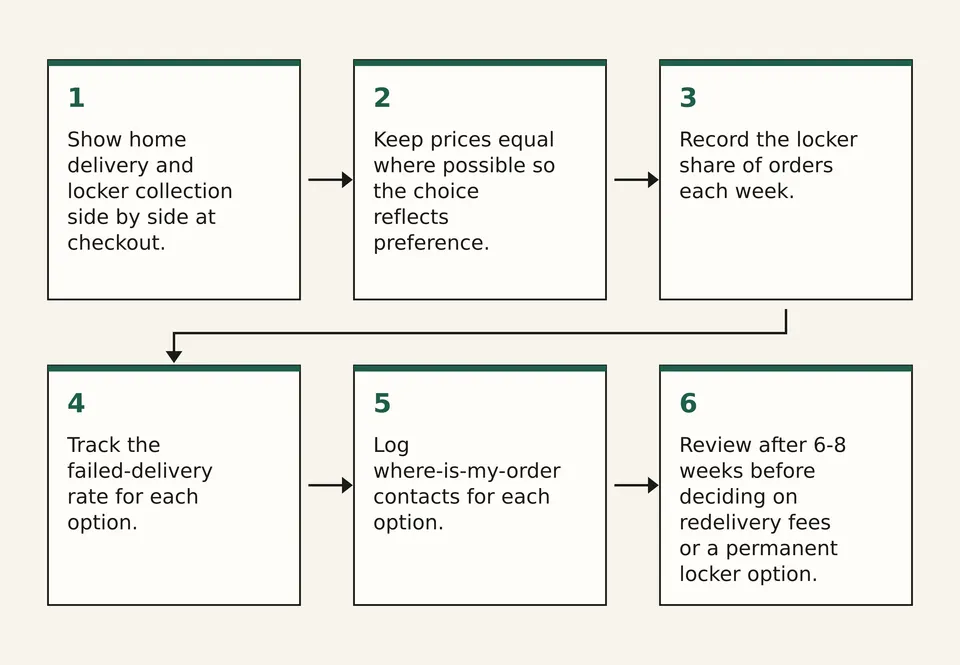
We suggest a simple test that needs no new carrier contract beyond the checkout option you choose to offer:
- Show home delivery and locker collection side by side at checkout.
- Keep prices equal where possible so the choice reflects preference.
- Record the locker share of orders each week.
- Track the failed-delivery rate for each option.
- Log where-is-my-order contacts for each option.
- Review after 6-8 weeks before deciding on redelivery fees or a permanent locker option.
A sensible decision rule is to add redelivery fees or make lockers permanent only if the test shows a clear fall in failed deliveries that outweighs the extra collection steps and cost.
What to watch next
- A published sample size and methodology for the 18–30 subgroup.
- Whether InPost publishes outcome data beyond Superdry, including the complaint and contact-volume reductions it currently claims.
- Whether Superdry’s locker share holds once its three free delivery options are compared on equal terms.
Questions readers ask
Is the 49% figure from an independent source?
No. The research was commissioned by InPost, a parcel locker operator, and conducted by Yonder Data Services among 2,074 Britons2,5. The 18–30 subgroup's size and selection method are not stated in the coverage reviewed1,5.
Did Superdry's customers choose lockers when given a fair choice?
The reported checkout share was reached when InPost was Superdry's sole free delivery option, and Superdry now offers three free options, so the 49% figure was not measured under equal terms1.