
Store Breakdowns · Analysis
David's Bridal to split off Pearl: what store owners can learn
David's Bridal has signed a non-binding letter of intent to separate Pearl, its AI wedding-planning platform, at a proposed $350 million enterprise value. The figure rests on a proposal and unaudited forecasts, with no audited Pearl financials in the sources reviewed.
- By
- The Cart Plot Editorial
- Published
- Sources checked
- Evidence
- 6 sources
At a glance
- David's Bridal has signed a non-binding letter of intent to separate Pearl, its AI wedding-planning platform, at a pro forma enterprise value of $350 million2.
- Under the announced plan, Pearl would acquire David's Bridal's intellectual property and license it back, with closing expected in the first half of 20271.
- The 2026 EBITDA margin above 30% and the 2027 revenue forecast are unaudited management projections, not verified results2,3.
- David's Bridal's storefront went live inside ChatGPT and Microsoft Copilot on 13 April 2026, and the company remains merchant of record6.

David's Bridal to split off Pearl: what a store owner should take from the structure
David's Bridal has signed a non-binding letter of intent to separate Pearl, its AI wedding-planning platform, into a stand-alone public company with a pro forma enterprise value of $350 million, announced on 22 October 20262. The proposed vehicle is a merger with K&F Growth Acquisition Corp. II, a special purpose acquisition company (SPAC, a shell company that raises money to buy or merge with a private business), and the deal is expected to close in the first half of 20271. A service tool can be separated and valued on paper, but this figure rests on a proposal and unaudited forecasts2, so a mid-size store should study the structure before copying it.
What has actually been announced
David's Bridal plans to spin off Pearl into a stand-alone, publicly traded company, targeting a valuation of roughly $350 million1. The company told CNBC this, and CEO Kelly Cook described the plan in an interview3. Pearl would combine with K&F Growth Acquisition Corp. II1,2.
The document signed is a letter of intent, and it is non-binding2.
Under the structure, Pearl would own David's Bridal's intellectual property and brand1,2. After Pearl acquires the IP, it would license it back to David's Bridal, a company spokesperson confirmed1. Cook is expected to become chief executive of Pearl2.
The deal anticipates $75 million in private investment in public equity (PIPE), including a proposed $25 million anchor investment from CION Investment Corporation, David's Bridal's largest shareholder2.
What is forecast, claimed or still unverified
The table separates company statements from verified results. No audited Pearl financial statements appear in the sources reviewed for this article.
| Claim | Status | Source |
|---|---|---|
| Pearl valued at a pro forma enterprise value of $350 million | Proposal under a non-binding letter of intent | 2 |
| Closing expected in the first half of 2027 | Expectation, not a binding date | 1,3 |
| 2026 EBITDA margin above 30% | Unaudited management forecast | 2,3 |
| 2027 revenue growth above 100%, to more than $85 million | Unaudited management forecast | 2 |
| Debt-free after the deal and positive free cash flow over the next two years | Company projection | 1,3 |
| About 90% of U.S. brides engage with Pearl's ecosystem | Pearl's own estimate | 2 |
| Pearl is “fast-growing, high-margin” and “generating positive cash flow right now” | Cook's description, not audited | 3 |
| David's Bridal stores will operate as usual | Company statement | 1,2 |
Pearl's revenue model has four streams: advertising and media, vendor listings and subscriptions, commerce and marketplaces, and licensing and brand partnerships2. Pearl Planner, the wedding-planning platform, is one component of an ecosystem that also includes Pearl Connect, a vendor software platform, and a digital content network2.
How the tool was built before the split
Pearl Planner's agentic wedding-planner features, which generate and update a planning timeline, were in closed beta in June 20255. Agentic here means the software acts on a user's behalf rather than only answering questions. The same month, David's Bridal announced a move to Shopify's platform, with real-time inventory visibility and online-to-offline cart integration among six enhancements4.
Digital Commerce 360 described plans for an agentic commerce-enabled version of Pearl Planner in the same article as the Shopify announcement4. The separation release does not mention Shopify, so the link between the two should be treated as trade-press context rather than a stated fact of the deal.
On 13 April 2026, David's Bridal's storefront went live inside ChatGPT and Microsoft Copilot, running on Shopify's agentic storefronts. David's Bridal remains the merchant of record, handling orders and collecting first-party customer data6.
Our analysis: separation is a licensing and valuation question
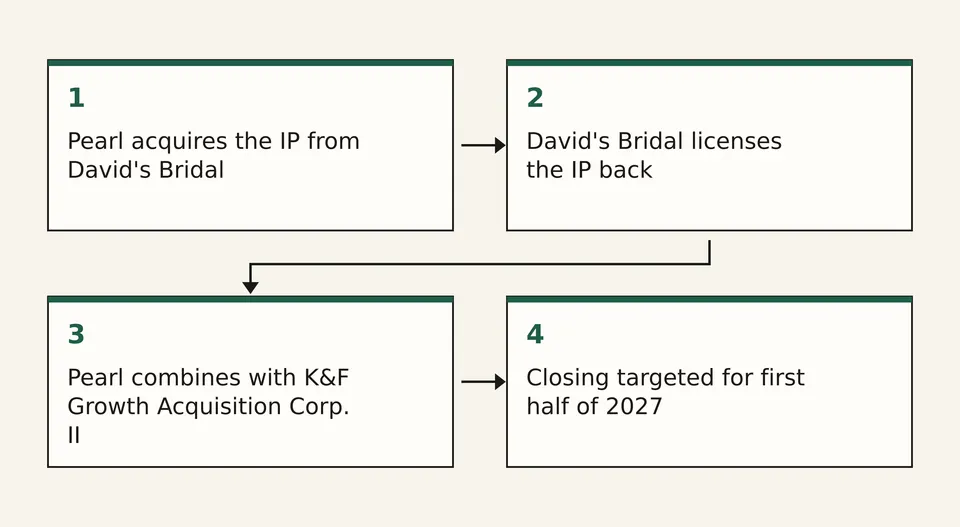
Our view is that the structure matters more than the headline. If Pearl owns the intellectual property and licenses it back to the store, the value Pearl holds depends on the licence terms, which the sources do not publish. Those terms will decide how much value sits in Pearl rather than in the store. This is our interpretation, not a sourced finding. The sequence below shows the steps in the announced plan.
- Pearl acquires the IP from David's Bridal1
- David's Bridal licenses the IP back1
- Pearl combines with K&F Growth Acquisition Corp. II2
- Closing targeted for the first half of 20271
Pearl's revenue streams include vendor listings, advertising and marketplaces2. Our interpretation is that a tool serving many brands is easier to argue is independent than one embedded in a single store's checkout. A retailer's own customers are only part of the value case.
The 90% figure is Pearl's own estimate of brides who engage with its ecosystem2, not an independent measure, so check its method once Pearl publishes more detail.
Illustrative scenarios, not predictions:
- Deal closes on the current timetable. Audited margins could then be compared with the forecast.
- Letter of intent lapses or changes. The tool stays inside the retailer, and its value remains tied to store results.
- Closing with a smaller anchor investment or different terms. The $350 million figure would be a starting point rather than a settled value1.
What a mid-size store should check before copying the approach
These checks are our recommendations, not requirements from any source.
- Is there usage beyond your own store? Without it, there is little independent revenue to value.
- Can the tool be licensed back on clear terms? Settle who owns the customer data it generates before building anything.
- Can you measure its contribution separately? Track conversion, average order value and returns for customers who use the tool, apart from overall store results.
- Does someone own it as a product? A named operator should be accountable for its roadmap, not only for a feature in the store.
- Would it run if separated? Check whether your platform, whether Shopify or another system, would let the tool run independently.
- Is your product data clean for AI shopping? The David's Bridal storefront in ChatGPT and Copilot shows product images, pricing, style details and size and colour availability6, so check the matching fields in your catalogue before investing. For how shoppers check AI suggestions, see AI shopping research: which checks shoppers make after an AI suggestion.
What to watch next
The next checkpoint is whether the non-binding letter of intent leads to a binding agreement with K&F Growth Acquisition Corp. II2. No audited Pearl financials appear in the sources reviewed, so check any SEC filings for them. Also watch for confirmation of the CION anchor investment and the final valuation2.

David's Bridal expects to have a new chief executive in place before the split is finalised1. Any audited figure for the 90% bride-engagement claim or the 2026 margin forecast would turn these projections into evidence2.
Finally, check whether company statements, rather than trade-press descriptions, confirm the Shopify link. The 22 October 2026 announcement is the starting point for the deal's official terms2.
Questions readers ask
What is David's Bridal proposing for Pearl?
David's Bridal has signed a non-binding letter of intent to separate Pearl into a stand-alone public company with a pro forma enterprise value of $350 million2. The vehicle is a merger with K&F Growth Acquisition Corp. II, a SPAC1.
Sources
- David’s Bridal to spin off Pearl into stand-alone, publicly traded company Primary source
- K&F Growth Acquisition Corp. II - Form 425 exhibit 99.1 (David's Bridal / Pearl separation release)
- David's Bridal plans to spin off AI platform Pearl into publicly traded company
- David's Bridal adds new Shopify capabilities to ecommerce and omnichannel offerings
- David's Bridal introduces agentic wedding planner features in beta
- David's Bridal adds two AI platforms as shopping channels