
Platforms · Analysis
Amazon Prime Big Deal Days: 3P sellers grew twice as fast as 1P in UK
Venture Forge data shows UK third-party sellers grew about twice as fast as first-party during the October 2026 event, with lighter discounting, but the sources do not show discount depth caused that growth.
- By
- The Cart Plot Editorial
- Published
- Sources checked
- Evidence
- 7 sources
At a glance
- Estimated 3P sales in Amazon UK's October 2026 event week rose 27.5% year on year, against 13.9% for 1P1.
- Three-quarters of 3P growth came from brands already mainly selling their own stock, pointing to brand mix rather than discount depth1.
- The 3P versus 1P comparison sets product groups against each other and is not a controlled test of like-for-like products1.
- Sellers should confirm the UK Black Friday sourcing close date in Seller Central, as sources conflict on deadlines5,6.

Venture Forge's analysis of about 1.6 million Amazon UK products found that third-party (3P) sellers grew about twice as fast as first-party (1P) sellers during Prime Big Deal Days on 6 and 7 October 2026, and that 3P-led products were discounted less, not more1. The data does not show that lighter discounting caused 3P's growth, so it does not justify cutting your discount depth to copy 3P. Set stock and discount depth from your own event-week volume and margin at each price level, and use the UK Black Friday and Cyber Monday deal window, which opens after the October event5, to test that.
What did the Venture Forge data actually measure?
In ChannelX's labels, 3P is 'Amazon Seller' and 1P is 'Amazon Vendor'1. The analysis was written by ChannelX's Chris Dawson on 22 October 2026, using Venture Forge data1. Venture Forge tracks the Amazon UK market by category, brand and product, covering around 1.6 million products in the event week1.
The event itself is a separate matter. Amazon announced the autumn event on 14 September 20264. Deals ran from 12:01 BST on 6 October to 23:59 BST on 7 October 20263. Amazon described its Epic Prime Deals as dropping twice a day with savings of up to 40% or more3. Amazon's own posts about the event give no 1P or 3P sales figures, so the channel split comes only from Venture Forge2,3.
The channel figures are:
- Estimated 3P sales rose from £523.9m to £667.7m, up 27.5% on the same week of last year's event1.
- Estimated 1P sales rose from £340.3m to £387.6m, up 13.9%1.
- 1P's share of event-week sales fell from 39.4% to 36.7%1.
- Amazon UK's estimated event-week sales were £1.06bn, against £864m the year before1.
Brand grouping shows a wider spread. Brands selling over 80% through 3P grew 41%, brands selling over 80% through 1P grew 15%, and mixed-channel brands grew 5%, the slowest group1.
Discounting was measured by comparing each product's event-week price with its price in the four weeks before. Products sold mostly through 1P had an average cut of 6.3%, and 32% of their event sales came from cuts of 10% or more1. Products sold mostly through 3P had an average cut of 3.5%, and 17% of their sales came from cuts of 10% or more1. This is a comparison between product groups, not a controlled test of like-for-like products.
Does a shallower discount explain 3P's growth?
No, the evidence does not show that. The comparison sets product groups against each other, and the growth gap appears to come mainly from which brands grew.
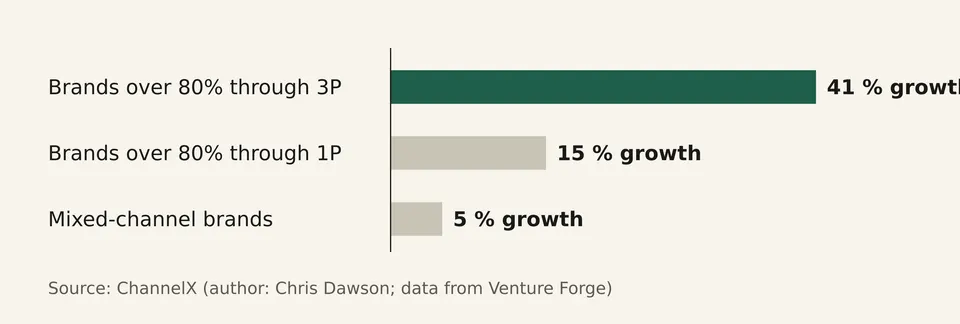
ChannelX reports that three-quarters of all the 3P growth came from brands that were already mainly selling their own stock1. Excluding the ten largest brands in each group, 3P-led brands still grew 36%, against 18% for 1P-led brands1. Those figures point to brand mix rather than price depth as the main difference.
Our reading is that matching 3P's shallower discounts would not reliably protect volume. Discounting lifts units, but it also reduces margin per unit, and the sources do not show that a shallower discount would produce 3P-style growth for your products. eStore Factory advises calculating promotional costs before committing to a discount, because a deal that increases order volume but significantly reduces profit may not support business goals7. The practical test is your own margin per unit at each discount depth, not the channel average.
How much stock should you hold for the event week?
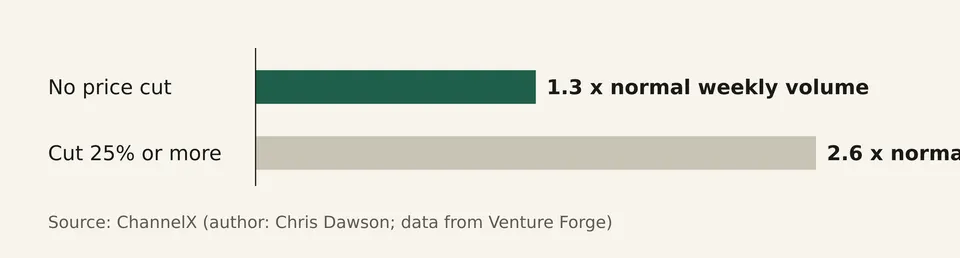
Both product groups sold about 1.5 times their normal weekly volume in the event week1. Treat that as a prompt, not a target. Calculate your own ratio of event-week sales to normal weekly sales for your category, and compare it with peers in the same category rather than with Venture Forge's overall figures.
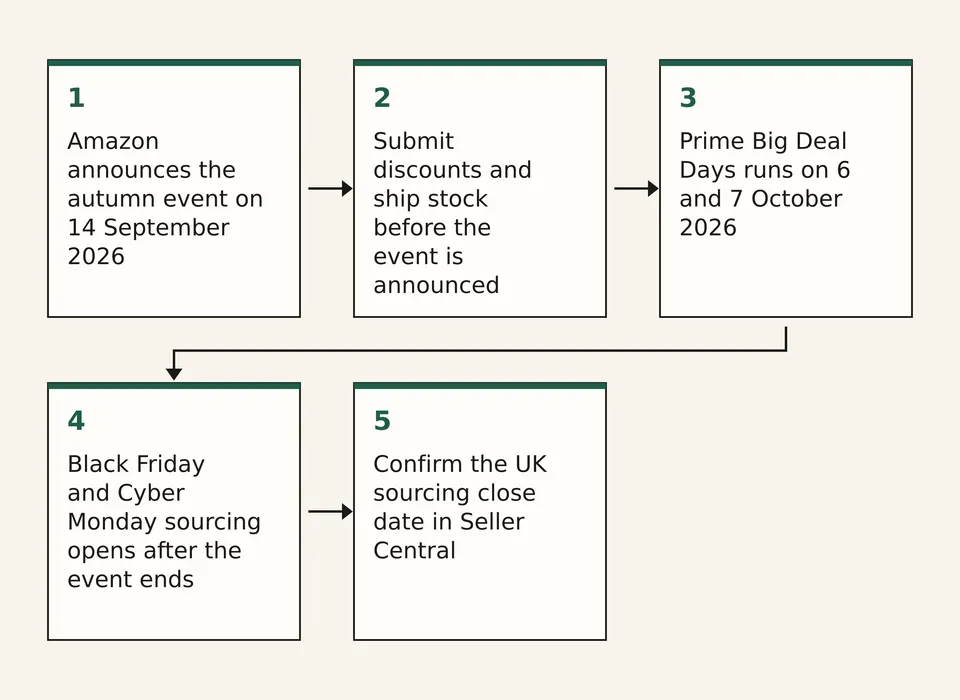
Sellers had to send in their discounts and ship stock before Amazon announced the event dates4. The sequence of key dates is below.
- Amazon announces the autumn event on 14 September 20264
- Submit discounts and ship stock before the event is announced4
- Prime Big Deal Days runs on 6 and 7 October 20262,3
- Black Friday and Cyber Monday sourcing opens after the event ends5
- Confirm the UK sourcing close date in Seller Central5
The Seller Central forum post for Black Friday planning advises bringing enough inventory into the Amazon network to meet deal demand at least four weeks before the deal event, and sending shipments consistently afterwards to keep more than 28 days of supply5. The same post gives 28 October 2026 as the date for FBA inventory to arrive at fulfilment centres for UK Black Friday readiness5. Use the 1.5 times ratio as one input to a forecast that also includes these lead times.
Which scenario fits your category?
Category results varied sharply. Across ten categories, 3P grew faster than 1P in eight1. The largest gaps were in DIY & Tools (3P up 36%, 1P up 12%), Toys & Games (26% against 10%) and Beauty (34% against 24%)1.
Computers & Accessories was the extreme case. 1P sales in the category fell 37%, 3P grew 3%, and 1P's share of the category during the event dropped from 57% to 45%1. Electronics & Photo, and Sports & Outdoors, were the two exceptions, where 1P grew faster: 21% against 10% for 3P, and 56% against 41%1.
The following scenarios are illustrative and depend on how closely your category matches the reported figures.
- Scenario A: your category resembles Computers & Accessories. 3P sellers with stock in place may be best placed to gain share. In this case stock availability matters most, and an unavailable product is the main risk.
- Scenario B: your category resembles Electronics & Photo or Sports & Outdoors. The channel shift is smaller and 1P is growing faster. Keep the stock plan conservative.
- Scenario C: your brand sells through a mixed channel split. The mixed group grew slowest, at 5%1. Any shift towards 3P should be a deliberate decision rather than a reaction to the headline figure.
What are the limits of this evidence?
The channel and category figures come from one consultancy's sample of one event, reported through a secondary article1. Venture Forge also runs Vendor, Seller and hybrid accounts for established brands1, which may shape how it frames channel choice. The sources describe the event week only and do not show how 3P share will move at Black Friday.
The category splits are reported only for selected categories. Check whether your category appears in the full dataset before using a split as a planning input.
What should you watch next?
The UK sourcing close date needs confirming before you plan around it. A Seller Central UK forum post gives 18 November 2026 as the submission close for Lightning Deals and Best Deals for Black Friday and Cyber Monday5. Check that date in your own Deals Dashboard before planning. A ChannelMAX report gives 20 October 2026 as the deadline for submitting deals, but it refers to the Amazon US Seller Central update and should not be used for UK planning6.
Signals to track:
- Whether 3P's share holds in Black Friday week. The sources do not yet show this.
- Whether the Computers & Accessories pattern repeats in other Venture Forge category splits.
- Your own 3P event-week lift against your category peers, set alongside your margin at each discount depth.
Questions readers ask
Did third-party sellers grow faster than first-party during the October 2026 event?
Yes. Estimated 3P sales rose 27.5% on the same week last year, while 1P rose 13.9%1. The figures come from one consultancy's sample of the event week1.
Does offering shallower discounts help 3P sellers grow?
The evidence does not show this. Products sold mostly through 3P had smaller average cuts, but the growth gap appears to come mainly from which brands grew1.
How much stock should I plan for the event week?
Both product groups sold about 1.5 times their normal weekly volume1. Treat this as one input and calculate your own ratio for your category, alongside sourcing lead times5.
When is the UK Black Friday sourcing deadline?
A Seller Central UK forum post gives 18 November 2026 for Lightning Deals and Best Deals submissions5. Confirm this date in your own Deals Dashboard before planning.
Sources
- Prime Big Deal Days 2026: 3P grew twice as fast as 1P, and discounted less Primary source
- Amazon Prime Big Deal Days 2026: Deal event returns to the UK from 6 to 7 October
- Prime Big Deal Days: Save big on autumn and Christmas shopping from October 6-7th
- Amazon sets Prime Big Deal Days for October 6-7 across 22 countries
- Seller Forums (Black Friday Week 2026: Your UK Peak Readiness Guide)
- Black Friday and Cyber Monday 2026: Amazon Sellers Must Submit Deals by October 20
- Amazon Black Friday/Cyber Monday 2026 Checklist