
Conversion · Comparison
Temu adds Pay by Bank in Germany: what a store can verify with its PSP
Temu's Pay by Bank option is live for German customers, but Temu's own fees, settlement and refund terms are not published, so stores must check their own payment provider's terms.
- By
- The Cart Plot Editorial
- Published
- Sources checked
- Evidence
- 6 sources
At a glance
- Temu's Pay by Bank option, integrated through TrueLayer, is live for customers in Germany, with no timeline given for other European markets1.
- Stripe's documented Pay by Bank refund window is up to 730 days, with refunds free but original processing fees non-refundable2.
- Stripe publishes 1.5% + EUR 0.25 for standard European Economic Area cards, but no Pay by Bank fee appears in the text retrieved2,4.
- Stripe says Pay by Bank has no dispute process, and a third-party review says TrueLayer one-off payments have no chargeback process3,6.

On 17 November 2026, ChannelX reported that TrueLayer, a Pay by Bank network, had integrated its option at Temu checkout, and that it was live for Temu customers in Germany ahead of the Black Friday and Christmas peak1. Temu's other European markets will follow, but the report gives no timeline1. Checked on 19 November 2026, the public record gives little on Temu's own merchant terms, so a European store deciding whether to copy the option has to rely on its own payment provider's published terms.
Who the sources are written for
Most of the terms below come from Stripe's developer documentation, TrueLayer's sales pages and a third-party payments review. All three are written for businesses taking payments directly, not for sellers listing on a marketplace. Temu's UK payment-methods page returned no text in our research, so this article does not describe Temu's full checkout line-up.
What has Temu actually published about Pay by Bank?
Pay by Bank is a payment method in which the customer pays directly from their bank account through their banking app, instead of using a card2. The Temu launch was announced by TrueLayer, which the ChannelX report describes as the network used by more than 30 million people across Europe1.
The published launch facts are narrow:
- Pay by Bank is live at Temu checkout for customers in Germany, and Temu's other European markets will follow1.
- The launch report gives no timeline for those other markets1.
- Temu's own terms for the option, including fees, settlement and refund windows, are not published in the sources we reviewed.
Temu has also introduced TrueLayer's Verification product for sellers in eight European markets, including the UK, Germany, Spain, France, Italy, the Netherlands, Belgium and Finland. It lets a business confirm bank account ownership to speed up onboarding1. This is a seller-onboarding tool, not a checkout option, so it does not transfer to a store's own checkout.
This comparison therefore uses TrueLayer's and Stripe's published terms as a proxy. Where no figure is published, the table says Not published.
How does the shopper flow compare with card checkout?
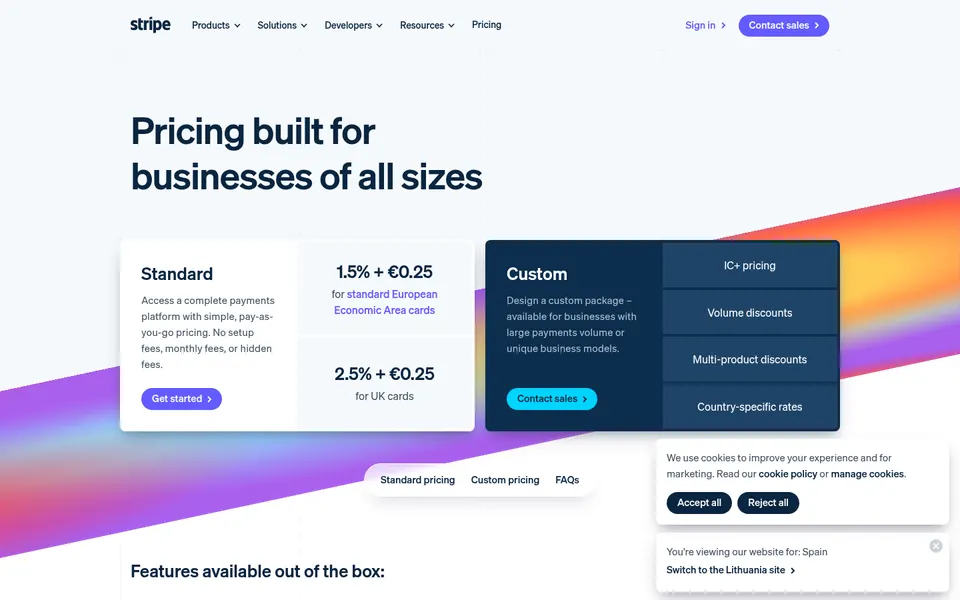
The customer-side flow is the clearest verified difference. Temu describes the Pay by Bank steps as follows1:
- Choose Pay by Bank at checkout.
- Approve the payment in the banking app.
- The payment moves instantly.
Stripe's documented flow adds more steps: the customer selects a bank, is redirected, enters account credentials, completes authorisation, and returns to the merchant's site for confirmation2. The payment needs no card details1.
With card checkout, the shopper enters card details at checkout, a step that Pay by Bank removes. Our view is that the flow difference matters most for shoppers who do not hold a card or do not want to use one online. We have no published data on how many shoppers fall into that group.
What do the fee and settlement numbers show?
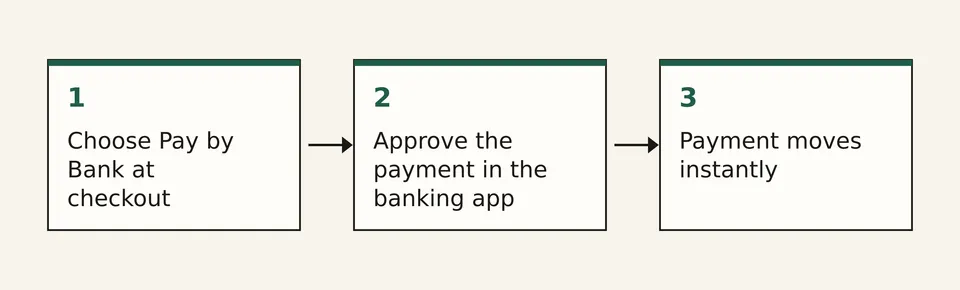
The only fee published in the sources for the card benchmark is Stripe's pricing page: 1.5% + EUR 0.25 for standard European Economic Area cards, and 2.5% + EUR 0.25 for UK cards4.
No Pay by Bank fee appears in the Stripe Pay by Bank text we retrieved2. TrueLayer publishes no prices. Rates are quoted per account, and for merchants using a TrueLayer merchant account, fees come out of that balance each day6.
TrueLayer's marketing makes comparative claims, but these are vendor statements, not published rates. It says card payments can carry interchange fees of up to 3% per transaction, and that Pay by Bank can cut fees by up to 50% against cards5. A named TrueLayer merchant's payments product manager says the business lowered its payment costs by more than 40%5. These are testimonials and claims, not a rate a store can apply.
On settlement, Stripe says standard payout timing applies to Pay by Bank but does not give a duration2. Stripe's general payout options are rolling, weekly or monthly4. TrueLayer says Pay by Bank settles in real time5, and a third-party review says one-off payments settle in seconds over Faster Payments or SEPA Instant6. The same review notes that the merchant agreement is not public, so its terms cannot be assessed6.
How do refunds and disputes differ?
Stripe says Pay by Bank payments can be refunded for up to 730 days (2 years) after the original payment, in full or in part2. Refunds are free of charge, but the processing fees for the original payment are non-refundable2. A refund generally arrives by the next business day but can take up to 7 days to appear as successful3.
Refunds can also fail. If the customer's bank cannot process one, for example because the account is closed, the refund amount is returned to the Stripe balance, and the merchant must arrange another way to refund the customer2.
For disputes, Stripe says Pay by Bank has no dispute process because the customer authenticates with their bank3. A third-party review says one-off TrueLayer Pay by Bank payments have no chargeback process, and that refunds are issued by the merchant through TrueLayer6. The review adds that customers lose card-style chargeback protection on these payments6.
Temu's and TrueLayer's refund windows are not published in the sources we reviewed. The sources reviewed do not cover card chargeback rules, so this article does not describe them.
What are the genuine advantages of each?
Pay by Bank has three verified advantages. No card details are needed1. Stripe and the third-party review both describe no chargeback process on these payments3,6. Stripe also notes that the customer's strong authentication in the banking app is why its disputes risk is low2. The cost case rests on vendor testimonials5, not on a published rate.
Card checkout has its own advantages. European card pricing is published4, and shoppers already know how to pay by card. The card rate is a fixed, visible figure, which makes it easier to model against a margin.
How do the two compare on each criterion?
| Criterion | Temu Pay by Bank (TrueLayer) | Card checkout (Stripe EEA cards as benchmark) |
|---|---|---|
| Availability | Live in Germany at Temu checkout; other European markets to follow; timeline Not published1 | Standard rate for EEA cards and UK cards4 |
| Shopper flow | Choose Pay by Bank, approve in banking app, payment moves instantly1 | Shopper enters card details at checkout |
| Fees | Not published for Temu; TrueLayer publishes no prices6 | 1.5% + EUR 0.25 for standard EEA cards4 |
| Settlement | Not published for Temu; TrueLayer merchant agreement not public6 | Payout options: rolling, weekly or monthly4 |
| Refund window | Not published for Temu or TrueLayer; Stripe Pay by Bank up to 730 days2 | Not published in the sources reviewed |
| Chargebacks and disputes | No chargeback process on one-off TrueLayer payments; refunds issued by merchant6 | Not covered by the sources reviewed |
| PSP country coverage (Stripe) | Generally available: Finland, Ireland, UK; private preview: Belgium, France, Germany2 | Not applicable to the card benchmark |
What must a store verify with its PSP before copying?
A store cannot copy Temu's arrangement directly, because the option is integrated through TrueLayer and Temu's merchant terms are not public. Before adding Pay by Bank beside card checkout, we recommend confirming the following in writing with the payment provider (PSP):
- Country status. Whether the PSP offers Pay by Bank for your customers' bank country, and whether that offer is generally available or in private preview. Stripe lists Finland, Ireland and the UK as generally available, and Belgium, France and Germany as private preview2.
- Fees. The Pay by Bank fee schedule. No Stripe Pay by Bank fee appears in the text we retrieved2, so this must be confirmed directly.
- Currency and order rules. Stripe supports EUR and GBP, and its Checkout integration requires one currency per session and only one-time line items2,3.
- Amount limits. Stripe makes Pay by Bank available by default for payments between 0.50 GBP and 10,000 GBP, and larger amounts need a request to Stripe2.
- Settlement during peak. The payout timing for Pay by Bank and how it sits alongside card payouts in the peak weeks.
- Refunds and disputes. Whether refunds run through the PSP or through the bank route, and how the 730-day refund window applies2.
Who should choose each option?
Pay by Bank suits a store whose PSP offers it as generally available in the customer's bank country, which has a repeat-customer base and which can handle a different refund and dispute process from cards. Our view is that such a store should trial it on a small share of checkouts before the peak, and track refunds and failed payments separately.
Card checkout suits a store that needs the widest shopper reach, takes cross-border orders, and wants the fewest unknowns during peak. Stripe's EEA card rate is published4.
On the facts available, neither option is a clear winner. The answer depends on the PSP's published terms for your country. For a broader view of checkout options during the same peak, see Adding Klarna before Black Friday: six checks before a store decides.
Questions readers ask
Is Pay by Bank now available at Temu checkout across Europe?
Temu's Pay by Bank option is live for customers in Germany, and the report says other European markets will follow, but it gives no timeline1.
What fees does Temu charge for Pay by Bank?
Temu's fees for Pay by Bank are not published in the sources reviewed, and TrueLayer publishes no prices6. Stripe's card rate of 1.5% + EUR 0.25 for standard EEA cards is the only published benchmark4.
Can a Pay by Bank payment be refunded?
Stripe says Pay by Bank payments can be refunded for up to 730 days after the original payment, in full or in part, and refunds are free of charge2.
Do customers have chargeback protection on Pay by Bank?
No. A third-party review says one-off TrueLayer Pay by Bank payments have no chargeback process, and customers lose card-style chargeback protection6.