
Store Breakdowns · Analysis
Levi's US distribution delay: what a stock move before peak can learn
Levi's now expects US distribution benefits in 2027, a second slip, after a fire and transition complexity. Sources do not isolate SKU mix as a cause, so a seller's own risk must be tested.
- By
- The Cart Plot Editorial
- Published
- Sources checked
- Evidence
- 3 sources
At a glance
- Levi's said on its 7 October 2026 earnings call that it does not expect US distribution benefits until 2027, after closing its Hebron, Kentucky, centre at the end of the third quarter1,2.
- This is the second time the completion date has slipped, with management citing transition complexity and a fire at a distribution centre1,2.
- Retail Dive reports the CEO also cited the number of SKUs managed, but no source isolates SKU breadth as a separate cause of the delay1.
- Stores planning a warehouse move should budget for parallel running costs, keep a fallback site until the new one is stable, and check order commitments before moving1,3.

The Levi Strauss & Co. overhaul is a useful test case for store owners planning a stock move before peak. On the 7 October 2026 earnings call, management said it does not expect benefits from its US distribution changes until 2027, after closing its Hebron, Kentucky, distribution centre at the end of the third quarter1,2. This is the second time the completion date has slipped, and management blamed transition complexity and a fire at one of its distribution centres1,2.
What Levi's changed, and what it has said about the result
The sources are written for investors and supply-chain reporters, not for online sellers. They report earnings-call remarks and a securities filing, so the figures and quotes below describe Levi's network, not a typical store.
Levi's moved the work from its Hebron, Kentucky, distribution centre to Groveport, Ohio, a facility run by a third party1,3. The company had planned a hybrid model in which leased sites are operated by third parties, replacing owned facilities3.
The completion date has moved before. On the 28 January 2026 earnings call, Levi's said it would finish the US move by the end of 2026, after it kept running the owned Hebron centre because the Groveport transition had taken longer than expected1,3.
On the 7 October call, Chief Financial and Growth Officer Harmit Singh said “Distribution costs were higher than we expected this quarter”2. He also said the path to the network benefits “has taken longer than we anticipated,” citing “the complexity of the transition and a fire-related incident that impacted operations”2.
CEO Michelle Gass said the fire “was a big disruption in some of our most important weeks”1. She said 2027 is “very reasonable and realistic” for benefits to start1, and Retail Dive reports that she noted the recovery had gone smoothly1. Levi's did not respond to a request about which facility in its network was affected1. This article therefore cannot confirm the affected site.
A securities filing said the damaged inventory was insured and the impact on financial results was not significant1. The same filing said the delay could cause shipping delays, order cancellations and higher costs, affecting relationships with wholesale customers1.
How a warehouse or 3PL switch works in practice
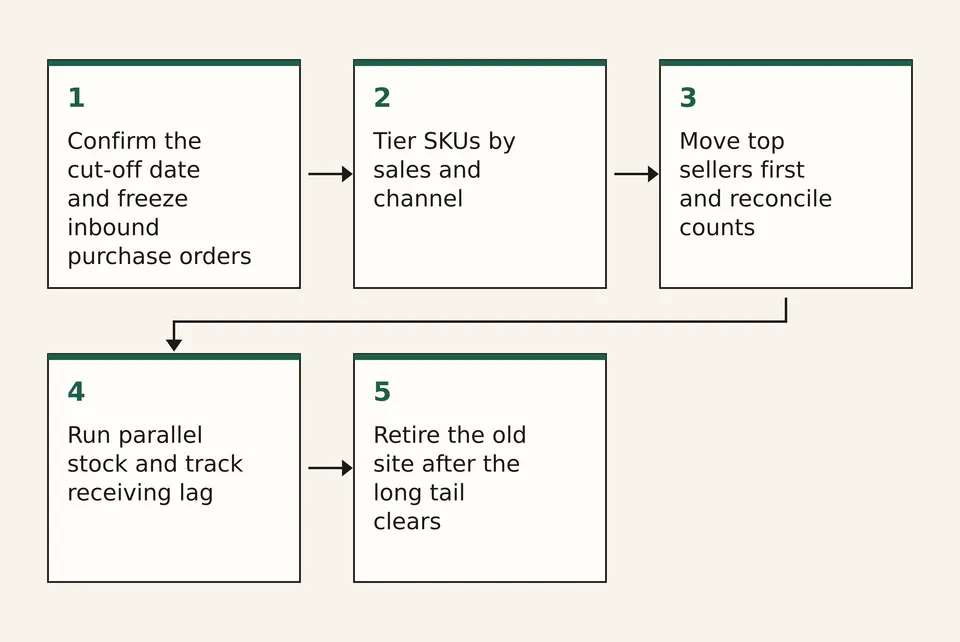
In this article, a third-party logistics provider (3PL) means an outside company that stores stock and ships orders. The sequence below is our analysis of common practice. It is not a description of Levi's internal plan.
- Confirm the cut-off date and freeze inbound purchase orders
- Tier SKUs by sales and channel
- Move top sellers first and reconcile counts
- Run parallel stock and track receiving lag
- Retire the old site after the long tail clears
Illustrative only: a store with 1,000 SKUs, where 80 lines produce most orders, would move those 80 first, count them at the receiving site, and leave slow lines at the old site until the new site has handled several weeks of orders without errors.
What the record says about SKU mix
Retail Dive's summary names “the complexity of its SKU mix” alongside the fire as causes of the delay, and reports that Gass cited the number of SKUs the company manages1. On the call, the explanation Singh gave was the complexity of the transition and the fire2.
No source isolates SKU breadth as a separate cause, or measures how much delay it added. Because the causes were reported together, readers cannot attribute the delay to SKU mix alone.
Our analysis: which risks matter and which stores they fit
This section is our interpretation of the sources, not reported findings.

Parallel running costs. Levi's reported higher distribution costs in the quarter2 and kept the Hebron centre running while Groveport ramped up3. A seller who keeps two sites open during an overlap pays for both during those weeks. Budget for that overlap, not only for the move.
Single-site exposure. The fire disrupted what Gass called “some of our most important weeks”1. Closing the old site before the new one is stable removes the fallback, which matters most in the weeks before peak.
Order risk. The filing names shipping delays and order cancellations as risks1. If you have wholesale or marketplace commitments, the cost of a missed delivery can go beyond the lost sale. Check those terms before you move.
Is SKU mix the main risk? For a narrow range, the count and cut-off are simpler. For a broad range across several channels, the overlap is longer and the list of lines that must work on day one is bigger. SKU breadth is a plausible driver to test in your own move. The Levi's record does not prove it is the main one.
Scenario A (illustrative): A narrow-range, single-channel store whose 3PL already handles receiving could plan a short overlap, with a clean count and a fixed cut-off date.
Scenario B (illustrative): A broad-range, multi-channel store with wholesale or marketplace obligations should plan a longer overlap, higher running costs and more order risk. It should not start the move inside the peak window.
Most stores sit between these two. The useful question is how many channels and SKUs must be live on the first day at the new site, and what happens to committed orders if the site slips.
What to watch next
The sources give four tests for whether Levi's delay is temporary. Each uses a signal that can be checked.
- Closure and benefits. Gass said 2027 is “very reasonable and realistic” for benefits to start1. Check whether they appear in the company's 2027 reporting.
- The European precedent. Singh pointed to the 2025 European transition as a blueprint3. If the US follows that pattern, the delay should narrow once the transition ends.
- Filing language. Track distribution costs in the next annual and quarterly filings, and whether the references to shipping delays and order cancellations drop out1.
- Guidance. The Q3 call summary reports full-year 2026 guidance2. A 2027 outlook would be the first direct test of the timing.
A further change to the 2027 timing would be a third pushback, and a clear signal that the delay is structural rather than temporary.
The sources were checked on 28 October 2026. For current figures, use the company's investor relations site and its SEC filings.
Questions readers ask
When does Levi's expect US distribution benefits to start?
Levi's said on its 7 October 2026 earnings call that it does not expect benefits until 20271,2. CEO Michelle Gass called 2027 "very reasonable and realistic"1.
Why was the Levi's distribution move delayed?
Management blamed the complexity of the transition and a fire-related incident that affected operations2. Retail Dive also reports the SKU mix was named as a cause, though no source measures its share1.
What risks should a store consider before moving stock?
The filing names shipping delays, order cancellations and higher costs as risks to wholesale relationships1. Running two sites during an overlap also adds cost2,3.
Can the affected Levi's facility be confirmed?
No. Levi's did not respond to a request about which facility was affected, so the article cannot confirm the site1.