
Platforms · Guide
First wholesale order: seven checks before a reseller pays
Insurance, stock location, catalogue format, VAT treatment, authenticity, labelling and written terms can each be requested in writing before payment. Those documents show what a supplier has committed to, not that goods are genuine or that another marketplace will accept the invoice.
- By
- The Cart Plot Editorial
- Published
- Sources checked
- Evidence
- 8 sources
At a glance
- Trade credit insurance protects a business from unpaid invoices, so insurance on a supplier tells a buyer about payment risk rather than whether goods are genuine5,1.
- A marketplace's written assurances describe what the platform checks, and under its Terms every seller is solely responsible for the quality of the goods it supplies3.
- Under the EU General Product Safety Regulation, products sold to EU consumers need manufacturer contact details, a product identifier and, for non-EU manufacturers, an EU-established responsible person6.
- A marketplace's FAQ says it does not issue product certification or authentication documents, and that acceptance of its invoices by another marketplace depends on that marketplace's policies8.
- Buyers act as importer of record and are responsible for import VAT, customs duties and other local taxes, so the VAT figure on an order depends on the rate stated and on whether a valid VAT number is supplied8,4.

A small reseller placing a first multi-brand order from a wholesale supplier can check seven things before paying: the supplier's credit insurance, where its stock ships from, the catalogue format, VAT treatment and minimum order, written authenticity confirmation, product labelling and written terms. This guide reflects the rules and pages read on 30 October 2026. A marketplace's written assurances describe what the platform checks. They do not promise product quality or that another marketplace will accept the invoice.
What should a first supplier check cover?
Seven checks cover the supplier's insurance, stock location, catalogue, order terms, authenticity, labelling and written terms. The table maps each check to the document to request and to what that document does not prove.
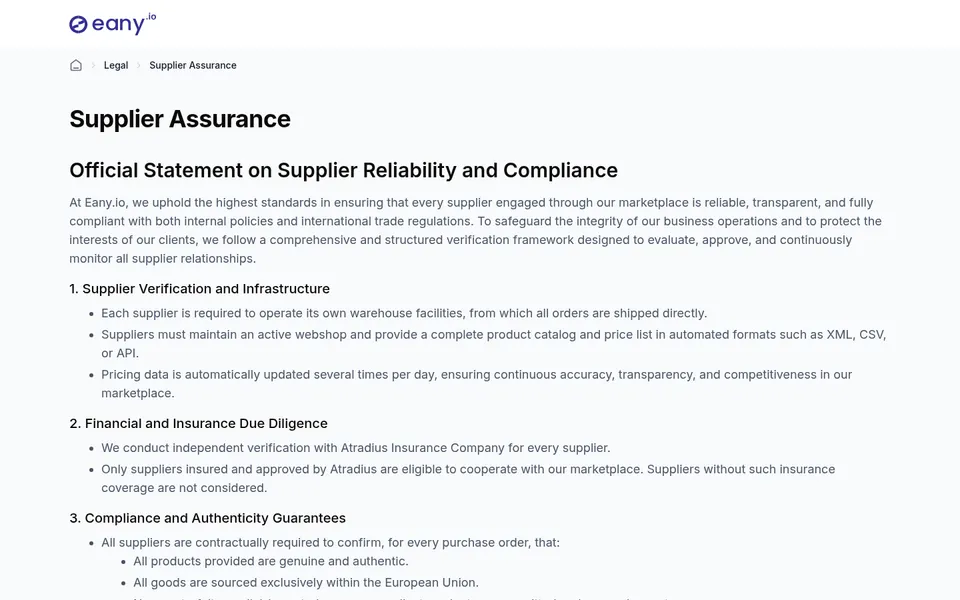
This guide uses the marketplace Terms, version 260914-1 dated 24 September 20263. The Supplier Assurance page has no publication date; this guide read it on 30 October 20262.
| Check | Document to request | What it does not prove |
|---|---|---|
| Insurance | Name of the supplier's credit insurer and confirmation of insured status | Product quality. Trade credit insurance covers unpaid invoices5 |
| Stock location | Warehouse address, and confirmation that the supplier owns and runs it | That the goods are genuine |
| Catalogue | Sample file in XML, CSV or API form with EAN, price and stock fields | That prices stay correct after the file is issued |
| VAT and order size | Written price basis (excluding VAT) and minimum order value | Whether a marketplace will accept the invoice |
| Authenticity | Written statement for each order that goods are genuine and EU-sourced | Quality of the goods |
| Labelling | Packaging showing manufacturer contact, product identifier and safety information | That the product meets its safety rules |
| Written terms | Warranty, claim window and cancellation rules | Anything not written down |
How do you check insurance and stock location?
Ask the supplier to name its credit insurer and confirm that it is insured. Trade credit insurance protects a business from bad debts, meaning unpaid invoices caused by customer bankruptcy, political risks or other agreed reasons5. It is a payment-risk product.
Atradius explains that when suppliers offer payment terms they take on the risk of non-payment, through buyer insolvency, delayed settlement or political disruption1. In our reading, insurance on a supplier tells a buyer about the supplier's exposure to unpaid invoices. It says nothing about whether the goods are genuine, so the two checks answer different questions.
Ask for the warehouse address and whether the supplier owns and runs it. Under the marketplace's supplier rules, each supplier must run its own warehouse and ship directly from it2. If a supplier dispatches from a third-party site, ask for that dispatch address in writing before ordering.
How do you check the catalogue format, VAT and order size?
Request the catalogue in XML, CSV or API form and test that the EAN, price and stock fields load correctly before you order.


On eany.io's tutorial, wholesale prices are stated excluding VAT, with transport to the buyer included, and 21% VAT is added at checkout without a valid VAT number4. The applicable Incoterms 2020 rule is always stated on the invoice and proforma invoice8. Check it before paying.
The VAT figure is arithmetic on the stated rate. A valid VAT number changes it, so confirm it before you check out.
Which suppliers should you accept?
Accept a supplier only when it passes the written checks above. A marketplace's vetting is a second layer and does not replace them.
Eany is a wholesale marketplace with 300+ EU suppliers7. The minimum is €300 for the whole order, with no minimum per supplier4, and orders from several suppliers are combined at its Łódź hub and shipped as one delivery with one unified EU invoice7. On its supplier assurance page, the marketplace says every supplier is checked with Atradius, only Atradius-insured suppliers are accepted, and each supplier confirms in writing for every order that goods are genuine and sourced only within the EU2. Qogita, another B2B wholesale marketplace, lists a €500 minimum order (checked 8 October 2026; Qogita)7.
Labelling is the next check. A secondary guide by Instrioo, dated 31 July 2026, says the EU General Product Safety Regulation has applied since 13 December 20246. Under it, a product needs a postal and electronic address for the manufacturer and a product identifier such as a batch, serial or type number6. Instructions must be in language easily understood by consumers in the market where the product is sold6. For products sold to EU consumers, the regulation requires a 'responsible person' established in the EU6. Ask the supplier to name that person.
What can a marketplace's written assurances and Terms promise?
Under the marketplace Terms, every seller is solely responsible to buyers for supplying goods of appropriate quality, and the marketplace does not guarantee product quality3. An authenticity statement is therefore a supplier's written commitment. It does not move quality responsibility to the marketplace.


Other points in the Terms shape what a buyer can rely on:
- The marketplace is not the seller or buyer in a transaction unless it acts through its own account. Ownership of goods passes directly from seller to buyer3.
- Side agreements between users may not be enforced against the marketplace3.
- Payment is generally made in advance at the time of order3.
- Once payment has been made, orders may not be cancelled or modified3.
- If a seller cancels an accepted order in full, the seller must refund all amounts paid, including marketplace commissions3. The Terms refer to commissions but do not state their rate.
- The FAQ lists 'What is a processing fee?', but its answer is not visible to outside readers, so its amount is not reported here8.
- Buyers act as the importer of record in all cases and are responsible for import VAT, customs duties and other local taxes8. For tax questions, consult a professional adviser.
The marketplace's FAQ says it does not issue product certification or authentication documents8. It also says its invoices meet international invoicing standards, but acceptance by another marketplace depends on that marketplace's policies, and the marketplace cannot guarantee approval8. The vetting described above is the marketplace's own account of its process. This guide has not verified it independently, and the marketplace decides which suppliers and invoices it accepts.
What should you request in writing before the first order?
Send each supplier this list before paying. It asks for documents. It does not guarantee any outcome.
- Insurance confirmation naming the insurer and the insured status.
- Warehouse address, and confirmation that the supplier ships from it.
- A catalogue sample in XML, CSV or API form with EAN, price and stock fields.
- A written statement, for each order, that goods are genuine, EU-sourced and not parallel-imported.
- Warranty and claim-window terms in writing.
- Packaging labels showing the manufacturer's contact details, a product identifier and safety information.
- Written cancellation and refund rules for the order.
Questions readers ask
Does supplier credit insurance show that the goods are genuine?
No. Trade credit insurance covers unpaid invoices caused by customer bankruptcy, political risks or other agreed reasons, so it does not prove product quality5.
Who is responsible for the quality of goods sold through a marketplace?
Under the marketplace Terms, every seller is solely responsible to buyers for supplying goods of appropriate quality, and the marketplace does not guarantee product quality3.
Will a marketplace's invoice be accepted by another marketplace?
Not necessarily. The marketplace says its invoices meet international invoicing standards, but acceptance by another marketplace depends on that marketplace's policies, and the marketplace cannot guarantee approval8.
What should a buyer ask for on product labelling?
Ask for packaging showing the manufacturer's postal and electronic address, a product identifier such as a batch, serial or type number, and, for products sold to EU consumers, the name of the EU-established responsible person6.
Sources
- Credit insurance: the hidden engine driving global trade Primary source
- Supplier Assurance
- eany.io - General Terms and Conditions (Version 260914-1)
- From Sourcing to Purchase - Step by Step Tutorial
- Credit Insurance
- GPSR 2023/988: EU Product Safety Requirements
- About eany.io | Wholesale from 300+ EU suppliers
- FAQ - Eany | Frequently Asked Questions