
Store Breakdowns · Analysis
EU 0% VAT rate for resellers changes when VAT is paid, not the price
For a VAT-registered reseller that can deduct input VAT, the 0% route mainly changes when VAT is paid, not the net price [S2]. The exemption holds only if the buyer's EU VAT number is valid and the other conditions for a 0% supply are met [S5].
- By
- The Cart Plot Editorial
- Published
- Sources checked
- Evidence
- 6 sources
At a glance
- For a VAT-registered reseller that can deduct the VAT it self-assesses on EU imports, the 0% route mainly changes when VAT is paid, not the net price2.
- The 0% treatment holds only when the buyer's EU VAT number is valid, a physical transport out of the seller's country is evidenced, and a correct EC Sales List is filed4.
- VIES confirms whether an EU VAT number is valid on the day it is checked, but it does not show whether the customer is acting as a business4.
- A marketplace's Terms say checkout VAT on a 0% intra-Community order is refunded after dispatch, while the refund date is not given in the sources reviewed2.
- Because paid orders may not be cancelled, a wrong VAT number or failed 0% condition would be hard to correct by cancelling the order2.


For a VAT-registered reseller that can deduct the VAT it self-assesses on imports from other EU countries, the 0% route mainly changes when VAT is paid, not the net price2. That is this article's analysis. The 0% treatment holds only if the buyer's EU VAT number is valid and the other conditions for a 0% supply are met4. How a marketplace charges VAT at checkout, and whether it is refunded, depends on its own terms, so the checkout treatment is worth checking before the first order.
What the 0% rate changes at the invoice
An intra-Community acquisition is the buyer-side event for goods moving between EU countries, and the EU VAT Directive treats it as one of four types of taxable transaction1. In the standard model, the supplier invoices without VAT and the buyer accounts for VAT in the country where the goods arrive4.
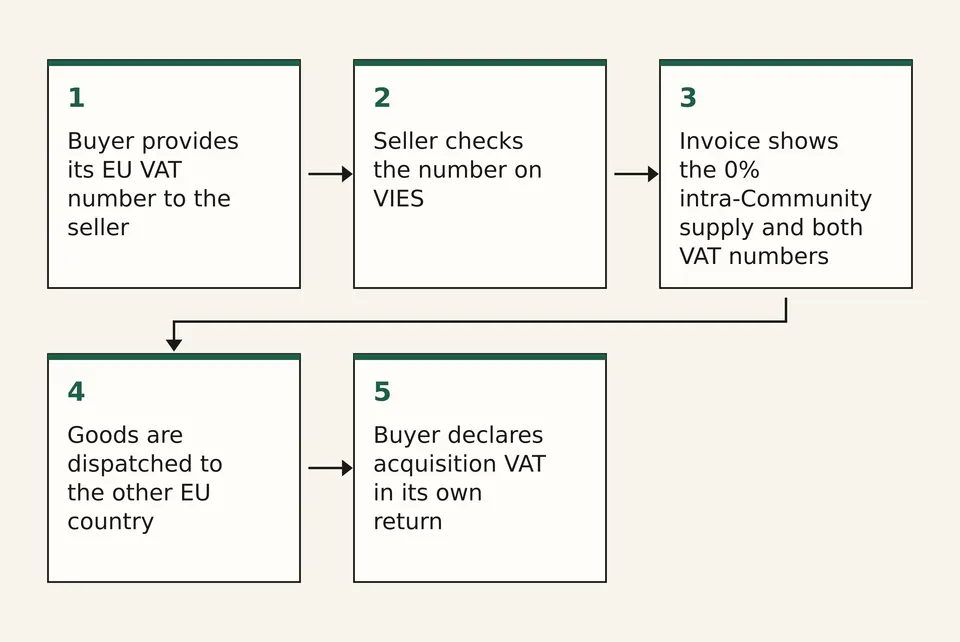
Under that model, the buyer self-assesses the VAT on the acquisition and, if it has full deduction rights, deducts the same amount in the same return4. The sequence therefore has two steps: the VAT is recorded as a liability and then recovered.
Does the exemption hold? The buyer's VAT number decides it
Since the 2020 EU VAT Quick Fixes, the zero rate on an intra-Community supply holds only when four conditions are met together: a customer identified for VAT in another Member State who has given the seller that number, a physical transport out of the seller's country, evidence of that transport, and a correct EC Sales List4. The customer's VAT number is now a substantive condition, not a formality4.
VIES, the VAT Information Exchange System of the European Commission, validates whether an EU VAT number is valid on the day it is checked. It does not show whether the customer is acting as a business or where it is established4. The Eurofiscalis guide recommends saving the VIES consultation result as evidence4. We think sellers should run that check before each order, keep the record, and reconcile the VAT numbers they use with the EC Sales List before filing.
The EC Sales List is part of the exemption, not only a statistical report. Article 138(1a) of the VAT Directive lets the tax authority refuse the exemption when a supply is missing from the list or reported incorrectly4.


How to compare the landed cost, step by step
The landed cost is the total cost of getting goods to your warehouse. We think the comparison should start with the supplier's ex-VAT unit price, add delivery on the same basis, then add any cost you cannot recover. Compare that total with the domestic price, using the domestic VAT-inclusive price only if your input VAT is not deductible.
The figures below are illustrative, not from the sources. Replace them with your own order value and destination rate. Take a €1,000 ex-VAT order and an assumed destination VAT rate of 21%:3
- Checkout VAT at the destination rate, if charged: €1,000 × 21% = €210, paid up front and refunded later3.
- Net cost with full input-VAT deduction: €1,000, the same as the ex-VAT price3.
- VAT float: €210, or 21% of the ex-VAT price, held until the refund arrives5.
On eany.io, a Vilnius-based wholesale marketplace, the minimum is €300 for the whole order, delivery to EU addresses is included in the price, and prices are shown without VAT, so buyers compare net with net5. Its Terms state that when an order ships from another EU country as a 0% intra-Community supply, the VAT charged at checkout is refunded after dispatch2; the full wording is in the Terms and Conditions.
Where the cash float bites
Eany's Terms say payment is generally made in advance at the time of order, and that paid orders may not be cancelled or modified2. Where a supplier cancels an accepted order, the seller must refund everything paid, including commissions. The Terms confirm that a commission exists but do not state its size2.


Because paid orders may not be cancelled2, a wrong VAT number or a failed 0% condition on a paid order would be hard to correct by cancelling. The fix would have to come from the VAT treatment itself.
What this means
This section is our analysis, not sourced reporting.
For a buyer whose input VAT is deductible, the float is recurring working capital for a steady, high-volume restock. For a single order, it is a one-off, fixed delay.
For a buyer whose input VAT is not deductible, VAT is a cost on either route, so the comparison depends on the rate and on whether the 0% conditions hold4. If a VAT number is invalid, the guide's advice is to stop and invoice local VAT until the number is valid4. That risk belongs in the cost model, not in the refund assumption.
These are general checks, not tax advice; a tax adviser should confirm the treatment for your business.
Supplier vetting and invoice descriptions come from marketplace websites and have not been checked independently. This article cannot confirm how a given supplier or invoice will be handled. Whether another marketplace accepts an invoice depends on that marketplace's policies6.
What to watch next
- The refund timing. Checkout VAT on a 0% intra-Community order is refunded after dispatch under the Terms2. The sources reviewed do not give the refund date, so ask any marketplace for it in writing before placing a large order.
- Whether checkout checks the buyer's VAT number, and against which database. The sources do not say.
- The invoice wording. The buyer's evidence for a 0% supply depends on the invoice and the transport documents4.
- The processing fee. The FAQ lists a processing-fee question, but its answer is not visible on the public page6, so the amount is unconfirmed.
- Rule changes. The Eurofiscalis guide was updated on 1 October 20264. Check the European Commission's VAT pages for the current rules1.
Questions readers ask
Does the 0% EU intra-Community rate change the net price a reseller pays?
For a VAT-registered reseller that can deduct the VAT it self-assesses, the 0% route mainly changes when VAT is paid rather than the net price2. The article's own analysis treats the float as the main cost, not a change in price2.
What four conditions must hold for the zero rate on an intra-Community supply?
The buyer must be identified for VAT in another Member State and have given the seller that number, the goods must be physically transported out of the seller's country, the seller must hold evidence of transport, and a correct EC Sales List must be filed4.
Does a valid VIES result prove the customer is a business?
No. VIES validates whether an EU VAT number is valid on the day it is checked, but it does not show whether the customer is acting as a business or where it is established4. The guide recommends saving the consultation result as evidence4.
Why does the EC Sales List matter for the exemption?
Under Article 138(1a) of the VAT Directive, the tax authority can refuse the exemption when a supply is missing from the EC Sales List or reported incorrectly4.
Sources
- Taxable transactions - Taxation and Customs Union (European Commission) Primary source
- Terms & Conditions - Wholesale procurement, simplified (eany.io General Terms and Conditions)
- Cross-border VAT rates in Europe - Your Europe
- Intra-Community Supply and VAT: 4 Conditions [2026 Guide]
- About eany.io | Wholesale from 300+ EU suppliers
- FAQ - Eany | Frequently Asked Questions