Platforms · Analysis
eBay Live vs non-live sales: how to measure a 200% rise
Mark Crowhurst reports eBay sales up more than 200% since starting eBay Live, but the figure does not split Live from other channels or other platforms. A store can test the claim by baselining non-live sales and reconciling each stream to Seller Hub.
- By
- The Cart Plot Editorial
- Published
- Sources checked
- Evidence
- 4 sources
At a glance
- Mark Crowhurst says his eBay sales grew by more than 200% year on year after he started on eBay Live, but the figure does not split Live from his other channels1.
- eBay's help page says publishing an event does not start the livestream, so the window start should be the time the seller goes live2.
- eBay's announcement says a Live sale becomes an order in Seller Hub, which should be the total a seller reconciles against4.
- eBay's Business Academy page gives a '90%' growth claim with no published method, period or sample, so it is not measured evidence3.
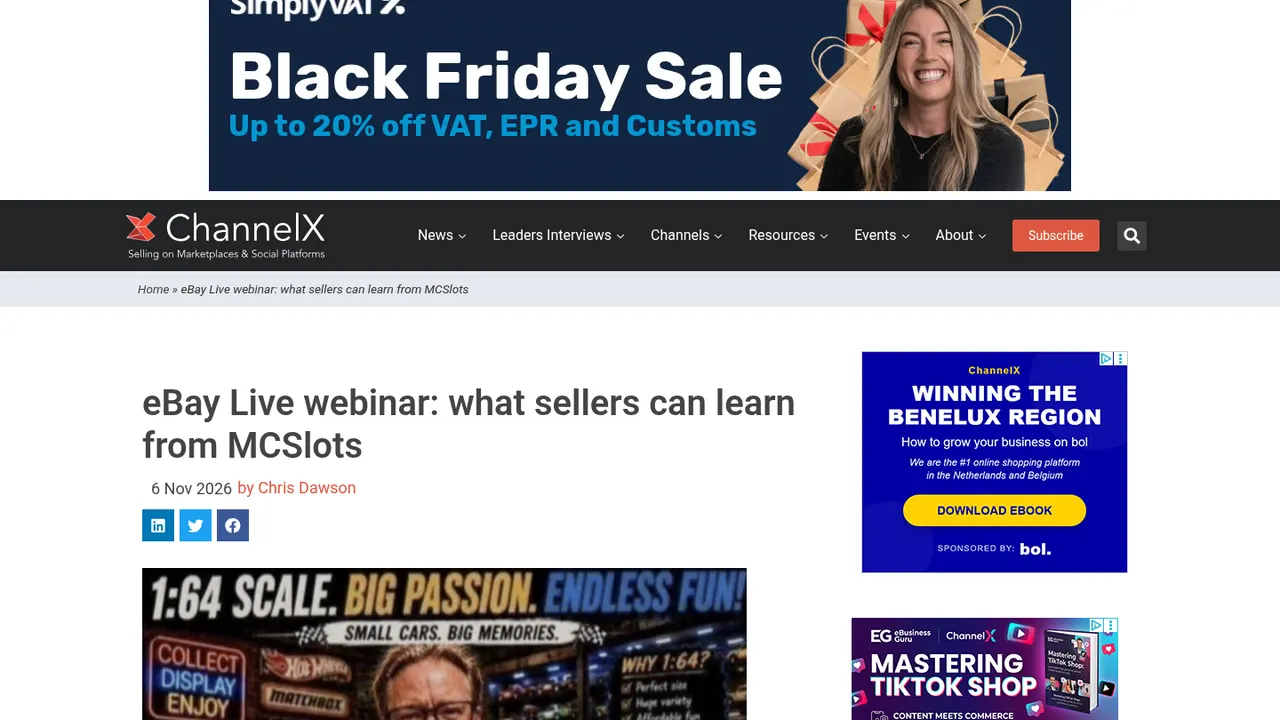
Mark Crowhurst, Managing Director of MCSlots, a Cornwall business selling collectibles and diecast models, says his eBay sales have grown by more than 200% year on year since he started on eBay Live, eBay's livestream selling format1. The figure, reported by ChannelX on 6 November 2026, does not split sales between Live and his other channels1. A small seller can test the question by recording a non-live baseline, tying each stream to Seller Hub totals, and comparing the two.
Can a 200% rise be credited to eBay Live?
Not on the headline figure alone. The article says Mark Crowhurst has been on Live for just over a year and sells across nine online platforms1. Any rise on eBay could come from Live, from ordinary eBay listings, from changes on the other platforms, or from seasonal demand.
Our analysis: treat the 200% figure as a reason to measure, not as proof that Live caused the growth1.
What does eBay's guidance say about Live and Seller Hub?
eBay's help page says publishing an event makes it visible to buyers on the eBay Live Homepage and the event page, but does not start the livestream2. The same page says listings are not exclusive to an event by default, and that the seller controls how listings behave between the live event and the eBay marketplace2. A product featured on stream can therefore also sell on the wider marketplace, outside the stream window.
eBay's announcement says a Live sale becomes an order in Seller Hub4.
Our analysis: treat the Live report and Seller Hub as two different measures. The Live report shows what happened inside the stream. Seller Hub is the total to reconcile against. Where they differ, note the gap rather than picking one figure.
What should you baseline before going live?
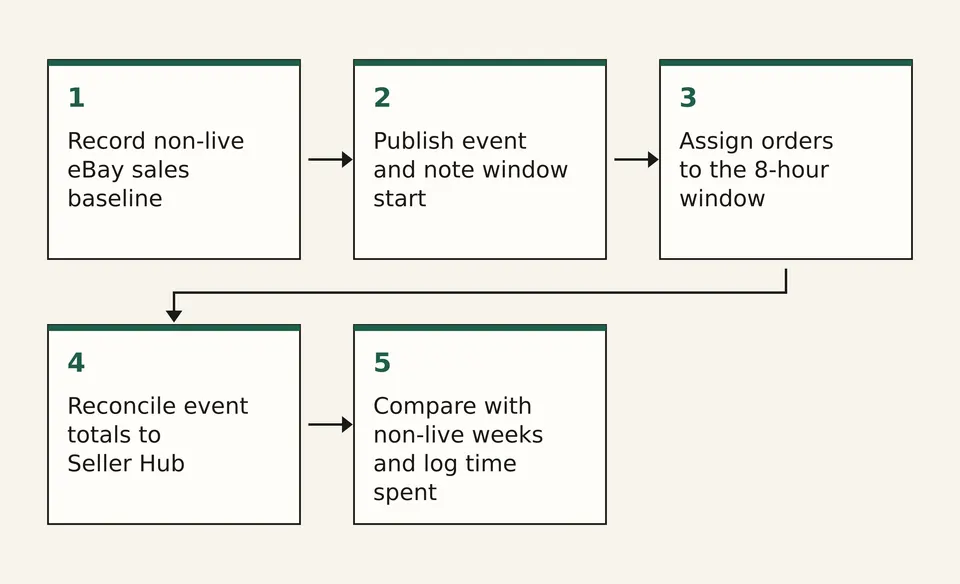
Before the first stream, record a baseline of non-live eBay sales and use the same steps for every event:
- Record non-live eBay sales baseline
- Publish event and note the window start
- Assign orders to a window you define in advance, for example eight hours after the scheduled start
- Reconcile event totals to Seller Hub
- Compare with non-live weeks and log time spent
The window start is the time you choose to go live, not the time you publish, because publishing does not start the stream2. Note items listed or sold outside the window so they are not counted as stream sales by default. Track your other platforms in the same weeks, so any shift in demand elsewhere is visible.
The official webinar agenda lists “assess sales, customer engagement and the time involved” as the way to understand what is working3. Time involved is therefore part of the measure, not an afterthought. Log the hours spent preparing, streaming and following up on each event.
How do the scenarios change the answer?
Our analysis: whether Live lift can be measured depends on what else is running at the same time, and on how much history the store has.
- Stable baseline, no other promotions. If non-live eBay sales are steady and no other offers are running, the store can compare event windows with the baseline and measure lift directly. This is the cleanest case.
- Launch, sale or price change running at the same time. The stream and the promotion will move the same numbers, so Live cannot be isolated. The store should either run the stream without the promotion for a test period, or accept that the result is combined.
- Recent start on eBay Live. A store that has only just started has too little history for a reliable baseline. It should run a fixed test period before crediting the channel.
eBay's onboarding announcement describes the sellers it is currently onboarding as those “who have past streaming or social media experience and are able to stream 1-2 days a week, and/or 4-8 hours a week”4. It gives preference to sellers in several categories, including Electronics and Home & Garden4. Our analysis: Mark Crowhurst's starting point may not match a typical small seller's. The announcement is dated 12 March 20264, so check the criteria on eBay's current pages before applying.
Eligibility is also set by category. eBay's help page lists the categories for livestream events, including Collectibles, Sneakers, Apparel and Home & Garden, and requires a desktop or laptop plus a stable internet connection2.
What to watch next
Three open questions decide whether the 200% figure can be generalised1.
First, the Business Academy session “Go live, grow your business: Discover live selling with eBay” runs on Wednesday 11 November 2026 at 3:00pm for one hour. It aims to measure success by assessing sales, customer engagement and the time involved3. The session page says sellers will cover “what they would do differently, and the impact on their sales”3.
Second, the same page says “more than 90% of established eBay sellers who livestream regularly” grow the value of their sales3. The page gives no method, period or sample for that figure, so it is not measured evidence. Look for eBay to publish how it was calculated.
Third, Live audience and insights data are the main route to linking viewing to purchases. Check what those insights cover on eBay's current help pages before relying on them.
Our view: a seller should wait for a method behind the 90% claim, or for a session that shows baselines and comparison groups, before treating published growth figures as the expected result for their own store3.
For a similar approach to tracking channel growth, see Wayfair's Q3 growth came from orders: what a small store can track.
Questions readers ask
Does the 200% eBay sales rise prove that eBay Live caused the growth?
No. The reported figure does not split sales between Live and other channels, and the seller also sells across nine online platforms1. Any rise could come from Live, ordinary eBay listings, other platforms or seasonal demand1.
How should a small seller measure eBay Live lift?
Record a non-live eBay sales baseline, define the event window in advance, reconcile event totals to Seller Hub, and compare with non-live weeks while logging time spent2,3,4.
Is the 90% growth figure from eBay reliable?
The page gives no method, period or sample for the figure, so it is not measured evidence. Sellers should look for eBay to publish how it was calculated3.