
Store Breakdowns · Analysis
Amazon's 2027 low-inventory fee: which SKUs face the 28-day test
From 1 February 2027 Amazon's low-inventory fee applies only when stock falls below 28 days of supply on actual shipments, and Amazon gives no per-unit rate for the new test [S2]. The sources give no unit-price or delivery-time figures for smaller orders, so this article states no cost difference.
- By
- The Cart Plot Editorial
- Published
- Sources checked
- Evidence
- 7 sources
At a glance
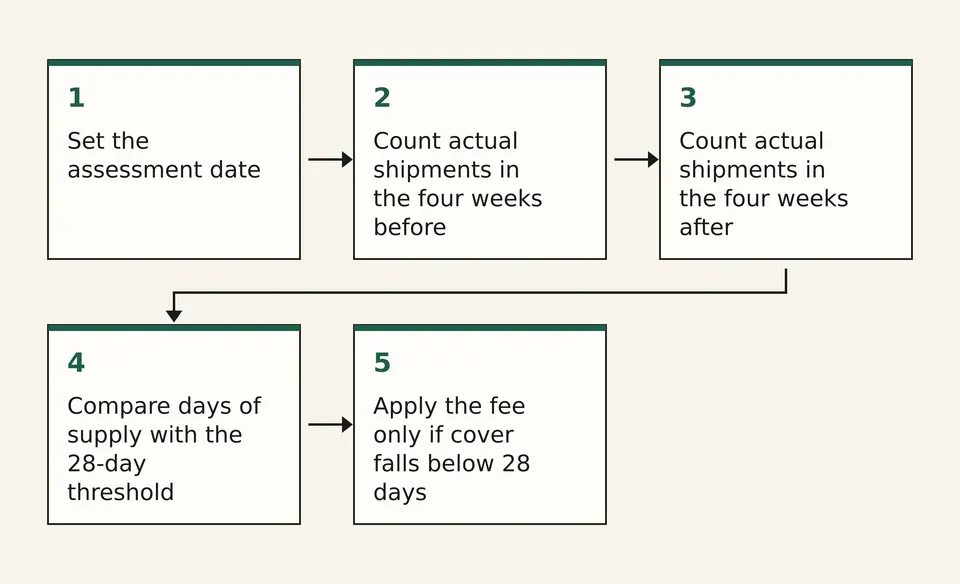
- Amazon's low-inventory-level fee changes on 1 February 2027 and applies only when inventory falls below 28 days of supply, measured on actual shipments in the four weeks before and after the assessment date2.
- Amazon says the new test targets SKUs that need replenishment and aims to reduce charges from unexpected demand spikes or end-of-season and end-of-life products2.
- Amazon's 2027 notice gives no per-unit low-inventory rate, while a April 2026 third-party estimate of $0.32 to $2.09 describes the pre-2027 rule2,4.
- Storage charges also change on 1 February 2027, with flat or lower fees for inventory turning in under six months and higher fees for aged inventory2.

Amazon's 5 November 2026 notice changes its low-inventory-level fee from 1 February 2027. The fee will apply only when a seller's inventory falls below 28 days of supply, measured on actual shipments in the four weeks before and after the assessment date2. The sources give no unit-price or delivery-time figures for smaller orders, so this article does not state that cost.
What changes on 1 February 2027
Most of Amazon's US fee changes take effect on 15 January 20272. On average, Fulfillment by Amazon (FBA, the service in which Amazon stores and ships seller stock) fulfilment fees will rise by $0.19 per unit sold, about 0.8% of the average item's selling price2.
Storage charges change on 1 February 2027. Amazon will eliminate the storage utilization surcharge and remove the aged inventory surcharge, combining it with monthly storage fees into a single, age-based rate2. Amazon says this will result in flat or lower fees for inventory that turns in under six months, and higher fees for aged inventory2.
The low-inventory-level fee also changes on the same date. Before 2027, Amazon assessed it using trailing 30- and 90-day sales2. Amazon says the new test is meant to target SKUs (stock-keeping units, individual products) that need replenishment, and to reduce charges triggered by unexpected demand spikes or by end-of-season and end-of-life products2.
How the older rule measured stock cover
Amazon's 2023 Seller Central forum post described the metric as 'the product's inventory levels relative to actual historical sales', and said the fee was assessed only when both the 30-day and 90-day measures were below 28 days3. That post describes the rule in force before 2027, so it shows the older method rather than the new one. Under that method, the metric was calculated at the parent-product level3.
PYMNTS wrote that looking ahead as well as back should help distinguish a product that regularly needs replenishing from a seasonal item that had one unexpectedly strong week1.
Third-party figures give a sense of scale, but they describe the pre-2027 rule. Nova Analytics, in an article dated 8 April 2026, gave a range of $0.32 to $2.09 per unit for the fee4. Amazon's 2027 notice does not give a per-unit low-inventory rate2.
Restock planning: consolidating supplier orders
A reseller buying from several suppliers can place one order per supplier or consolidate them. eany.io is a Vilnius-based wholesale marketplace7 where one order can mix items from several suppliers: the minimum is €300 for the whole order, with no minimum quantity per product or supplier6,5. Its About page describes one contract, one checkout and one unified EU invoice for 300+ suppliers6. For comparison, Qogita lists a €500 minimum order value, checked 8 October 2026 Qogita2.
Cost of smaller orders and delivery time: what the sources do not show
No source reviewed for this article gives a unit price or delivery time for a smaller order compared with a larger one, so no cost difference is stated here.
Whether a marketplace accepts stock bought through a wholesale intermediary is decided by that marketplace, for any supplier. Sellers should check each marketplace's brand-approval rules before buying from any supplier.
Our analysis: when frequent restocks fit
Our view, not a source finding: the fee test works per SKU, so the question is which lines need a shorter cycle, not whether to change ordering across the whole range.
Here is an illustrative calculation with invented numbers. A SKU that sells 10 units a day needs 280 units on hand to hold 28 days of cover at that rate. A 420-unit buy covers 42 days, and a 300-unit buy covers 30 days, before any further sales are counted. Amazon measures actual shipments in the surrounding four-week windows, not stock on hand, so this calculation is only a planning check.
Three scenarios follow from the sources and that logic:
- Fast-selling SKUs that would run below 28 days of cover before the next delivery are where more frequent restocks matter most.
- Slow SKUs that turn within six months may cost the same or less to store under the new rates2, so a larger order can suit them, while older stock faces higher fees2.
- Frequency has its own cost. Each order on Eany must meet the €300 minimum for the whole order6, so splitting buys into more, smaller orders increases the number of orders that must clear that threshold.
A sensible check is to review days of supply line by line before changing cadence. Amazon's 2023 forum post described a Seller Central column for this metric, and the 2027 version should be checked in Amazon's own tools3,2.
What to watch next
- Amazon's full 2027 fee summary. Amazon's notice links to a full summary of fee changes2. That page was not retrieved for this article.
- Amazon's Fee Change Comparison dashboard, in Profit Analytics, which Amazon says shows the effect at account and product level, and its Revenue Calculator, which models fee scenarios2.
- Statements after 15 January 2027, which will show the effect of the average $0.19 rise2.
Questions readers ask
When does Amazon's new low-inventory-level fee take effect?
The change takes effect on 1 February 2027 according to Amazon's 5 November 2026 notice2. Under the new test the fee applies only when inventory falls below 28 days of supply2.
How does the new fee measure stock cover?
It is measured on actual shipments in the four weeks before and after the assessment date rather than trailing 30- and 90-day sales2. The older rule assessed the fee only when both the 30-day and 90-day measures were below 28 days3.
Does the sources give a per-unit rate for the 2027 fee?
No. Amazon's 2027 notice does not give a per-unit low-inventory rate2. A third-party range of $0.32 to $2.09 per unit describes the pre-2027 rule4.
Are there unit-price or delivery-time figures for smaller orders?
No source reviewed gives a unit price or delivery time for a smaller order compared with a larger one, so no cost difference is stated in the article.
Sources
- Amazon Raises Seller Fees as Walmart Courts Holiday Shoppers Primary source
- Update to US Referral and Fulfillment by Amazon fees for 2027
- Low-inventory-level fee further explained
- Amazon Low-Inventory Level Fee - Nova Analytics
- From Sourcing to Purchase - Step by Step Tutorial
- About eany.io | Wholesale from 300+ EU suppliers
- Wholesale procurement, simplified