
Platforms · Analysis
Amazon Brand Registry: what a reseller needs before creating a new ASIN
Sources retrieved 5 November 2026 say a brand-assigned Reseller role is needed, but disagree on whether a Letter of Authorization can replace it, and the 30-day suspension claim rests on one law firm.
- By
- The Cart Plot Editorial
- Published
- Sources checked
- Evidence
- 10 sources
At a glance
- On sources retrieved 5 November 2026, a reseller with supplier invoices for an Amazon Brand Registry brand still needs a Reseller role the brand assigns before creating a new ASIN1,5.
- The sources disagree on whether a Letter of Authorization can replace the Reseller role, and no Amazon policy text confirming the June 2026 change was retrieved1,5,6.
- The 30-day deactivation and account-suspension claim comes only from DAM Law Firm and remains unverified1,5,6.
On sources retrieved on 5 November 2026, a reseller holding supplier invoices for an Amazon Brand Registry brand still needs a Reseller role that the brand assigns before it can create a new ASIN (Amazon Standard Identification Number, the product code Amazon assigns to each listing)1,5. The sources disagree on whether a Letter of Authorization (LOA, a written statement from the brand) can replace that role, and the only account-suspension claim comes from one law firm1,5,6.
Invoices alone do not replace the brand's Reseller role
Amazon's guide to creating new ASINs, dated 28 September 2025, explains how to create and match ASINs2. Its retrieved text does not reach the Brand Registry rules, so the points below rely on other sources.
Amazon's Seller Central community defines two selling roles. A Brand Representative is an internal, first-party seller directly employed by the brand, and a Reseller is “An external, third-party seller authorized by the brand to sell goods and services on Amazon”3. A brand Administrator, described as having “full permission to assign roles to user accounts”, assigns these roles3. The steps are taken inside Brand Registry, and the selling role shows as active on the Connected tab of the Manage selling roles page once the invited seller accepts4.
DAM Law Firm, a US firm that sells Amazon seller legal services, says invoices alone do not trigger the Reseller role and that only the brand's administrator can assign it. Its wording is: “A seller cannot self-assign this role or obtain it solely through invoice submission”1.
Sources disagree on whether a Letter of Authorization can stand in
EcomCrew, a seller-education site, says that from 1 June 2026, vendors in the US store must hold a formally assigned Reseller role before creating new ASINs for Brand Registry brands5. In its account of deactivation notices, sellers are “generally required to produce either a Letter of Authorization (LOA) from the brand directly, or invoices sourced from the brand or an authorized distributor”5. That treats the LOA and the invoices as alternatives in the deactivation case.
Vendlab, a UK agency, wrote on 11 June 2026: “Everyone else must find existing ASINs or get a Letter of Authorisation from the brand”6. It does not describe the LOA as a route to creating new ASINs6.
DAM's table lists the post-June 2026 invoice standard as “Commercial wholesale invoice plus formal Reseller role assignment or Letter of Authorization from the brand”1. Amazon's own June 2026 policy text was not retrieved, so the 1 June date and the LOA mechanics rest on secondary reporting1,5,6.
The 30-day deadline is a single-source claim
DAM says a seller who receives a 30-day deactivation notice and does not obtain brand authorisation or remove the affected listings within that window faces suspension, because “Amazon suspends the entire seller account, not just the flagged listings”1. DAM is the only source reviewed that makes this account-level claim1,5,6.
Vendlab reports sellers receiving 30-day deactivation notices for ASINs they thought were legitimate, but does not describe account suspension6. EcomCrew says sellers with FBA inventory on affected ASINs “may need to arrange removal orders to avoid disposal fees”5. None of the Amazon pages in the set (S2, S3, S4) mentions a 30-day period or account-level suspension2,3,4.
What to do when a reseller's invoices are not enough
The steps below are our practical order for a reseller without a brand role. They are not an Amazon procedure, and the sources do not rank them.
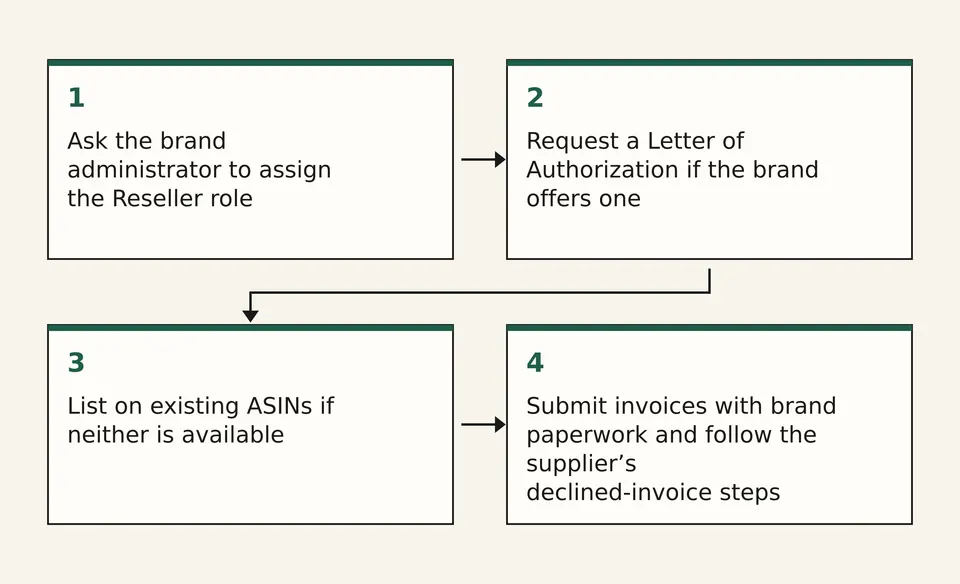
- Ask the brand administrator to assign the Reseller role
- Request a Letter of Authorization if the brand offers one
- List on existing ASINs if neither is available
- Submit invoices with brand paperwork and follow the supplier's declined-invoice steps
For step 1, Amazon's community describes the administrator's steps, which include choosing the Reseller role and connecting the selling account4. For step 2, EcomCrew reports that sellers are generally asked for an LOA or brand or distributor invoices when a deactivation notice arrives5. For step 3, Vendlab describes existing ASINs as the route for sellers without authorisation6.
For step 4, the eany.io brand approval playbook lists steps for a declined invoice, including a fresh review request and asking which documents are missing7. Eany, which is free to join, lists 300+ vetted EU suppliers and a €300 minimum order for the whole order, with no minimum per supplier8,9. Qogita, by comparison, has a €500 minimum order (checked 8 October 2026) Qogita2. Eany's FAQ says its invoices include the information required to meet international standards for third-party marketplaces10.
Our analysis: what the sources do and do not settle
Our reading is that invoices are evidence of a supply relationship, but they are not the brand's action in Brand Registry. On the sources available, a reseller with invoices and no assigned role does not meet the Reseller condition that the June 2026 change is described as creating1,5. Whether an LOA alone is enough for new ASINs is the open question1,5,6.
The 30-day account suspension should be treated as unverified until Amazon confirms it. A store that relies on existing ASINs faces a different risk from one that depends on creating new listings, so the first check is which of its listings would need a new ASIN.
Marketplace acceptance is not guaranteed for any invoice. Eany's FAQ says acceptance depends on each marketplace's policies10, and no supplier's invoices or playbook can settle Amazon's decision. The guides cited here are written by a law firm, a seller-education site, an agency and, in the case of the playbook, by Eany itself. None is Amazon's own policy text.
What to watch next
- Scenario A: the brand has assigned the Reseller role. The sources describe this as the condition for creating new ASINs for the brand1,5.
- Scenario B: the brand issues an LOA but no role. The sources disagree, so check with the brand and Seller Support before creating new ASINs1,5.
- Scenario C: neither is in place. Use existing ASINs and do not assume a grace period.
Checked on 5 November 2026. Watch for Amazon's own June 2026 policy text, the Connected tab status in Seller Central4, and any written Seller Support confirmation of the 30-day deadline.
Questions readers ask
Can supplier invoices alone let a reseller create new ASINs for a brand?
DAM says a seller cannot self-assign the role or obtain it solely through invoice submission, so invoices alone do not trigger the Reseller role1.
Do sources agree that a Letter of Authorization can replace the Reseller role?
No. DAM lists an LOA as an alternative, while Vendlab describes an LOA as a route for existing ASINs rather than new ones1,6.
Sources
- Amazon Brand Gating 2026: Why Authorized Resellers Are Being Locked Out and What to Do Primary source
- How to create a new ASIN on Amazon - Sell on Amazon
- Brand Registry Selling & Protection Roles
- Brand Representative
- Amazon Tightens ASIN Creation Rules: What the June 2026 Policy Update Means for Sellers
- Amazon tightens ASIN creation rules: what it means for UK sellers
- Brand Approval Playbook
- Wholesale procurement, simplified
- About eany.io | Wholesale from 300+ EU suppliers
- FAQ - Eany | Frequently Asked Questions