Platforms · Analysis
AI shopping access: three checks a store should run before peak
Human Forward's test found 98 of 200 US retailer and direct-to-consumer sites turned its crawler away or would not load, but the blocks came from bot protection, not robots.txt, and the method is not verified in the text we retrieved.
- By
- The Cart Plot Editorial
- Published
- Sources checked
- Evidence
- 6 sources
At a glance
- Human Forward's test found 98 of 200 US retailer and direct-to-consumer sites turned its crawler away or would not load, but the test measured one crawler, not AI shopping agent traffic1,2.
- The blocks came from bot protection that turns away unverified automated visitors, and 58 of the 63 blocked sites whose robots.txt could be checked said AI was welcome there1,2.
- Billions Network found none of the 51 large US retailers it audited had a route for a verified agent to complete a purchase, with the audit conducted in August 20265.
- A store should check robots.txt for each named bot, bot-protection logs on product and cart URLs, and whether price and stock appear in page HTML without JavaScript2,5,6.
Not as a blanket change. The “almost half” figure comes from Human Forward’s test, published 2 November 2026, in which 98 of 200 US retailer and direct-to-consumer sites turned its crawler away or would not load2. That result shows how one crawler was treated on those sites. The fix depends on which bots are refused, and where the refusal happens.
What the “almost half” figure actually measures
ChannelX reported the result on 6 November 2026 as “almost 50%” of sites blocking AI traffic1. The underlying test is narrower. Human Forward asked eight AI assistants the questions shoppers ask about 200 US retailers and direct-to-consumer brands, then checked each site for the standards AI agents use to find products and check out2.
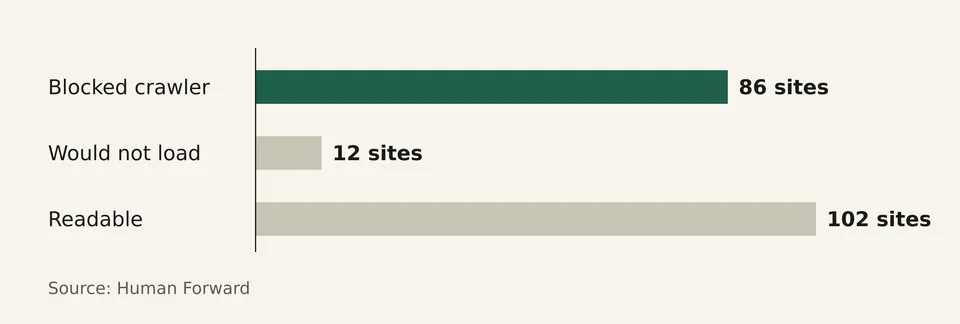
The crawler was the thing being tested. Human Forward says 86 of the 200 sites blocked it outright and 12 more would not load, including 52 of the 100 big retailers2. The report also states that its crawler “is not an AI shopping agent”2, so the result is a proxy for what agents might meet, not a measurement of agent traffic.
Our view: “almost half of sites block AI traffic” overstates one company’s test of 200 sites. Before a store acts on the share, it should read the method in the full report on Human Forward’s site. The text we retrieved is cut off before the method section, so how “would not load” was defined and how many retries were made remain unverified.
Why the three questions are separate
Opening a catalogue to AI involves three separate questions: whether assistants can read product pages, whether bot protection lets them through, and whether an agent can complete a purchase. One decision does not settle all three.
Visibility. Several OpenAI, Anthropic and Perplexity bots are listed by name in the Billions Network audit, including OAI-SearchBot and ChatGPT-User5. The DEV Community check describes ChatGPT-User, Claude-User and Perplexity-User as “the bots that fetch a page when a person asks an assistant a question in real time”, and separates them from training crawlers6. The OpenAI crawler page we retrieved contained only site navigation, so we have not relied on it for how OpenAI treats these bots. Check its current text at developers.openai.com/api/docs/bots.
Bot protection. Human Forward says the blocks on these sites come from bot protection rather than robots.txt rules. Its report says the block “comes from bot protection that turns away automated visitors it cannot verify”2. Of the 63 blocked sites whose robots.txt it could check, 58 “say in their robots.txt that AI is welcome”1,2.
Our view: robots.txt alone is not enough. A store should also check its CDN or firewall rules on product and cart URLs. Billions Network describes robots.txt and terms of service as tools that “can only say yes or no to a type of traffic”5.
Agent checkout. This is a separate build. Human Forward says Google’s Universal Commerce Protocol (UCP) and OpenAI’s Agentic Commerce Protocol “give agents a front door the brand controls”2. Google says UCP will “power a new checkout feature on eligible Google product listings” for eligible US retailers4. Google’s help page says the feature “is available for select merchants at this time” and that the retailer “will remain the seller of record”3. Billions Network found that none of the 51 large US retailers it audited had a route for a verified agent to complete a purchase; its audit was conducted in August 20265.
What this means for a small catalogue store
The right step depends on which situation the store is in. Our view is that there are three common cases.
Scenario A: product pages are readable and bot rules allow verified bots. The change needed is small. The work is mostly a check that the rules still do what the store intends.
Scenario B: the CDN challenges every visitor without a verified identity. Human Forward says that to a retailer’s bot protection, agents running in the AI company’s own cloud “looks like any other data center traffic, so these agents are the most likely to be turned away”2. A store in this position may be invisible to those agents, and changing robots.txt alone will not fix that.
Scenario C: price and stock exist only in scripts. On 82 of the 102 sites Human Forward could read, it “found no public product feed and no product data in the page code that carries them”2. An agent that can open the page but cannot find a price has nothing to quote.
A separate check by DEV Community’s X1Y1 team ran on 5 November 2026 across 20 large US retailers. It found that Amazon’s robots.txt has “Disallow: /” for several named AI bots, including GPTBot and OAI-SearchBot6. Target (88 out of 100) was the only one of the nine sites it could read that served an llms.txt file6. The authors state that “nobody has proven they move sales” for these signals6. The check covered homepages only, and the authors call it “a first look, not an audit”6.
Pre-peak checklist
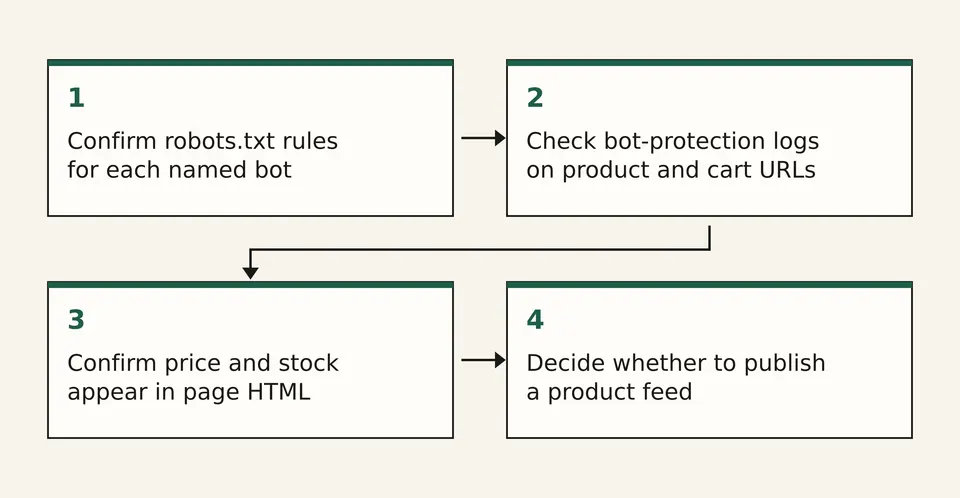
Our recommended order, if the store has limited time, is to start with the bot rules and product-page readability, then decide on feeds. Check each item below for every bot named in the store’s rules.
- Confirm robots.txt rules for each named bot
- Check bot-protection logs on product and cart URLs
- Confirm price and stock appear in page HTML
- Decide whether to publish a product feed
For item 1, keep checkout and account paths disallowed unless the store has decided otherwise. For item 2, look for challenge pages served to bots you have allowed. For item 3, load a product page with JavaScript switched off and check that the name, price, stock and main description are present. The DEV Community team suggests the same test6.
For item 4, Google says Merchant Center “will continue to be the central hub to prepare your product data” and advises making all of that data “as robust and up-to-date as possible”3. Feeds sent privately to Google or OpenAI are not visible to Human Forward’s testers, so some brands may reach those two even where the public test showed nothing2.
Caution: opening checkout to all automated traffic is not the same as opening it to agents. Billions Network notes that “opening checkout to all automated traffic is not the fix, because it lets bad bots in along with good agents”5. Billions sells an identity and trust layer for AI agents, so its view on verification has a commercial interest.
What to watch next
- Human Forward’s full method and agent-level re-test. Human Forward says it has “not yet tested” Grok Bot or Meta’s Muse on these sites2.
- Google’s UCP checkout rollout. Google says it will “expand globally and add more capabilities” in “the coming months”4. Until merchants can see it on their own listings, checkout through Google’s AI surfaces stays a plan rather than a route.
- Adobe’s holiday data. Adobe forecasts a 130% rise in AI traffic to US retail sites, but the forecast does not say how large the starting base is6. Our view: a store should check its own referral numbers in analytics before deciding whether the work is worth more time.
For UK stores considering the same checks, see Five checks a UK store can run before Christmas for AI shopping agents. For how the agent-led purchase model works in practice, see Walmart lets AI agents buy for shoppers within set spending limits.
Questions readers ask
Does the 'almost half of sites block AI traffic' figure apply to all stores?
No. The figure comes from one company's test of 200 US retailer and direct-to-consumer sites, using one crawler, so it is not a general measure of AI agent traffic1,2.
Is robots.txt enough to let AI shopping agents in?
No. Human Forward says the blocks came from bot protection rather than robots.txt rules, so a store should also check its CDN or firewall rules on product and cart URLs2,5.
What should a store check first before peak?
Start with bot rules and product-page readability, then decide on a feed. Load a product page with JavaScript switched off and confirm the name, price, stock and main description are present6.
Sources
- America's biggest stores aren't ready for Agentic Commerce this Black Friday! Primary source
- Black Friday 2026: AI will hunt the deals. America's biggest stores aren't ready.
- About the Universal Commerce Protocol (UCP) and UCP-powered checkout feature on Google
- New tech and tools for retailers to succeed in an agentic shopping era
- How top US retailers are responding to AI shopping agents
- We Checked 20 Big US Retailers Before the AI Shopping Holiday. Half Turned Our Checker Away.